

Formulation, Production, and Characterization …
213
Table 1 Proximate
composition of chia seed
Content
Amount (%)
Moisture
5.18 ± 0.032
Carbohydrate
46 ± 0.01
Protein
20 ± 0.03
Fat
24 ± 0.41
Ash
4.82 ± 0.025
All tests were performed in triplets. Data is expressed as mean ±
SD
3 Results and discussions
3.1 Proximate Composition of Chia Seed
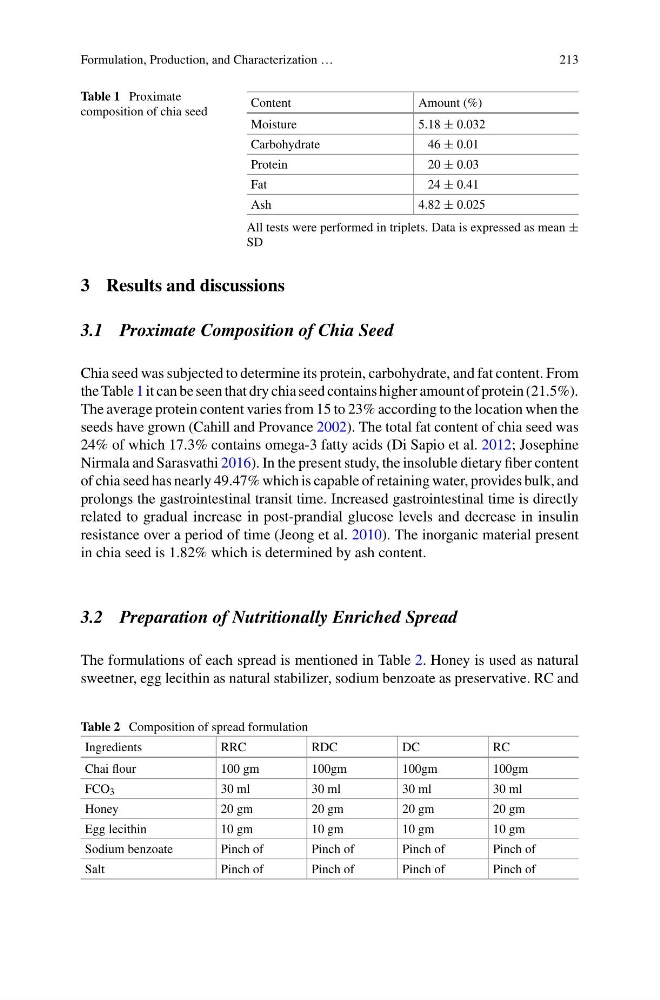
Chia seed was subjected to determine its protein, carbohydrate, and fat content. From
the Table 1 it can be seen that dry chia seed contains higher amount of protein (21.5%).
The average protein content varies from 15 to 23% according to the location when the
seeds have grown (Cahill and Provance 2002). The total fat content of chia seed was
24% of which 17.3% contains omega-3 fatty acids (Di Sapio et al. 2012; Josephine
Nirmala and Sarasvathi 2016). In the present study, the insoluble dietary fiber content
of chia seed has nearly 49.47% which is capable of retaining water, provides bulk, and
prolongs the gastrointestinal transit time. Increased gastrointestinal time is directly
related to gradual increase in post-prandial glucose levels and decrease in insulin
resistance over a period of time (Jeong et al. 2010). The inorganic material present
in chia seed is 1.82% which is determined by ash content.
3.2 Preparation of Nutritionally Enriched Spread
The formulations of each spread is mentioned in Table 2. Honey is used as natural
sweetner, egg lecithin as natural stabilizer, sodium benzoate as preservative. RC and
Table 2 Composition of spread formulation
Ingredients
RRC
RDC
DC
RC
Chai flour
100 gm
100gm
100gm
100gm
FCO 3
30 ml
30 ml
30 ml
30 ml
Honey
20 gm
20 gm
20 gm
20 gm
Egg lecithin
10 gm
10 gm
10 gm
10 gm
Sodium benzoate
Pinch of
Pinch of
Pinch of
Pinch of
Salt
Pinch of
Pinch of
Pinch of
Pinch of
213
Table 1 Proximate
composition of chia seed
Content
Amount (%)
Moisture
5.18 ± 0.032
Carbohydrate
46 ± 0.01
Protein
20 ± 0.03
Fat
24 ± 0.41
Ash
4.82 ± 0.025
All tests were performed in triplets. Data is expressed as mean ±
SD
3 Results and discussions
3.1 Proximate Composition of Chia Seed
Chia seed was subjected to determine its protein, carbohydrate, and fat content. From
the Table 1 it can be seen that dry chia seed contains higher amount of protein (21.5%).
The average protein content varies from 15 to 23% according to the location when the
seeds have grown (Cahill and Provance 2002). The total fat content of chia seed was
24% of which 17.3% contains omega-3 fatty acids (Di Sapio et al. 2012; Josephine
Nirmala and Sarasvathi 2016). In the present study, the insoluble dietary fiber content
of chia seed has nearly 49.47% which is capable of retaining water, provides bulk, and
prolongs the gastrointestinal transit time. Increased gastrointestinal time is directly
related to gradual increase in post-prandial glucose levels and decrease in insulin
resistance over a period of time (Jeong et al. 2010). The inorganic material present
in chia seed is 1.82% which is determined by ash content.
3.2 Preparation of Nutritionally Enriched Spread
The formulations of each spread is mentioned in Table 2. Honey is used as natural
sweetner, egg lecithin as natural stabilizer, sodium benzoate as preservative. RC and
Table 2 Composition of spread formulation
Ingredients
RRC
RDC
DC
RC
Chai flour
100 gm
100gm
100gm
100gm
FCO 3
30 ml
30 ml
30 ml
30 ml
Honey
20 gm
20 gm
20 gm
20 gm
Egg lecithin
10 gm
10 gm
10 gm
10 gm
Sodium benzoate
Pinch of
Pinch of
Pinch of
Pinch of
Salt
Pinch of
Pinch of
Pinch of
Pinch of