

Effect of Medicinal Plants on Biofilm-Forming …
195
128*MIC
256*MIC 512*MIC
Concentration
128*MIC
256*MIC
512*MIC
Concentration
128*MIC
256*MIC
512*MIC
Concentration
a
b
c
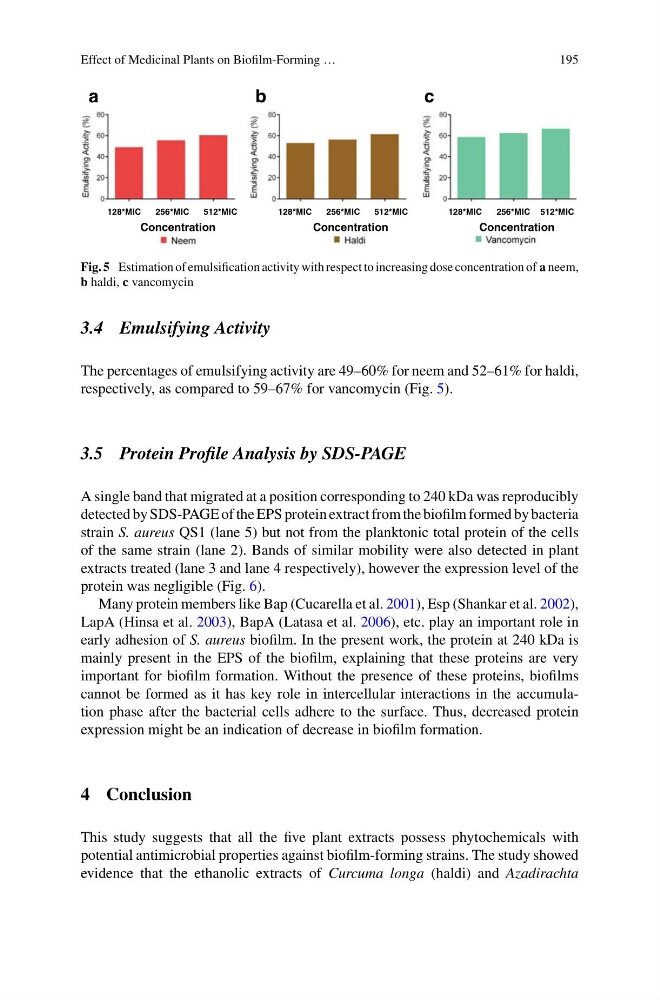
Fig. 5 Estimation of emulsification activity with respect to increasing dose concentration of a neem,
b haldi, c vancomycin
3.4 Emulsifying Activity
The percentages of emulsifying activity are 49–60% for neem and 52–61% for haldi,
respectively, as compared to 59–67% for vancomycin (Fig. 5).
3.5 Protein Profile Analysis by SDS-PAGE
A single band that migrated at a position corresponding to 240 kDa was reproducibly
detected by SDS-PAGE of the EPS protein extract from the biofilm formed by bacteria
strain S. aureus QS1 (lane 5) but not from the planktonic total protein of the cells
of the same strain (lane 2). Bands of similar mobility were also detected in plant
extracts treated (lane 3 and lane 4 respectively), however the expression level of the
protein was negligible (Fig. 6).
Many protein members like Bap (Cucarella et al. 2001), Esp (Shankar et al. 2002),
LapA (Hinsa et al. 2003), BapA (Latasa et al. 2006), etc. play an important role in
early adhesion of S. aureus biofilm. In the present work, the protein at 240 kDa is
mainly present in the EPS of the biofilm, explaining that these proteins are very
important for biofilm formation. Without the presence of these proteins, biofilms
cannot be formed as it has key role in intercellular interactions in the accumulation phase after the bacterial cells adhere to the surface. Thus, decreased protein
expression might be an indication of decrease in biofilm formation.
4 Conclusion
This study suggests that all the five plant extracts possess phytochemicals with
potential antimicrobial properties against biofilm-forming strains. The study showed
evidence that the ethanolic extracts of Curcuma longa (haldi) and Azadirachta
195
128*MIC
256*MIC 512*MIC
Concentration
128*MIC
256*MIC
512*MIC
Concentration
128*MIC
256*MIC
512*MIC
Concentration
a
b
c
Fig. 5 Estimation of emulsification activity with respect to increasing dose concentration of a neem,
b haldi, c vancomycin
3.4 Emulsifying Activity
The percentages of emulsifying activity are 49–60% for neem and 52–61% for haldi,
respectively, as compared to 59–67% for vancomycin (Fig. 5).
3.5 Protein Profile Analysis by SDS-PAGE
A single band that migrated at a position corresponding to 240 kDa was reproducibly
detected by SDS-PAGE of the EPS protein extract from the biofilm formed by bacteria
strain S. aureus QS1 (lane 5) but not from the planktonic total protein of the cells
of the same strain (lane 2). Bands of similar mobility were also detected in plant
extracts treated (lane 3 and lane 4 respectively), however the expression level of the
protein was negligible (Fig. 6).
Many protein members like Bap (Cucarella et al. 2001), Esp (Shankar et al. 2002),
LapA (Hinsa et al. 2003), BapA (Latasa et al. 2006), etc. play an important role in
early adhesion of S. aureus biofilm. In the present work, the protein at 240 kDa is
mainly present in the EPS of the biofilm, explaining that these proteins are very
important for biofilm formation. Without the presence of these proteins, biofilms
cannot be formed as it has key role in intercellular interactions in the accumulation phase after the bacterial cells adhere to the surface. Thus, decreased protein
expression might be an indication of decrease in biofilm formation.
4 Conclusion
This study suggests that all the five plant extracts possess phytochemicals with
potential antimicrobial properties against biofilm-forming strains. The study showed
evidence that the ethanolic extracts of Curcuma longa (haldi) and Azadirachta