

Characterization, Purification and Immobilization …
165
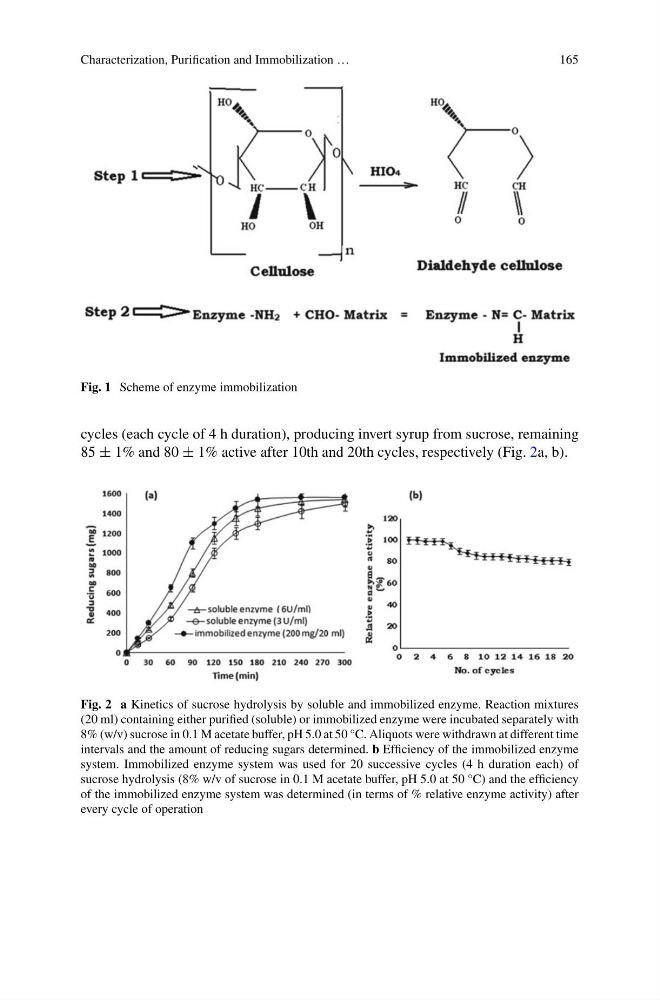
Fig. 1 Scheme of enzyme immobilization
cycles (each cycle of 4 h duration), producing invert syrup from sucrose, remaining
85 ± 1% and 80 ± 1% active after 10th and 20th cycles, respectively (Fig. 2a, b).
Fig. 2 a Kinetics of sucrose hydrolysis by soluble and immobilized enzyme. Reaction mixtures
(20 ml) containing either purified (soluble) or immobilized enzyme were incubated separately with
8% (w/v) sucrose in 0.1 M acetate buffer, pH 5.0 at 50 °C. Aliquots were withdrawn at different time
intervals and the amount of reducing sugars determined. b Efficiency of the immobilized enzyme
system. Immobilized enzyme system was used for 20 successive cycles (4 h duration each) of
sucrose hydrolysis (8% w/v of sucrose in 0.1 M acetate buffer, pH 5.0 at 50 °C) and the efficiency
of the immobilized enzyme system was determined (in terms of % relative enzyme activity) after
every cycle of operation
165
Fig. 1 Scheme of enzyme immobilization
cycles (each cycle of 4 h duration), producing invert syrup from sucrose, remaining
85 ± 1% and 80 ± 1% active after 10th and 20th cycles, respectively (Fig. 2a, b).
Fig. 2 a Kinetics of sucrose hydrolysis by soluble and immobilized enzyme. Reaction mixtures
(20 ml) containing either purified (soluble) or immobilized enzyme were incubated separately with
8% (w/v) sucrose in 0.1 M acetate buffer, pH 5.0 at 50 °C. Aliquots were withdrawn at different time
intervals and the amount of reducing sugars determined. b Efficiency of the immobilized enzyme
system. Immobilized enzyme system was used for 20 successive cycles (4 h duration each) of
sucrose hydrolysis (8% w/v of sucrose in 0.1 M acetate buffer, pH 5.0 at 50 °C) and the efficiency
of the immobilized enzyme system was determined (in terms of % relative enzyme activity) after
every cycle of operation