

Understanding the Mechanical Response of Friction Stir Welded …
47
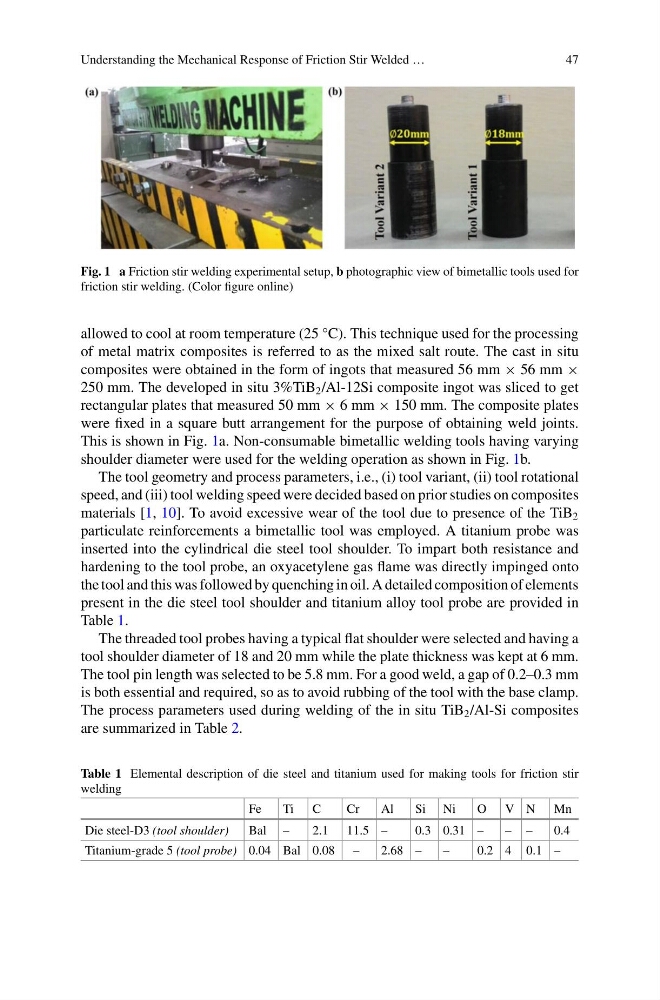
Fig. 1 a Friction stir welding experimental setup, b photographic view of bimetallic tools used for
friction stir welding. (Color figure online)
allowed to cool at room temperature (25 °C). This technique used for the processing
of metal matrix composites is referred to as the mixed salt route. The cast in situ
composites were obtained in the form of ingots that measured 56 mm × 56 mm ×
250 mm. The developed in situ 3%TiB 2 /Al-12Si composite ingot was sliced to get
rectangular plates that measured 50 mm × 6 mm × 150 mm. The composite plates
were fixed in a square butt arrangement for the purpose of obtaining weld joints.
This is shown in Fig. 1a. Non-consumable bimetallic welding tools having varying
shoulder diameter were used for the welding operation as shown in Fig. 1b.
The tool geometry and process parameters, i.e., (i) tool variant, (ii) tool rotational
speed, and (iii) tool welding speed were decided based on prior studies on composites
materials [1, 10]. To avoid excessive wear of the tool due to presence of the TiB 2
particulate reinforcements a bimetallic tool was employed. A titanium probe was
inserted into the cylindrical die steel tool shoulder. To impart both resistance and
hardening to the tool probe, an oxyacetylene gas flame was directly impinged onto
the tool and this was followed by quenching in oil. A detailed composition of elements
present in the die steel tool shoulder and titanium alloy tool probe are provided in
Table 1.
The threaded tool probes having a typical flat shoulder were selected and having a
tool shoulder diameter of 18 and 20 mm while the plate thickness was kept at 6 mm.
The tool pin length was selected to be 5.8 mm. For a good weld, a gap of 0.2–0.3 mm
is both essential and required, so as to avoid rubbing of the tool with the base clamp.
The process parameters used during welding of the in situ TiB 2 /Al-Si composites
are summarized in Table 2.
Table 1 Elemental description of die steel and titanium used for making tools for friction stir
welding
Fe
Ti C
Cr
Al
Si Ni
O V N Mn
Die steel-D3 (tool shoulder)
Bal –
2.1 11.5 –
0.3 0.31 –
– –
0.4
Titanium-grade 5 (tool probe) 0.04 Bal 0.08 –
2.68 –
–
0.2 4 0.1 –
47
Fig. 1 a Friction stir welding experimental setup, b photographic view of bimetallic tools used for
friction stir welding. (Color figure online)
allowed to cool at room temperature (25 °C). This technique used for the processing
of metal matrix composites is referred to as the mixed salt route. The cast in situ
composites were obtained in the form of ingots that measured 56 mm × 56 mm ×
250 mm. The developed in situ 3%TiB 2 /Al-12Si composite ingot was sliced to get
rectangular plates that measured 50 mm × 6 mm × 150 mm. The composite plates
were fixed in a square butt arrangement for the purpose of obtaining weld joints.
This is shown in Fig. 1a. Non-consumable bimetallic welding tools having varying
shoulder diameter were used for the welding operation as shown in Fig. 1b.
The tool geometry and process parameters, i.e., (i) tool variant, (ii) tool rotational
speed, and (iii) tool welding speed were decided based on prior studies on composites
materials [1, 10]. To avoid excessive wear of the tool due to presence of the TiB 2
particulate reinforcements a bimetallic tool was employed. A titanium probe was
inserted into the cylindrical die steel tool shoulder. To impart both resistance and
hardening to the tool probe, an oxyacetylene gas flame was directly impinged onto
the tool and this was followed by quenching in oil. A detailed composition of elements
present in the die steel tool shoulder and titanium alloy tool probe are provided in
Table 1.
The threaded tool probes having a typical flat shoulder were selected and having a
tool shoulder diameter of 18 and 20 mm while the plate thickness was kept at 6 mm.
The tool pin length was selected to be 5.8 mm. For a good weld, a gap of 0.2–0.3 mm
is both essential and required, so as to avoid rubbing of the tool with the base clamp.
The process parameters used during welding of the in situ TiB 2 /Al-Si composites
are summarized in Table 2.
Table 1 Elemental description of die steel and titanium used for making tools for friction stir
welding
Fe
Ti C
Cr
Al
Si Ni
O V N Mn
Die steel-D3 (tool shoulder)
Bal –
2.1 11.5 –
0.3 0.31 –
– –
0.4
Titanium-grade 5 (tool probe) 0.04 Bal 0.08 –
2.68 –
–
0.2 4 0.1 –