

Role of Microstructure on the Potential of MAX and MAB Phases …
21
Fig. 6 of Ref. [41]). The authors hypothesized that the presence of pores reduced the
conductivity of Cu/Ti 3 SiC 2 as compared to Cu/graphite composites.
Zhang and Zhou [42] also fabricated Cu–Ti 3 AlC 2 and in situ Cu–TiC x composites
by using 10–30 vol% Ti 3 AlC 2 as reinforcements in the Cu matrix. They fabricated
the Cu–Ti 3 AlC 2 by hot-pressing them at 850 °C for 30 min under a pressure of
30 MPa. The Cu-matrix composites reinforced with TiC x was fabricated by reacting
Ti 3 AlC 2 with Cu to form TiC x in situ by hot-pressing Cu–Ti 3 AlC 2 compacts at
1000 °C, and by using reaction time of 60 min under a pressure of 15 MPa. Both
the experiments were performed under the continuous flow of Argon (Ar) to prevent
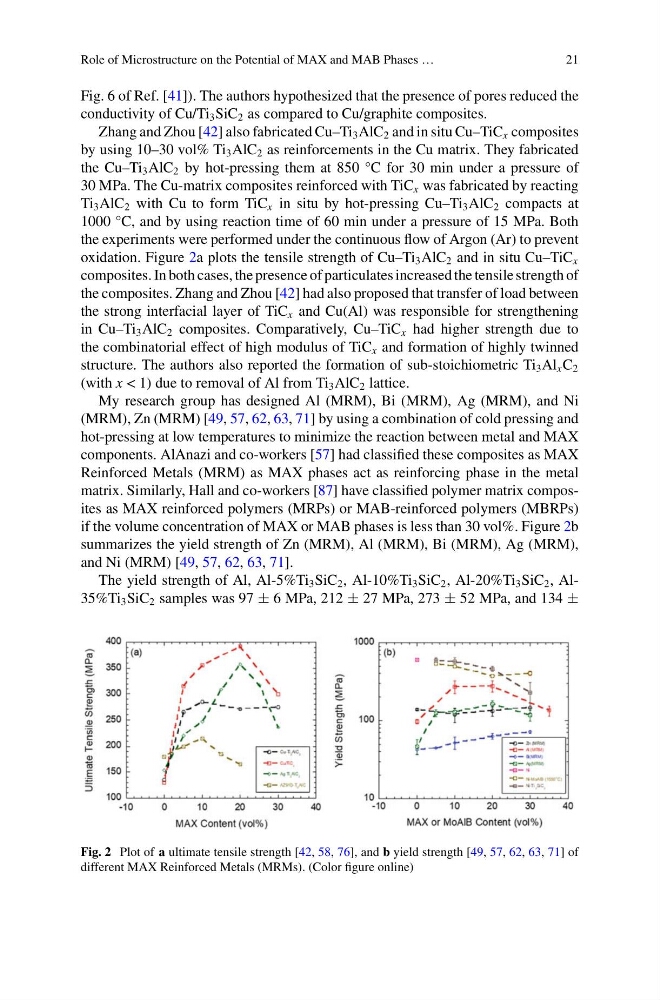
oxidation. Figure 2a plots the tensile strength of Cu–Ti 3 AlC 2 and in situ Cu–TiC x
composites. In both cases, the presence of particulates increased the tensile strength of
the composites. Zhang and Zhou [42] had also proposed that transfer of load between
the strong interfacial layer of TiC x and Cu(Al) was responsible for strengthening
in Cu–Ti 3 AlC 2 composites. Comparatively, Cu–TiC x had higher strength due to
the combinatorial effect of high modulus of TiC x and formation of highly twinned
structure. The authors also reported the formation of sub-stoichiometric Ti 3 Al x C 2
(with x < 1) due to removal of Al from Ti 3 AlC 2 lattice.
My research group has designed Al (MRM), Bi (MRM), Ag (MRM), and Ni
(MRM), Zn (MRM) [49, 57, 62, 63, 71] by using a combination of cold pressing and
hot-pressing at low temperatures to minimize the reaction between metal and MAX
components. AlAnazi and co-workers [57] had classified these composites as MAX
Reinforced Metals (MRM) as MAX phases act as reinforcing phase in the metal
matrix. Similarly, Hall and co-workers [87] have classified polymer matrix composites as MAX reinforced polymers (MRPs) or MAB-reinforced polymers (MBRPs)
if the volume concentration of MAX or MAB phases is less than 30 vol%. Figure 2b
summarizes the yield strength of Zn (MRM), Al (MRM), Bi (MRM), Ag (MRM),
and Ni (MRM) [49, 57, 62, 63, 71].
The yield strength of Al, Al-5%Ti 3 SiC 2 , Al-10%Ti 3 SiC 2 , Al-20%Ti 3 SiC 2 , Al35%Ti 3 SiC 2 samples was 97 ± 6 MPa, 212 ± 27 MPa, 273 ± 52 MPa, and 134 ±
Fig. 2 Plot of a ultimate tensile strength [42, 58, 76], and b yield strength [49, 57, 62, 63, 71] of
different MAX Reinforced Metals (MRMs). (Color figure online)
21
Fig. 6 of Ref. [41]). The authors hypothesized that the presence of pores reduced the
conductivity of Cu/Ti 3 SiC 2 as compared to Cu/graphite composites.
Zhang and Zhou [42] also fabricated Cu–Ti 3 AlC 2 and in situ Cu–TiC x composites
by using 10–30 vol% Ti 3 AlC 2 as reinforcements in the Cu matrix. They fabricated
the Cu–Ti 3 AlC 2 by hot-pressing them at 850 °C for 30 min under a pressure of
30 MPa. The Cu-matrix composites reinforced with TiC x was fabricated by reacting
Ti 3 AlC 2 with Cu to form TiC x in situ by hot-pressing Cu–Ti 3 AlC 2 compacts at
1000 °C, and by using reaction time of 60 min under a pressure of 15 MPa. Both
the experiments were performed under the continuous flow of Argon (Ar) to prevent
oxidation. Figure 2a plots the tensile strength of Cu–Ti 3 AlC 2 and in situ Cu–TiC x
composites. In both cases, the presence of particulates increased the tensile strength of
the composites. Zhang and Zhou [42] had also proposed that transfer of load between
the strong interfacial layer of TiC x and Cu(Al) was responsible for strengthening
in Cu–Ti 3 AlC 2 composites. Comparatively, Cu–TiC x had higher strength due to
the combinatorial effect of high modulus of TiC x and formation of highly twinned
structure. The authors also reported the formation of sub-stoichiometric Ti 3 Al x C 2
(with x < 1) due to removal of Al from Ti 3 AlC 2 lattice.
My research group has designed Al (MRM), Bi (MRM), Ag (MRM), and Ni
(MRM), Zn (MRM) [49, 57, 62, 63, 71] by using a combination of cold pressing and
hot-pressing at low temperatures to minimize the reaction between metal and MAX
components. AlAnazi and co-workers [57] had classified these composites as MAX
Reinforced Metals (MRM) as MAX phases act as reinforcing phase in the metal
matrix. Similarly, Hall and co-workers [87] have classified polymer matrix composites as MAX reinforced polymers (MRPs) or MAB-reinforced polymers (MBRPs)
if the volume concentration of MAX or MAB phases is less than 30 vol%. Figure 2b
summarizes the yield strength of Zn (MRM), Al (MRM), Bi (MRM), Ag (MRM),
and Ni (MRM) [49, 57, 62, 63, 71].
The yield strength of Al, Al-5%Ti 3 SiC 2 , Al-10%Ti 3 SiC 2 , Al-20%Ti 3 SiC 2 , Al35%Ti 3 SiC 2 samples was 97 ± 6 MPa, 212 ± 27 MPa, 273 ± 52 MPa, and 134 ±
Fig. 2 Plot of a ultimate tensile strength [42, 58, 76], and b yield strength [49, 57, 62, 63, 71] of
different MAX Reinforced Metals (MRMs). (Color figure online)