

20
S. Gupta
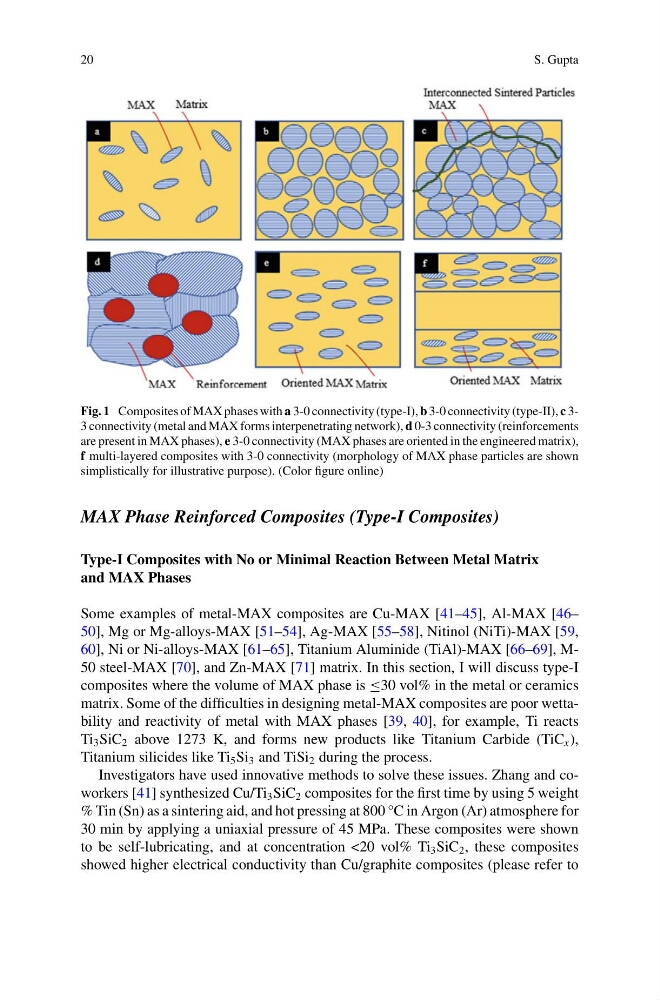
Fig. 1 Composites of MAX phases with a 3-0 connectivity (type-I), b 3-0 connectivity (type-II), c 33 connectivity (metal and MAX forms interpenetrating network), d 0-3 connectivity (reinforcements
are present in MAX phases), e 3-0 connectivity (MAX phases are oriented in the engineered matrix),
f multi-layered composites with 3-0 connectivity (morphology of MAX phase particles are shown
simplistically for illustrative purpose). (Color figure online)
MAX Phase Reinforced Composites (Type-I Composites)
Type-I Composites with No or Minimal Reaction Between Metal Matrix
and MAX Phases
Some examples of metal-MAX composites are Cu-MAX [41–45], Al-MAX [46–
50], Mg or Mg-alloys-MAX [51–54], Ag-MAX [55–58], Nitinol (NiTi)-MAX [59,
60], Ni or Ni-alloys-MAX [61–65], Titanium Aluminide (TiAl)-MAX [66–69], M50 steel-MAX [70], and Zn-MAX [71] matrix. In this section, I will discuss type-I
composites where the volume of MAX phase is ≤30 vol% in the metal or ceramics
matrix. Some of the difficulties in designing metal-MAX composites are poor wettability and reactivity of metal with MAX phases [39, 40], for example, Ti reacts
Ti 3 SiC 2 above 1273 K, and forms new products like Titanium Carbide (TiC x ),
Titanium silicides like Ti 5 Si 3 and TiSi 2 during the process.
Investigators have used innovative methods to solve these issues. Zhang and coworkers [41] synthesized Cu/Ti 3 SiC 2 composites for the first time by using 5 weight
% Tin (Sn) as a sintering aid, and hot pressing at 800 °C in Argon (Ar) atmosphere for
30 min by applying a uniaxial pressure of 45 MPa. These composites were shown
to be self-lubricating, and at concentration <20 vol% Ti 3 SiC 2 , these composites
showed higher electrical conductivity than Cu/graphite composites (please refer to
S. Gupta
Fig. 1 Composites of MAX phases with a 3-0 connectivity (type-I), b 3-0 connectivity (type-II), c 33 connectivity (metal and MAX forms interpenetrating network), d 0-3 connectivity (reinforcements
are present in MAX phases), e 3-0 connectivity (MAX phases are oriented in the engineered matrix),
f multi-layered composites with 3-0 connectivity (morphology of MAX phase particles are shown
simplistically for illustrative purpose). (Color figure online)
MAX Phase Reinforced Composites (Type-I Composites)
Type-I Composites with No or Minimal Reaction Between Metal Matrix
and MAX Phases
Some examples of metal-MAX composites are Cu-MAX [41–45], Al-MAX [46–
50], Mg or Mg-alloys-MAX [51–54], Ag-MAX [55–58], Nitinol (NiTi)-MAX [59,
60], Ni or Ni-alloys-MAX [61–65], Titanium Aluminide (TiAl)-MAX [66–69], M50 steel-MAX [70], and Zn-MAX [71] matrix. In this section, I will discuss type-I
composites where the volume of MAX phase is ≤30 vol% in the metal or ceramics
matrix. Some of the difficulties in designing metal-MAX composites are poor wettability and reactivity of metal with MAX phases [39, 40], for example, Ti reacts
Ti 3 SiC 2 above 1273 K, and forms new products like Titanium Carbide (TiC x ),
Titanium silicides like Ti 5 Si 3 and TiSi 2 during the process.
Investigators have used innovative methods to solve these issues. Zhang and coworkers [41] synthesized Cu/Ti 3 SiC 2 composites for the first time by using 5 weight
% Tin (Sn) as a sintering aid, and hot pressing at 800 °C in Argon (Ar) atmosphere for
30 min by applying a uniaxial pressure of 45 MPa. These composites were shown
to be self-lubricating, and at concentration <20 vol% Ti 3 SiC 2 , these composites
showed higher electrical conductivity than Cu/graphite composites (please refer to