

A Method for Measuring Total Protium and Total Deuterium …
249
Generating Protium-Deuterium (HD) Components and Testing
the New Analytical Method for Hydrogen Isotope
Quantification
Palladium silver diffusers are integral components for separation of hydrogen
isotopes from various inert species in tritium facilities [13]. The process is based
on the sorption/desorption of hydrogen molecules on the diffuser. Inside the diffuser,
the hydrogen molecules dissociate and form hydrogen atoms which subsequently
diffuse through the diffuser’s wall and re-combinate outside once passed the diffuser.
Depending on the gas analyte composition and characteristics, the hydrogen gas
streams permeate at different rates through the wall of the diffuser tubing into the
lower pressure cavity of the diffuser shell.
The mass transfer mechanism of hydrogen through dense metal lattice follows
the following (Eq. 1): [14]
F = Φ
p
n
up − p
n
down
A
t
(1)
where F is the hydrogen permeation flow rate (mol/s), F is the hydrogen permeability
(mol/m
−1 s
−1 Pa
−n ), p up and p down (Pa) are the hydrogen partial pressures upstream
and downstream, respectively, n is the pressure factor, A is the membrane area (m
2 ),
and t is the membrane thickness (m). The n factor is assumed to be 0.5 for palladium
alloy membranes.
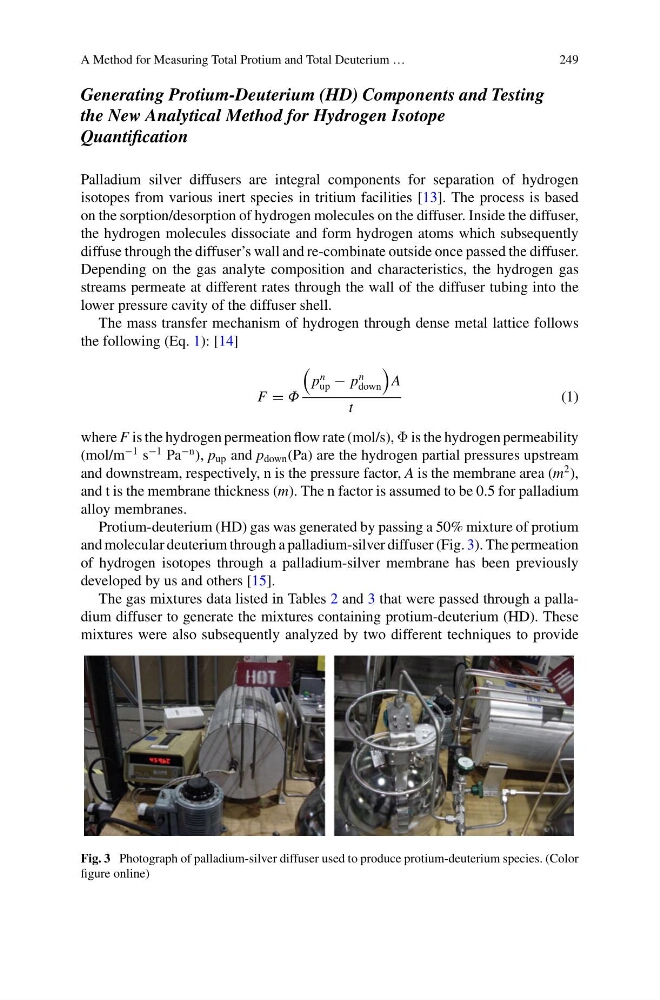
Protium-deuterium (HD) gas was generated by passing a 50% mixture of protium
and molecular deuterium through a palladium-silver diffuser (Fig. 3). The permeation
of hydrogen isotopes through a palladium-silver membrane has been previously
developed by us and others [15].
The gas mixtures data listed in Tables 2 and 3 that were passed through a palladium diffuser to generate the mixtures containing protium-deuterium (HD). These
mixtures were also subsequently analyzed by two different techniques to provide
Fig. 3 Photograph of palladium-silver diffuser used to produce protium-deuterium species. (Color
figure online)
249
Generating Protium-Deuterium (HD) Components and Testing
the New Analytical Method for Hydrogen Isotope
Quantification
Palladium silver diffusers are integral components for separation of hydrogen
isotopes from various inert species in tritium facilities [13]. The process is based
on the sorption/desorption of hydrogen molecules on the diffuser. Inside the diffuser,
the hydrogen molecules dissociate and form hydrogen atoms which subsequently
diffuse through the diffuser’s wall and re-combinate outside once passed the diffuser.
Depending on the gas analyte composition and characteristics, the hydrogen gas
streams permeate at different rates through the wall of the diffuser tubing into the
lower pressure cavity of the diffuser shell.
The mass transfer mechanism of hydrogen through dense metal lattice follows
the following (Eq. 1): [14]
F = Φ
p
n
up − p
n
down
A
t
(1)
where F is the hydrogen permeation flow rate (mol/s), F is the hydrogen permeability
(mol/m
−1 s
−1 Pa
−n ), p up and p down (Pa) are the hydrogen partial pressures upstream
and downstream, respectively, n is the pressure factor, A is the membrane area (m
2 ),
and t is the membrane thickness (m). The n factor is assumed to be 0.5 for palladium
alloy membranes.
Protium-deuterium (HD) gas was generated by passing a 50% mixture of protium
and molecular deuterium through a palladium-silver diffuser (Fig. 3). The permeation
of hydrogen isotopes through a palladium-silver membrane has been previously
developed by us and others [15].
The gas mixtures data listed in Tables 2 and 3 that were passed through a palladium diffuser to generate the mixtures containing protium-deuterium (HD). These
mixtures were also subsequently analyzed by two different techniques to provide
Fig. 3 Photograph of palladium-silver diffuser used to produce protium-deuterium species. (Color
figure online)