

238
A. Gupta and C. Srivastava
Table 3 Thermodynamic parameters associated with the deposition of Sn and Co over GO substrate
(data for σ and G c reproduced from [22] and [30])
η (V)
σ (J cm −2 )
G c (in kT)
G c (in kJ/mol)
n c (no. of atoms)
Sn
+0.50
6.11 × 10 −5
2.399
5.937
<1 (0.123)
Co
+0.50
3.03 × 10 −5
0.193
0.477
<1 (0.012)
where σ is the surface tension (J cm
−2 ), z is the number of electrons involved in
reduction of metal, υ a is the atomic volume (cm
−3 ) of the depositing metal.
The nucleation rate (I st ) is expressed as [29]:
I st =
√
(2σ )N 0 ϑ a j 0
ze
√
kT
× exp
αzeη
kT
× exp
−(G c )
kT
(18)
where j 0 is the exchange current density (A.cm
−2 ), α is the transfer coefficient, k is
the Boltzmann constant and T is in kelvin.
Using the relation in Eq. (15), A can be expressed as [29]:
A =
√
(2σ )ϑ a j 0
ze
√
kT
× exp
αzeη
kT
× exp
−8πσ
3
ϑ
2
a
3kT (zeη)
2
(19)
From Eq. (19), it can be observed that the fitting of ln(A) versus η can give out the
values of α and σ needed to find the G c and n c . The value of σ has been calculated
likewise in our previous manuscripts [22, 30]. The value of surface tension for Sn,
σ Sn = 6.11 × 10
−5 J cm
−2 [22]. Similar calculations in the case of Co yield σ Co =
3.03 × 10
−5 J cm
−2 [30]. Using the value of σ Sn and σ Co the G c and n c values
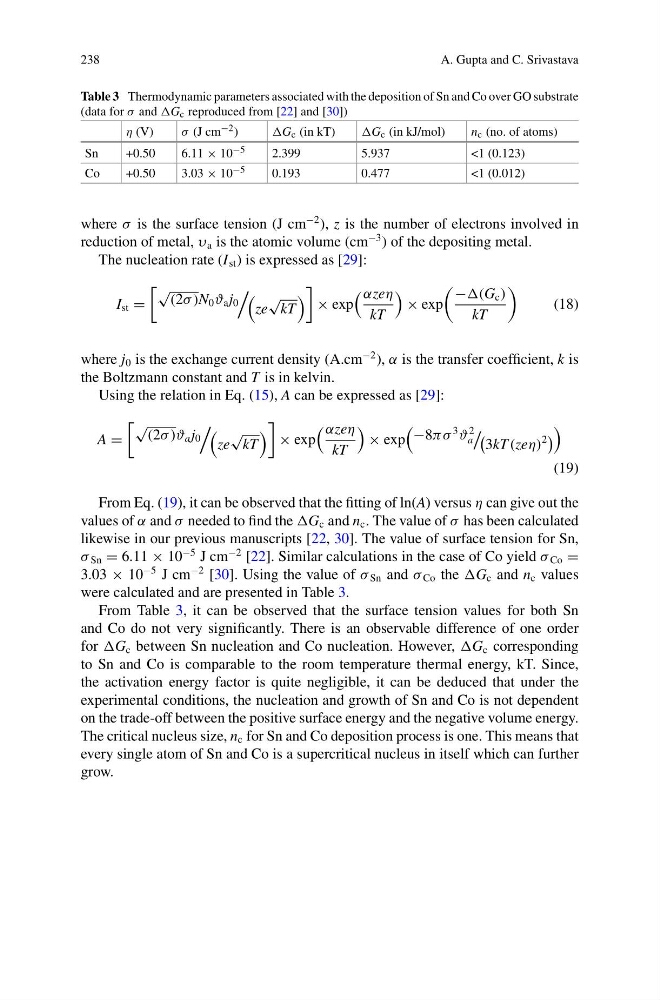
were calculated and are presented in Table 3.
From Table 3, it can be observed that the surface tension values for both Sn
and Co do not very significantly. There is an observable difference of one order
for G c between Sn nucleation and Co nucleation. However, G c corresponding
to Sn and Co is comparable to the room temperature thermal energy, kT. Since,
the activation energy factor is quite negligible, it can be deduced that under the
experimental conditions, the nucleation and growth of Sn and Co is not dependent
on the trade-off between the positive surface energy and the negative volume energy.
The critical nucleus size, n c for Sn and Co deposition process is one. This means that
every single atom of Sn and Co is a supercritical nucleus in itself which can further
grow.
A. Gupta and C. Srivastava
Table 3 Thermodynamic parameters associated with the deposition of Sn and Co over GO substrate
(data for σ and G c reproduced from [22] and [30])
η (V)
σ (J cm −2 )
G c (in kT)
G c (in kJ/mol)
n c (no. of atoms)
Sn
+0.50
6.11 × 10 −5
2.399
5.937
<1 (0.123)
Co
+0.50
3.03 × 10 −5
0.193
0.477
<1 (0.012)
where σ is the surface tension (J cm
−2 ), z is the number of electrons involved in
reduction of metal, υ a is the atomic volume (cm
−3 ) of the depositing metal.
The nucleation rate (I st ) is expressed as [29]:
I st =
√
(2σ )N 0 ϑ a j 0
ze
√
kT
× exp
αzeη
kT
× exp
−(G c )
kT
(18)
where j 0 is the exchange current density (A.cm
−2 ), α is the transfer coefficient, k is
the Boltzmann constant and T is in kelvin.
Using the relation in Eq. (15), A can be expressed as [29]:
A =
√
(2σ )ϑ a j 0
ze
√
kT
× exp
αzeη
kT
× exp
−8πσ
3
ϑ
2
a
3kT (zeη)
2
(19)
From Eq. (19), it can be observed that the fitting of ln(A) versus η can give out the
values of α and σ needed to find the G c and n c . The value of σ has been calculated
likewise in our previous manuscripts [22, 30]. The value of surface tension for Sn,
σ Sn = 6.11 × 10
−5 J cm
−2 [22]. Similar calculations in the case of Co yield σ Co =
3.03 × 10
−5 J cm
−2 [30]. Using the value of σ Sn and σ Co the G c and n c values
were calculated and are presented in Table 3.
From Table 3, it can be observed that the surface tension values for both Sn
and Co do not very significantly. There is an observable difference of one order
for G c between Sn nucleation and Co nucleation. However, G c corresponding
to Sn and Co is comparable to the room temperature thermal energy, kT. Since,
the activation energy factor is quite negligible, it can be deduced that under the
experimental conditions, the nucleation and growth of Sn and Co is not dependent
on the trade-off between the positive surface energy and the negative volume energy.
The critical nucleus size, n c for Sn and Co deposition process is one. This means that
every single atom of Sn and Co is a supercritical nucleus in itself which can further
grow.