

Effect of Heat Treatment on Mechanical Properties …
225
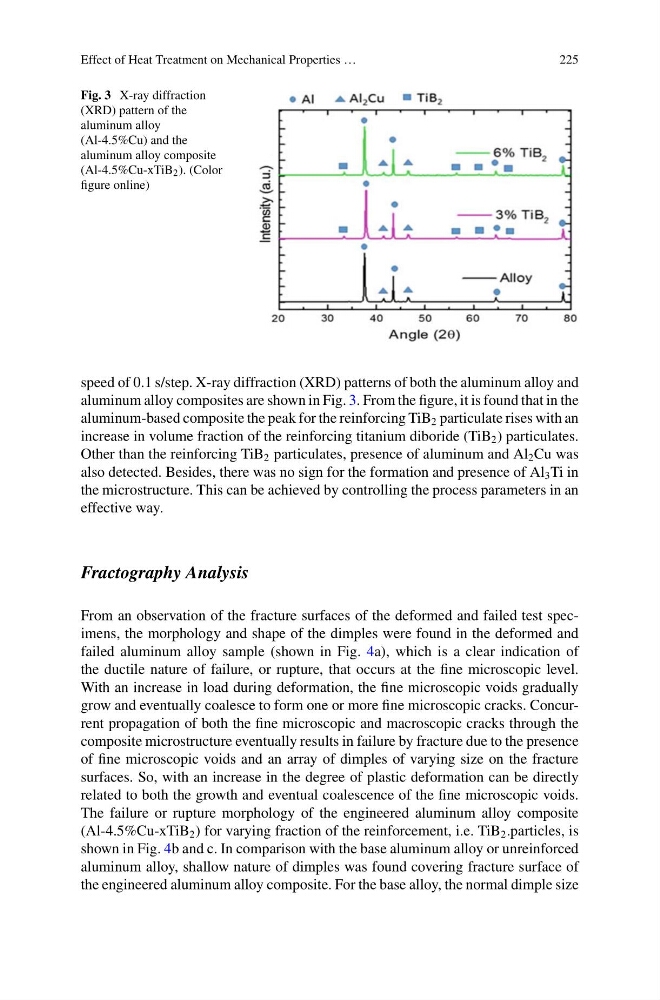
Fig. 3 X-ray diffraction
(XRD) pattern of the
aluminum alloy
(Al-4.5%Cu) and the
aluminum alloy composite
(Al-4.5%Cu-xTiB 2 ). (Color
figure online)
speed of 0.1 s/step. X-ray diffraction (XRD) patterns of both the aluminum alloy and
aluminum alloy composites are shown in Fig. 3. From the figure, it is found that in the
aluminum-based composite the peak for the reinforcing TiB 2 particulate rises with an
increase in volume fraction of the reinforcing titanium diboride (TiB 2 ) particulates.
Other than the reinforcing TiB 2 particulates, presence of aluminum and Al 2 Cu was
also detected. Besides, there was no sign for the formation and presence of Al 3 Ti in
the microstructure. This can be achieved by controlling the process parameters in an
effective way.
Fractography Analysis
From an observation of the fracture surfaces of the deformed and failed test specimens, the morphology and shape of the dimples were found in the deformed and
failed aluminum alloy sample (shown in Fig. 4a), which is a clear indication of
the ductile nature of failure, or rupture, that occurs at the fine microscopic level.
With an increase in load during deformation, the fine microscopic voids gradually
grow and eventually coalesce to form one or more fine microscopic cracks. Concurrent propagation of both the fine microscopic and macroscopic cracks through the
composite microstructure eventually results in failure by fracture due to the presence
of fine microscopic voids and an array of dimples of varying size on the fracture
surfaces. So, with an increase in the degree of plastic deformation can be directly
related to both the growth and eventual coalescence of the fine microscopic voids.
The failure or rupture morphology of the engineered aluminum alloy composite
(Al-4.5%Cu-xTiB 2 ) for varying fraction of the reinforcement, i.e. TiB 2 .particles, is
shown in Fig. 4b and c. In comparison with the base aluminum alloy or unreinforced
aluminum alloy, shallow nature of dimples was found covering fracture surface of
the engineered aluminum alloy composite. For the base alloy, the normal dimple size
225
Fig. 3 X-ray diffraction
(XRD) pattern of the
aluminum alloy
(Al-4.5%Cu) and the
aluminum alloy composite
(Al-4.5%Cu-xTiB 2 ). (Color
figure online)
speed of 0.1 s/step. X-ray diffraction (XRD) patterns of both the aluminum alloy and
aluminum alloy composites are shown in Fig. 3. From the figure, it is found that in the
aluminum-based composite the peak for the reinforcing TiB 2 particulate rises with an
increase in volume fraction of the reinforcing titanium diboride (TiB 2 ) particulates.
Other than the reinforcing TiB 2 particulates, presence of aluminum and Al 2 Cu was
also detected. Besides, there was no sign for the formation and presence of Al 3 Ti in
the microstructure. This can be achieved by controlling the process parameters in an
effective way.
Fractography Analysis
From an observation of the fracture surfaces of the deformed and failed test specimens, the morphology and shape of the dimples were found in the deformed and
failed aluminum alloy sample (shown in Fig. 4a), which is a clear indication of
the ductile nature of failure, or rupture, that occurs at the fine microscopic level.
With an increase in load during deformation, the fine microscopic voids gradually
grow and eventually coalesce to form one or more fine microscopic cracks. Concurrent propagation of both the fine microscopic and macroscopic cracks through the
composite microstructure eventually results in failure by fracture due to the presence
of fine microscopic voids and an array of dimples of varying size on the fracture
surfaces. So, with an increase in the degree of plastic deformation can be directly
related to both the growth and eventual coalescence of the fine microscopic voids.
The failure or rupture morphology of the engineered aluminum alloy composite
(Al-4.5%Cu-xTiB 2 ) for varying fraction of the reinforcement, i.e. TiB 2 .particles, is
shown in Fig. 4b and c. In comparison with the base aluminum alloy or unreinforced
aluminum alloy, shallow nature of dimples was found covering fracture surface of
the engineered aluminum alloy composite. For the base alloy, the normal dimple size