

224
S. Mozammil et al.
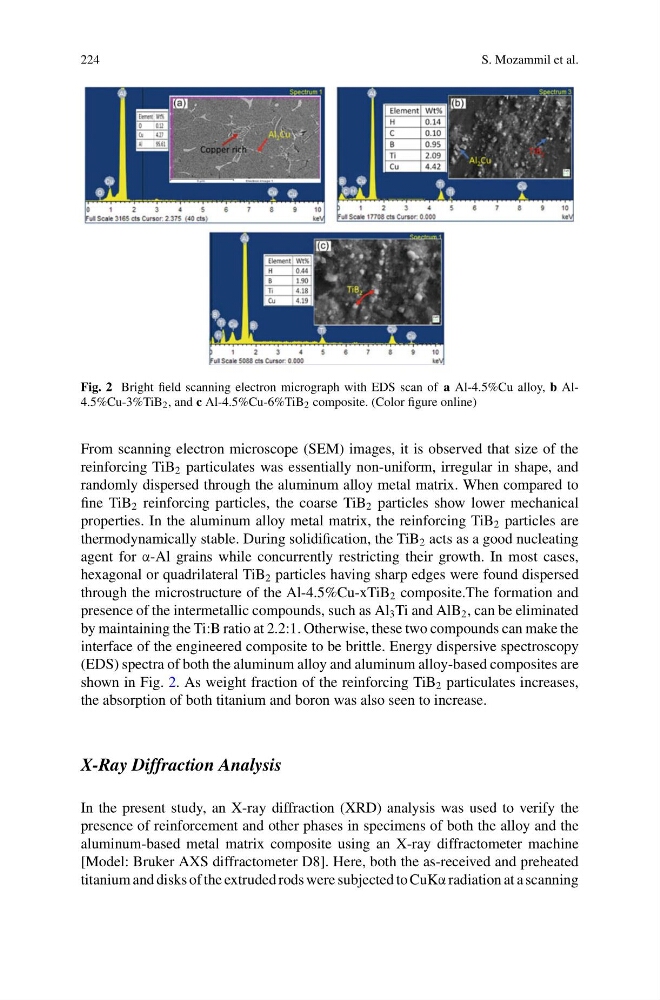
Fig. 2 Bright field scanning electron micrograph with EDS scan of a Al-4.5%Cu alloy, b Al4.5%Cu-3%TiB 2 , and c Al-4.5%Cu-6%TiB 2 composite. (Color figure online)
From scanning electron microscope (SEM) images, it is observed that size of the
reinforcing TiB 2 particulates was essentially non-uniform, irregular in shape, and
randomly dispersed through the aluminum alloy metal matrix. When compared to
fine TiB 2 reinforcing particles, the coarse TiB 2 particles show lower mechanical
properties. In the aluminum alloy metal matrix, the reinforcing TiB 2 particles are
thermodynamically stable. During solidification, the TiB 2 acts as a good nucleating
agent for α-Al grains while concurrently restricting their growth. In most cases,
hexagonal or quadrilateral TiB 2 particles having sharp edges were found dispersed
through the microstructure of the Al-4.5%Cu-xTiB 2 composite.The formation and
presence of the intermetallic compounds, such as Al 3 Ti and AlB 2 , can be eliminated
by maintaining the Ti:B ratio at 2.2:1. Otherwise, these two compounds can make the
interface of the engineered composite to be brittle. Energy dispersive spectroscopy
(EDS) spectra of both the aluminum alloy and aluminum alloy-based composites are
shown in Fig. 2. As weight fraction of the reinforcing TiB 2 particulates increases,
the absorption of both titanium and boron was also seen to increase.
X-Ray Diffraction Analysis
In the present study, an X-ray diffraction (XRD) analysis was used to verify the
presence of reinforcement and other phases in specimens of both the alloy and the
aluminum-based metal matrix composite using an X-ray diffractometer machine
[Model: Bruker AXS diffractometer D8]. Here, both the as-received and preheated
titanium and disks of the extruded rods were subjected to CuKα radiation at a scanning
S. Mozammil et al.
Fig. 2 Bright field scanning electron micrograph with EDS scan of a Al-4.5%Cu alloy, b Al4.5%Cu-3%TiB 2 , and c Al-4.5%Cu-6%TiB 2 composite. (Color figure online)
From scanning electron microscope (SEM) images, it is observed that size of the
reinforcing TiB 2 particulates was essentially non-uniform, irregular in shape, and
randomly dispersed through the aluminum alloy metal matrix. When compared to
fine TiB 2 reinforcing particles, the coarse TiB 2 particles show lower mechanical
properties. In the aluminum alloy metal matrix, the reinforcing TiB 2 particles are
thermodynamically stable. During solidification, the TiB 2 acts as a good nucleating
agent for α-Al grains while concurrently restricting their growth. In most cases,
hexagonal or quadrilateral TiB 2 particles having sharp edges were found dispersed
through the microstructure of the Al-4.5%Cu-xTiB 2 composite.The formation and
presence of the intermetallic compounds, such as Al 3 Ti and AlB 2 , can be eliminated
by maintaining the Ti:B ratio at 2.2:1. Otherwise, these two compounds can make the
interface of the engineered composite to be brittle. Energy dispersive spectroscopy
(EDS) spectra of both the aluminum alloy and aluminum alloy-based composites are
shown in Fig. 2. As weight fraction of the reinforcing TiB 2 particulates increases,
the absorption of both titanium and boron was also seen to increase.
X-Ray Diffraction Analysis
In the present study, an X-ray diffraction (XRD) analysis was used to verify the
presence of reinforcement and other phases in specimens of both the alloy and the
aluminum-based metal matrix composite using an X-ray diffractometer machine
[Model: Bruker AXS diffractometer D8]. Here, both the as-received and preheated
titanium and disks of the extruded rods were subjected to CuKα radiation at a scanning