

Use of an Infrared Spectroscopic Method for Isotopic Analysis …
197
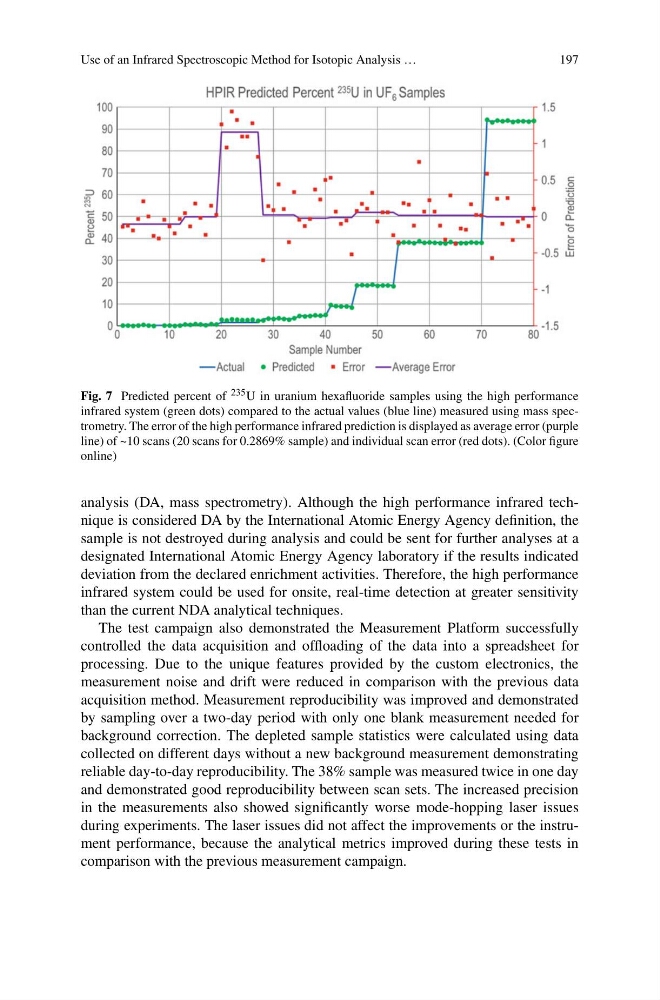
Fig. 7 Predicted percent of 235 U in uranium hexafluoride samples using the high performance
infrared system (green dots) compared to the actual values (blue line) measured using mass spectrometry. The error of the high performance infrared prediction is displayed as average error (purple
line) of ~10 scans (20 scans for 0.2869% sample) and individual scan error (red dots). (Color figure
online)
analysis (DA, mass spectrometry). Although the high performance infrared technique is considered DA by the International Atomic Energy Agency definition, the
sample is not destroyed during analysis and could be sent for further analyses at a
designated International Atomic Energy Agency laboratory if the results indicated
deviation from the declared enrichment activities. Therefore, the high performance
infrared system could be used for onsite, real-time detection at greater sensitivity
than the current NDA analytical techniques.
The test campaign also demonstrated the Measurement Platform successfully
controlled the data acquisition and offloading of the data into a spreadsheet for
processing. Due to the unique features provided by the custom electronics, the
measurement noise and drift were reduced in comparison with the previous data
acquisition method. Measurement reproducibility was improved and demonstrated
by sampling over a two-day period with only one blank measurement needed for
background correction. The depleted sample statistics were calculated using data
collected on different days without a new background measurement demonstrating
reliable day-to-day reproducibility. The 38% sample was measured twice in one day
and demonstrated good reproducibility between scan sets. The increased precision
in the measurements also showed significantly worse mode-hopping laser issues
during experiments. The laser issues did not affect the improvements or the instrument performance, because the analytical metrics improved during these tests in
comparison with the previous measurement campaign.
197
Fig. 7 Predicted percent of 235 U in uranium hexafluoride samples using the high performance
infrared system (green dots) compared to the actual values (blue line) measured using mass spectrometry. The error of the high performance infrared prediction is displayed as average error (purple
line) of ~10 scans (20 scans for 0.2869% sample) and individual scan error (red dots). (Color figure
online)
analysis (DA, mass spectrometry). Although the high performance infrared technique is considered DA by the International Atomic Energy Agency definition, the
sample is not destroyed during analysis and could be sent for further analyses at a
designated International Atomic Energy Agency laboratory if the results indicated
deviation from the declared enrichment activities. Therefore, the high performance
infrared system could be used for onsite, real-time detection at greater sensitivity
than the current NDA analytical techniques.
The test campaign also demonstrated the Measurement Platform successfully
controlled the data acquisition and offloading of the data into a spreadsheet for
processing. Due to the unique features provided by the custom electronics, the
measurement noise and drift were reduced in comparison with the previous data
acquisition method. Measurement reproducibility was improved and demonstrated
by sampling over a two-day period with only one blank measurement needed for
background correction. The depleted sample statistics were calculated using data
collected on different days without a new background measurement demonstrating
reliable day-to-day reproducibility. The 38% sample was measured twice in one day
and demonstrated good reproducibility between scan sets. The increased precision
in the measurements also showed significantly worse mode-hopping laser issues
during experiments. The laser issues did not affect the improvements or the instrument performance, because the analytical metrics improved during these tests in
comparison with the previous measurement campaign.