

Use of an Infrared Spectroscopic Method for Isotopic Analysis …
193
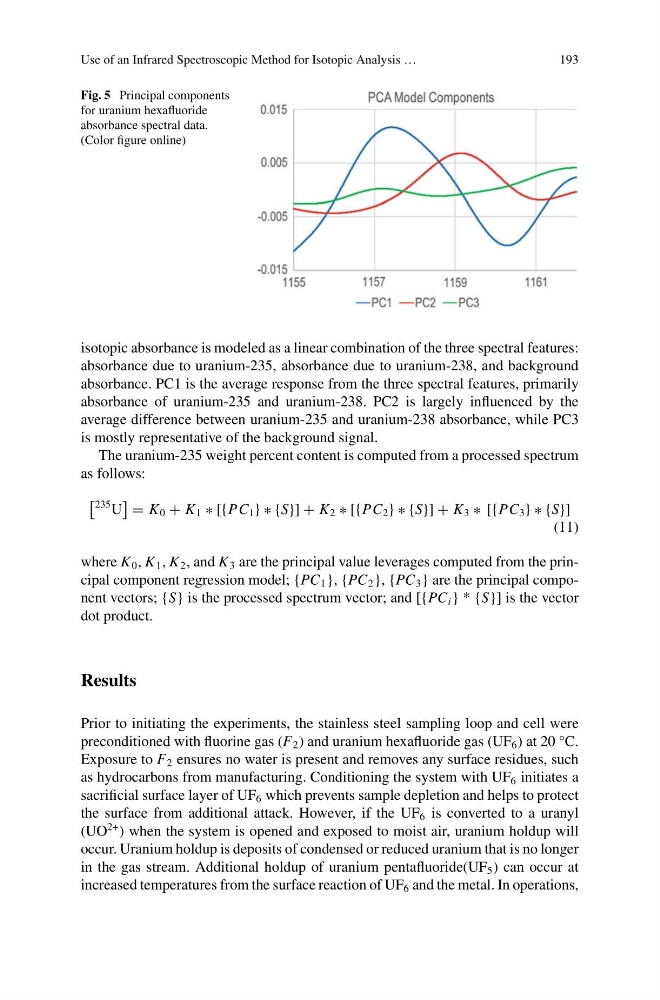
Fig. 5 Principal components
for uranium hexafluoride
absorbance spectral data.
(Color figure online)
isotopic absorbance is modeled as a linear combination of the three spectral features:
absorbance due to uranium-235, absorbance due to uranium-238, and background
absorbance. PC1 is the average response from the three spectral features, primarily
absorbance of uranium-235 and uranium-238. PC2 is largely influenced by the
average difference between uranium-235 and uranium-238 absorbance, while PC3
is mostly representative of the background signal.
The uranium-235 weight percent content is computed from a processed spectrum
as follows:
235 U
= K 0 + K 1 ∗ [{PC 1 } ∗ {S}] + K 2 ∗ [{PC 2 } ∗ {S}] + K 3 ∗ [{PC 3 } ∗ {S}]
(11)
where K 0 , K 1 , K 2 , and K 3 are the principal value leverages computed from the principal component regression model; {PC 1 }, {PC 2 }, {PC 3 } are the principal component vectors; {S} is the processed spectrum vector; and [{PC i } * {S}] is the vector
dot product.
Results
Prior to initiating the experiments, the stainless steel sampling loop and cell were
preconditioned with fluorine gas (F 2 ) and uranium hexafluoride gas (UF 6 ) at 20 °C.
Exposure to F 2 ensures no water is present and removes any surface residues, such
as hydrocarbons from manufacturing. Conditioning the system with UF 6 initiates a
sacrificial surface layer of UF 6 which prevents sample depletion and helps to protect
the surface from additional attack. However, if the UF 6 is converted to a uranyl
(UO
2+ ) when the system is opened and exposed to moist air, uranium holdup will
occur. Uranium holdup is deposits of condensed or reduced uranium that is no longer
in the gas stream. Additional holdup of uranium pentafluoride(UF 5 ) can occur at
increased temperatures from the surface reaction of UF 6 and the metal. In operations,
193
Fig. 5 Principal components
for uranium hexafluoride
absorbance spectral data.
(Color figure online)
isotopic absorbance is modeled as a linear combination of the three spectral features:
absorbance due to uranium-235, absorbance due to uranium-238, and background
absorbance. PC1 is the average response from the three spectral features, primarily
absorbance of uranium-235 and uranium-238. PC2 is largely influenced by the
average difference between uranium-235 and uranium-238 absorbance, while PC3
is mostly representative of the background signal.
The uranium-235 weight percent content is computed from a processed spectrum
as follows:
235 U
= K 0 + K 1 ∗ [{PC 1 } ∗ {S}] + K 2 ∗ [{PC 2 } ∗ {S}] + K 3 ∗ [{PC 3 } ∗ {S}]
(11)
where K 0 , K 1 , K 2 , and K 3 are the principal value leverages computed from the principal component regression model; {PC 1 }, {PC 2 }, {PC 3 } are the principal component vectors; {S} is the processed spectrum vector; and [{PC i } * {S}] is the vector
dot product.
Results
Prior to initiating the experiments, the stainless steel sampling loop and cell were
preconditioned with fluorine gas (F 2 ) and uranium hexafluoride gas (UF 6 ) at 20 °C.
Exposure to F 2 ensures no water is present and removes any surface residues, such
as hydrocarbons from manufacturing. Conditioning the system with UF 6 initiates a
sacrificial surface layer of UF 6 which prevents sample depletion and helps to protect
the surface from additional attack. However, if the UF 6 is converted to a uranyl
(UO
2+ ) when the system is opened and exposed to moist air, uranium holdup will
occur. Uranium holdup is deposits of condensed or reduced uranium that is no longer
in the gas stream. Additional holdup of uranium pentafluoride(UF 5 ) can occur at
increased temperatures from the surface reaction of UF 6 and the metal. In operations,