

168
K. L. Meena and T. S. Srivatsan
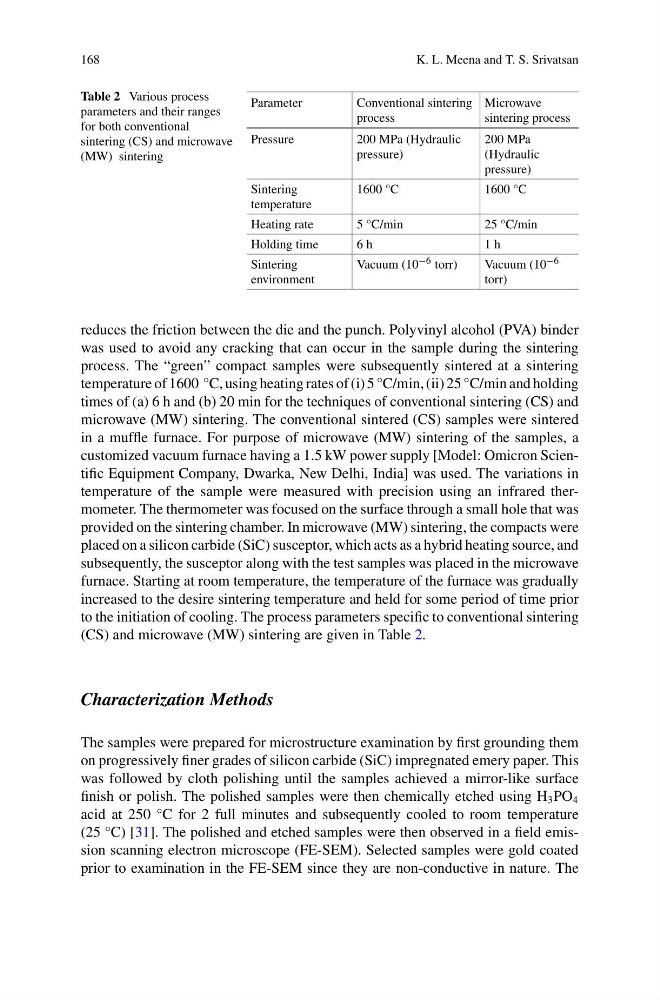
Table 2 Various process
parameters and their ranges
for both conventional
sintering (CS) and microwave
(MW) sintering
Parameter
Conventional sintering
process
Microwave
sintering process
Pressure
200 MPa (Hydraulic
pressure)
200 MPa
(Hydraulic
pressure)
Sintering
temperature
1600 °C
1600 °C
Heating rate
5 °C/min
25 °C/min
Holding time
6 h
1 h
Sintering
environment
Vacuum (10 −6 torr)
Vacuum (10 −6
torr)
reduces the friction between the die and the punch. Polyvinyl alcohol (PVA) binder
was used to avoid any cracking that can occur in the sample during the sintering
process. The “green” compact samples were subsequently sintered at a sintering
temperature of 1600 °C, using heating rates of (i) 5 °C/min, (ii) 25 °C/min and holding
times of (a) 6 h and (b) 20 min for the techniques of conventional sintering (CS) and
microwave (MW) sintering. The conventional sintered (CS) samples were sintered
in a muffle furnace. For purpose of microwave (MW) sintering of the samples, a
customized vacuum furnace having a 1.5 kW power supply [Model: Omicron Scientific Equipment Company, Dwarka, New Delhi, India] was used. The variations in
temperature of the sample were measured with precision using an infrared thermometer. The thermometer was focused on the surface through a small hole that was
provided on the sintering chamber. In microwave (MW) sintering, the compacts were
placed on a silicon carbide (SiC) susceptor, which acts as a hybrid heating source, and
subsequently, the susceptor along with the test samples was placed in the microwave
furnace. Starting at room temperature, the temperature of the furnace was gradually
increased to the desire sintering temperature and held for some period of time prior
to the initiation of cooling. The process parameters specific to conventional sintering
(CS) and microwave (MW) sintering are given in Table 2.
Characterization Methods
The samples were prepared for microstructure examination by first grounding them
on progressively finer grades of silicon carbide (SiC) impregnated emery paper. This
was followed by cloth polishing until the samples achieved a mirror-like surface
finish or polish. The polished samples were then chemically etched using H 3 PO 4
acid at 250 °C for 2 full minutes and subsequently cooled to room temperature
(25 °C) [31]. The polished and etched samples were then observed in a field emission scanning electron microscope (FE-SEM). Selected samples were gold coated
prior to examination in the FE-SEM since they are non-conductive in nature. The
K. L. Meena and T. S. Srivatsan
Table 2 Various process
parameters and their ranges
for both conventional
sintering (CS) and microwave
(MW) sintering
Parameter
Conventional sintering
process
Microwave
sintering process
Pressure
200 MPa (Hydraulic
pressure)
200 MPa
(Hydraulic
pressure)
Sintering
temperature
1600 °C
1600 °C
Heating rate
5 °C/min
25 °C/min
Holding time
6 h
1 h
Sintering
environment
Vacuum (10 −6 torr)
Vacuum (10 −6
torr)
reduces the friction between the die and the punch. Polyvinyl alcohol (PVA) binder
was used to avoid any cracking that can occur in the sample during the sintering
process. The “green” compact samples were subsequently sintered at a sintering
temperature of 1600 °C, using heating rates of (i) 5 °C/min, (ii) 25 °C/min and holding
times of (a) 6 h and (b) 20 min for the techniques of conventional sintering (CS) and
microwave (MW) sintering. The conventional sintered (CS) samples were sintered
in a muffle furnace. For purpose of microwave (MW) sintering of the samples, a
customized vacuum furnace having a 1.5 kW power supply [Model: Omicron Scientific Equipment Company, Dwarka, New Delhi, India] was used. The variations in
temperature of the sample were measured with precision using an infrared thermometer. The thermometer was focused on the surface through a small hole that was
provided on the sintering chamber. In microwave (MW) sintering, the compacts were
placed on a silicon carbide (SiC) susceptor, which acts as a hybrid heating source, and
subsequently, the susceptor along with the test samples was placed in the microwave
furnace. Starting at room temperature, the temperature of the furnace was gradually
increased to the desire sintering temperature and held for some period of time prior
to the initiation of cooling. The process parameters specific to conventional sintering
(CS) and microwave (MW) sintering are given in Table 2.
Characterization Methods
The samples were prepared for microstructure examination by first grounding them
on progressively finer grades of silicon carbide (SiC) impregnated emery paper. This
was followed by cloth polishing until the samples achieved a mirror-like surface
finish or polish. The polished samples were then chemically etched using H 3 PO 4
acid at 250 °C for 2 full minutes and subsequently cooled to room temperature
(25 °C) [31]. The polished and etched samples were then observed in a field emission scanning electron microscope (FE-SEM). Selected samples were gold coated
prior to examination in the FE-SEM since they are non-conductive in nature. The