

A Study Aimed at Understanding the Use of Nanomaterial-Treated Filters …
101
Gold Nanoparticles Surface Functionalization
In previous work, we have reported detailed studies regarding surface functionalization of noble metal nanomaterials, such as gold and silver [17]. Typically, a bifunctional linker is used to bind the metal nanoparticle via the thiol group while the other
functionality is used for other reactions. Thiols form self-assembled monolayers on
gold surfaces due to the relative strength of the gold-thiol bond [4].
In this case, gold nanoparticles are initially capped with citrate. Citrate is used
during preparation procedure as both a reducing agent and surfactant. The citrate,
with three carboxyl groups, serves a dual role: as stabilizing agent for the gold
nanoparticles and as a ligand to complex the heavy metal ions.
L-cysteine is used for gold nanoparticle’s surface functionalization and testing.
L-cysteine binds to the gold nanoparticles via the thiol group, while the carboxylic
acid functionality is exposed to the environment. Ultimately, both capping agents,
citrate and L-cysteine, have carboxylic acid groups available for reactions and can
be exploited for capturing/sequestration of metal ions [18].
The selectivity and sensitivity of L-cysteine as a ligand that augments the ability
of gold nanoparticles to uptake heavy metals have previously been reported [18,
19]. However, this is the first study that used functionalized gold nanoparticle bound
on stainless-steel wool as a heavy metal sequester. Surface functionalization of gold
nanoparticle-treated filter was achieved by the same mechanism described above [20].
At a pH of greater than 5.5, the carboxylic functionality is deprotonated, rendering a
negative surface charge that can bind with positive heavy metal ions [20]. The pH of
the L-cysteine-capped gold nanoparticle solution in this study was between 5.6 and
6.0.
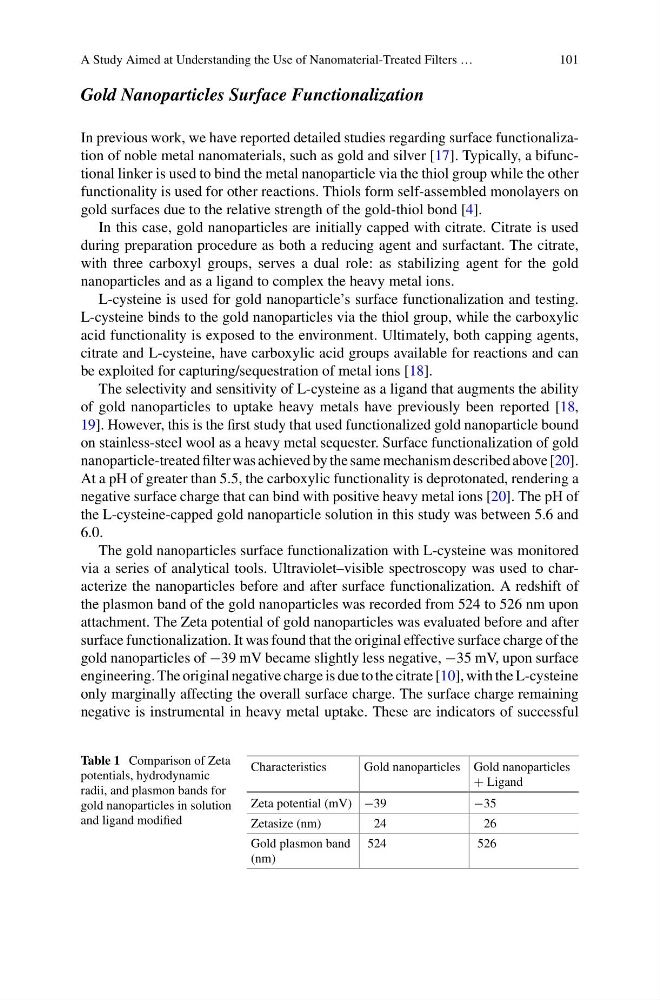
The gold nanoparticles surface functionalization with L-cysteine was monitored
via a series of analytical tools. Ultraviolet–visible spectroscopy was used to characterize the nanoparticles before and after surface functionalization. A redshift of
the plasmon band of the gold nanoparticles was recorded from 524 to 526 nm upon
attachment. The Zeta potential of gold nanoparticles was evaluated before and after
surface functionalization. It was found that the original effective surface charge of the
gold nanoparticles of −39 mV became slightly less negative, −35 mV, upon surface
engineering. The original negative charge is due to the citrate [10], with the L-cysteine
only marginally affecting the overall surface charge. The surface charge remaining
negative is instrumental in heavy metal uptake. These are indicators of successful
Table 1 Comparison of Zeta
potentials, hydrodynamic
radii, and plasmon bands for
gold nanoparticles in solution
and ligand modified
Characteristics
Gold nanoparticles Gold nanoparticles
+ Ligand
Zeta potential (mV) −39
−35
Zetasize (nm)
24
26
Gold plasmon band
(nm)
524
526
101
Gold Nanoparticles Surface Functionalization
In previous work, we have reported detailed studies regarding surface functionalization of noble metal nanomaterials, such as gold and silver [17]. Typically, a bifunctional linker is used to bind the metal nanoparticle via the thiol group while the other
functionality is used for other reactions. Thiols form self-assembled monolayers on
gold surfaces due to the relative strength of the gold-thiol bond [4].
In this case, gold nanoparticles are initially capped with citrate. Citrate is used
during preparation procedure as both a reducing agent and surfactant. The citrate,
with three carboxyl groups, serves a dual role: as stabilizing agent for the gold
nanoparticles and as a ligand to complex the heavy metal ions.
L-cysteine is used for gold nanoparticle’s surface functionalization and testing.
L-cysteine binds to the gold nanoparticles via the thiol group, while the carboxylic
acid functionality is exposed to the environment. Ultimately, both capping agents,
citrate and L-cysteine, have carboxylic acid groups available for reactions and can
be exploited for capturing/sequestration of metal ions [18].
The selectivity and sensitivity of L-cysteine as a ligand that augments the ability
of gold nanoparticles to uptake heavy metals have previously been reported [18,
19]. However, this is the first study that used functionalized gold nanoparticle bound
on stainless-steel wool as a heavy metal sequester. Surface functionalization of gold
nanoparticle-treated filter was achieved by the same mechanism described above [20].
At a pH of greater than 5.5, the carboxylic functionality is deprotonated, rendering a
negative surface charge that can bind with positive heavy metal ions [20]. The pH of
the L-cysteine-capped gold nanoparticle solution in this study was between 5.6 and
6.0.
The gold nanoparticles surface functionalization with L-cysteine was monitored
via a series of analytical tools. Ultraviolet–visible spectroscopy was used to characterize the nanoparticles before and after surface functionalization. A redshift of
the plasmon band of the gold nanoparticles was recorded from 524 to 526 nm upon
attachment. The Zeta potential of gold nanoparticles was evaluated before and after
surface functionalization. It was found that the original effective surface charge of the
gold nanoparticles of −39 mV became slightly less negative, −35 mV, upon surface
engineering. The original negative charge is due to the citrate [10], with the L-cysteine
only marginally affecting the overall surface charge. The surface charge remaining
negative is instrumental in heavy metal uptake. These are indicators of successful
Table 1 Comparison of Zeta
potentials, hydrodynamic
radii, and plasmon bands for
gold nanoparticles in solution
and ligand modified
Characteristics
Gold nanoparticles Gold nanoparticles
+ Ligand
Zeta potential (mV) −39
−35
Zetasize (nm)
24
26
Gold plasmon band
(nm)
524
526