

4.8 The Wess-Zumino Model and a Problem of the Chiral Effective Potential
91
G ++ −
1
4
¯
D
2
1 ( ¯
G −+ ) = 0;
G −+ −
1
4
D
2
1 ((G ++ ) =
1
16
D
2
1
¯
D
2
2 δ
8
(z 1 − z 2 );
G −− −
1
4
D
2
1 ((G +− ) = 0;
G +− −
1
4
¯
D
2
1 ( ¯
G −− ) =
1
16
¯
D
2
1 D
2
2 δ
8
(z 1 − z 2 ).
(4.159)
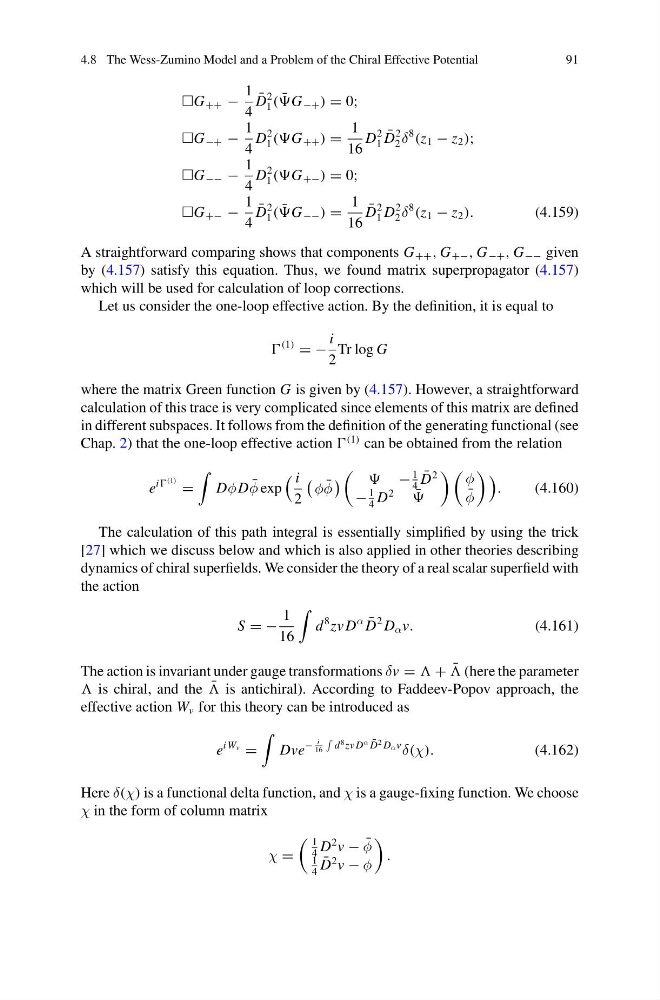
A straightforward comparing shows that components G ++ , G +− , G −+ , G −− given
by (4.157) satisfy this equation. Thus, we found matrix superpropagator (4.157)
which will be used for calculation of loop corrections.
Let us consider the one-loop effective action. By the definition, it is equal to
(1)
= −
i
2
Tr log G
where the matrix Green function G is given by (4.157). However, a straightforward
calculation of this trace is very complicated since elements of this matrix are defined
in different subspaces. It follows from the definition of the generating functional (see
Chap. 2) that the one-loop effective action
(1) can be obtained from the relation
e
i
(1) =
DφD ¯
φ exp
i
2
φ ¯
φ
−
1
4
¯
D
2
−
1
4
D
2
¯
φ
¯
φ
.
(4.160)
The calculation of this path integral is essentially simplified by using the trick
[27] which we discuss below and which is also applied in other theories describing
dynamics of chiral superfields. We consider the theory of a real scalar superfield with
the action
S = −
1
16
d
8 zv D
α ¯
D
2 D α v.
(4.161)
The action is invariant under gauge transformations δv = + ¯
(here the parameter
is chiral, and the ¯
is antichiral). According to Faddeev-Popov approach, the
effective action W v for this theory can be introduced as
e
i W v =
Dve
−
i
16
d
8 zvD
α ¯
D
2 D α v
δ(χ).
(4.162)
Here δ(χ) is a functional delta function, and χ is a gauge-fixing function. We choose
χ in the form of column matrix
χ =
1
4
D
2 v − ¯
φ
1
4
¯
D
2 v − φ
.
91
G ++ −
1
4
¯
D
2
1 ( ¯
G −+ ) = 0;
G −+ −
1
4
D
2
1 ((G ++ ) =
1
16
D
2
1
¯
D
2
2 δ
8
(z 1 − z 2 );
G −− −
1
4
D
2
1 ((G +− ) = 0;
G +− −
1
4
¯
D
2
1 ( ¯
G −− ) =
1
16
¯
D
2
1 D
2
2 δ
8
(z 1 − z 2 ).
(4.159)
A straightforward comparing shows that components G ++ , G +− , G −+ , G −− given
by (4.157) satisfy this equation. Thus, we found matrix superpropagator (4.157)
which will be used for calculation of loop corrections.
Let us consider the one-loop effective action. By the definition, it is equal to
(1)
= −
i
2
Tr log G
where the matrix Green function G is given by (4.157). However, a straightforward
calculation of this trace is very complicated since elements of this matrix are defined
in different subspaces. It follows from the definition of the generating functional (see
Chap. 2) that the one-loop effective action
(1) can be obtained from the relation
e
i
(1) =
DφD ¯
φ exp
i
2
φ ¯
φ
−
1
4
¯
D
2
−
1
4
D
2
¯
φ
¯
φ
.
(4.160)
The calculation of this path integral is essentially simplified by using the trick
[27] which we discuss below and which is also applied in other theories describing
dynamics of chiral superfields. We consider the theory of a real scalar superfield with
the action
S = −
1
16
d
8 zv D
α ¯
D
2 D α v.
(4.161)
The action is invariant under gauge transformations δv = + ¯
(here the parameter
is chiral, and the ¯
is antichiral). According to Faddeev-Popov approach, the
effective action W v for this theory can be introduced as
e
i W v =
Dve
−
i
16
d
8 zvD
α ¯
D
2 D α v
δ(χ).
(4.162)
Here δ(χ) is a functional delta function, and χ is a gauge-fixing function. We choose
χ in the form of column matrix
χ =
1
4
D
2 v − ¯
φ
1
4
¯
D
2 v − φ
.