

90
4 Four-Dimensional Superfield Supersymmetry
e
i
¯
[, ¯
]
=
DφD ¯
φ exp
i
2
φ ¯
φ
−
1
4
¯
D
2
−
1
4
D
2
¯
φ
¯
φ
+
+ i
√
(
λ
3!
φ
3
+ h.c.)
.
(4.153)
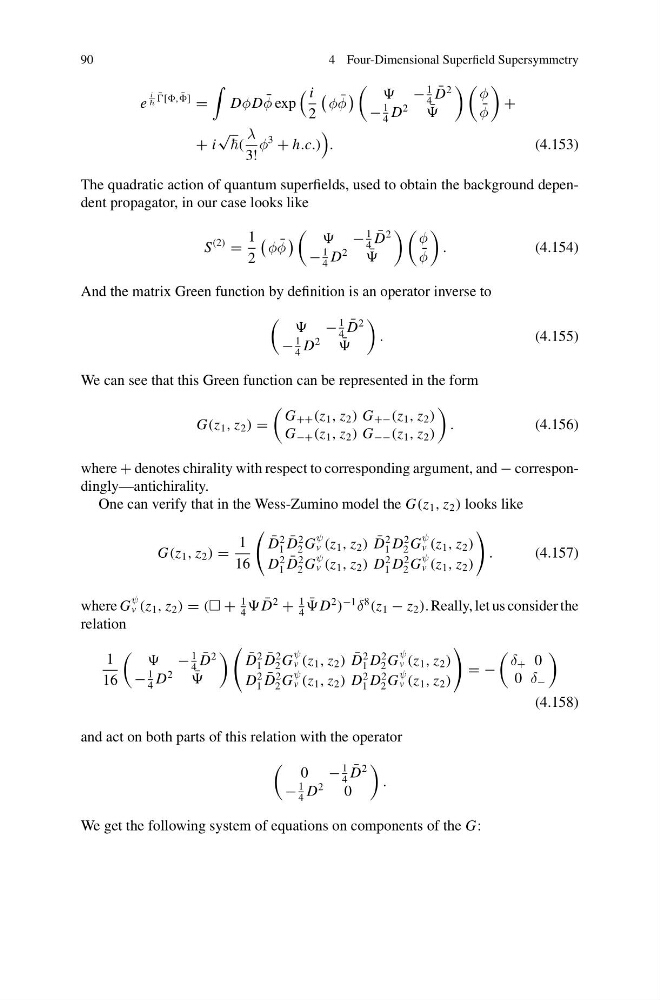
The quadratic action of quantum superfields, used to obtain the background dependent propagator, in our case looks like
S
(2)
=
1
2
φ ¯
φ
−
1
4
¯
D
2
−
1
4
D
2
¯
φ
¯
φ
.
(4.154)
And the matrix Green function by definition is an operator inverse to
−
1
4
¯
D
2
−
1
4
D
2
¯
.
(4.155)
We can see that this Green function can be represented in the form
G(z 1 , z 2 ) =
G ++ (z 1 , z 2 ) G +− (z 1 , z 2 )
G −+ (z 1 , z 2 ) G −− (z 1 , z 2 )
.
(4.156)
where + denotes chirality with respect to corresponding argument, and − correspondingly—antichirality.
One can verify that in the Wess-Zumino model the G(z 1 , z 2 ) looks like
G(z 1 , z 2 ) =
1
16
¯
D
2
1
¯
D
2
2 G
ψ
v (z 1 , z 2 ) ¯
D
2
1 D
2
2 G
ψ
v (z 1 , z 2 )
D
2
1
¯
D
2
2 G
ψ
v (z 1 , z 2 ) D
2
1 D
2
2 G
ψ
v (z 1 , z 2 )
.
(4.157)
where G
ψ
v (z 1 , z 2 ) = ( +
1
4
¯
D
2
+
1
4
¯
D
2
)
−1
δ
8
(z 1 − z 2 ). Really, let us consider the
relation
1
16
−
1
4
¯
D
2
−
1
4
D
2
¯
¯
D
2
1
¯
D
2
2 G
ψ
v (z 1 , z 2 ) ¯
D
2
1 D
2
2 G
ψ
v (z 1 , z 2 )
D
2
1
¯
D
2
2 G
ψ
v (z 1 , z 2 ) D
2
1 D
2
2 G
ψ
v (z 1 , z 2 )
= −
δ + 0
0 δ −
(4.158)
and act on both parts of this relation with the operator
0 −
1
4
¯
D
2
−
1
4
D
2
0
.
We get the following system of equations on components of the G:
4 Four-Dimensional Superfield Supersymmetry
e
i
¯
[, ¯
]
=
DφD ¯
φ exp
i
2
φ ¯
φ
−
1
4
¯
D
2
−
1
4
D
2
¯
φ
¯
φ
+
+ i
√
(
λ
3!
φ
3
+ h.c.)
.
(4.153)
The quadratic action of quantum superfields, used to obtain the background dependent propagator, in our case looks like
S
(2)
=
1
2
φ ¯
φ
−
1
4
¯
D
2
−
1
4
D
2
¯
φ
¯
φ
.
(4.154)
And the matrix Green function by definition is an operator inverse to
−
1
4
¯
D
2
−
1
4
D
2
¯
.
(4.155)
We can see that this Green function can be represented in the form
G(z 1 , z 2 ) =
G ++ (z 1 , z 2 ) G +− (z 1 , z 2 )
G −+ (z 1 , z 2 ) G −− (z 1 , z 2 )
.
(4.156)
where + denotes chirality with respect to corresponding argument, and − correspondingly—antichirality.
One can verify that in the Wess-Zumino model the G(z 1 , z 2 ) looks like
G(z 1 , z 2 ) =
1
16
¯
D
2
1
¯
D
2
2 G
ψ
v (z 1 , z 2 ) ¯
D
2
1 D
2
2 G
ψ
v (z 1 , z 2 )
D
2
1
¯
D
2
2 G
ψ
v (z 1 , z 2 ) D
2
1 D
2
2 G
ψ
v (z 1 , z 2 )
.
(4.157)
where G
ψ
v (z 1 , z 2 ) = ( +
1
4
¯
D
2
+
1
4
¯
D
2
)
−1
δ
8
(z 1 − z 2 ). Really, let us consider the
relation
1
16
−
1
4
¯
D
2
−
1
4
D
2
¯
¯
D
2
1
¯
D
2
2 G
ψ
v (z 1 , z 2 ) ¯
D
2
1 D
2
2 G
ψ
v (z 1 , z 2 )
D
2
1
¯
D
2
2 G
ψ
v (z 1 , z 2 ) D
2
1 D
2
2 G
ψ
v (z 1 , z 2 )
= −
δ + 0
0 δ −
(4.158)
and act on both parts of this relation with the operator
0 −
1
4
¯
D
2
−
1
4
D
2
0
.
We get the following system of equations on components of the G: