

82
4 Four-Dimensional Superfield Supersymmetry
. . .
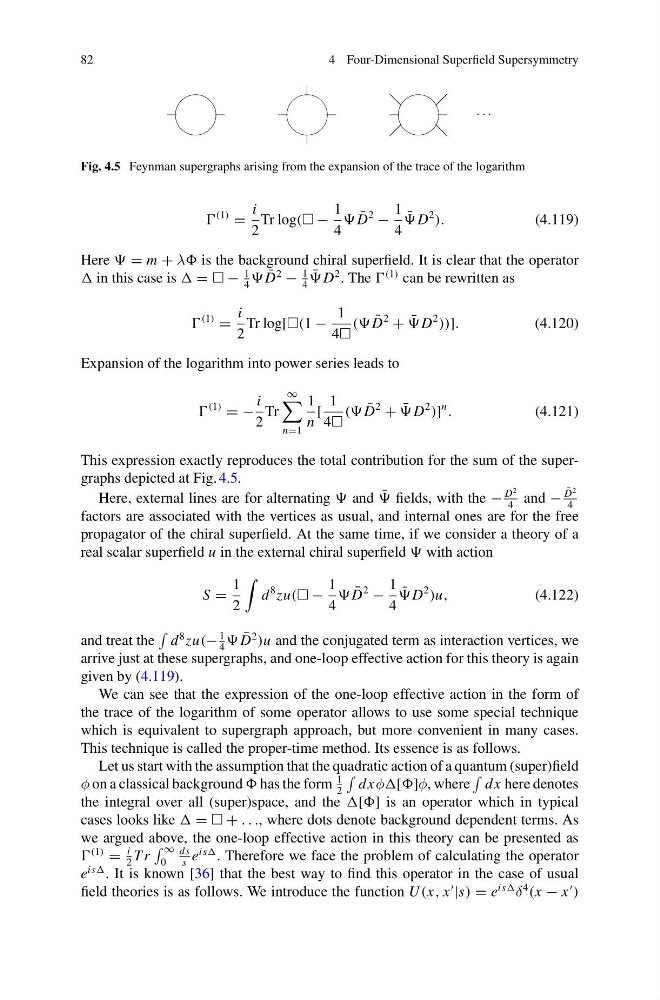
Fig. 4.5 Feynman supergraphs arising from the expansion of the trace of the logarithm
(1)
=
i
2
Tr log( −
1
4
¯
D
2
−
1
4
¯
D
2
).
(4.119)
Here = m + λ is the background chiral superfield. It is clear that the operator
in this case is = −
1
4
¯
D
2
−
1
4
¯
D
2 . The
(1) can be rewritten as
(1)
=
i
2
Tr log[ −
1
4
(( ¯
D
2
+ ¯
D
2
))].
(4.120)
Expansion of the logarithm into power series leads to
(1)
= −
i
2
Tr
∞
n=1
1
n
[
1
4
(( ¯
D
2
+ ¯
D
2
)]
n
.
(4.121)
This expression exactly reproduces the total contribution for the sum of the supergraphs depicted at Fig. 4.5.
Here, external lines are for alternating and ¯
fields, with the −
D
2
4
and −
¯
D
2
4
factors are associated with the vertices as usual, and internal ones are for the free
propagator of the chiral superfield. At the same time, if we consider a theory of a
real scalar superfield u in the external chiral superfield with action
S =
1
2
d
8 zu( −
1
4
¯
D
2
−
1
4
¯
D
2
)u,
(4.122)
and treat the
d
8 zu(−
1
4
¯
D
2
)u and the conjugated term as interaction vertices, we
arrive just at these supergraphs, and one-loop effective action for this theory is again
given by (4.119).
We can see that the expression of the one-loop effective action in the form of
the trace of the logarithm of some operator allows to use some special technique
which is equivalent to supergraph approach, but more convenient in many cases.
This technique is called the proper-time method. Its essence is as follows.
Let us start with the assumption that the quadratic action of a quantum (super)field
φ on a classical background has the form
1
2
dxφ where
dx here denotes
the integral over all (super)space, and the is an operator which in typical
cases looks like = + . . ., where dots denote background dependent terms. As
we argued above, the one-loop effective action in this theory can be presented as
(1)
=
i
2
T r
∞
0
ds
s
e
is . Therefore we face the problem of calculating the operator
e
is . It is known [36] that the best way to find this operator in the case of usual
field theories is as follows. We introduce the function U (x, x
|s) = e
is
δ
4
(x − x
)
4 Four-Dimensional Superfield Supersymmetry
. . .
Fig. 4.5 Feynman supergraphs arising from the expansion of the trace of the logarithm
(1)
=
i
2
Tr log( −
1
4
¯
D
2
−
1
4
¯
D
2
).
(4.119)
Here = m + λ is the background chiral superfield. It is clear that the operator
in this case is = −
1
4
¯
D
2
−
1
4
¯
D
2 . The
(1) can be rewritten as
(1)
=
i
2
Tr log[ −
1
4
(( ¯
D
2
+ ¯
D
2
))].
(4.120)
Expansion of the logarithm into power series leads to
(1)
= −
i
2
Tr
∞
n=1
1
n
[
1
4
(( ¯
D
2
+ ¯
D
2
)]
n
.
(4.121)
This expression exactly reproduces the total contribution for the sum of the supergraphs depicted at Fig. 4.5.
Here, external lines are for alternating and ¯
fields, with the −
D
2
4
and −
¯
D
2
4
factors are associated with the vertices as usual, and internal ones are for the free
propagator of the chiral superfield. At the same time, if we consider a theory of a
real scalar superfield u in the external chiral superfield with action
S =
1
2
d
8 zu( −
1
4
¯
D
2
−
1
4
¯
D
2
)u,
(4.122)
and treat the
d
8 zu(−
1
4
¯
D
2
)u and the conjugated term as interaction vertices, we
arrive just at these supergraphs, and one-loop effective action for this theory is again
given by (4.119).
We can see that the expression of the one-loop effective action in the form of
the trace of the logarithm of some operator allows to use some special technique
which is equivalent to supergraph approach, but more convenient in many cases.
This technique is called the proper-time method. Its essence is as follows.
Let us start with the assumption that the quadratic action of a quantum (super)field
φ on a classical background has the form
1
2
dxφ where
dx here denotes
the integral over all (super)space, and the is an operator which in typical
cases looks like = + . . ., where dots denote background dependent terms. As
we argued above, the one-loop effective action in this theory can be presented as
(1)
=
i
2
T r
∞
0
ds
s
e
is . Therefore we face the problem of calculating the operator
e
is . It is known [36] that the best way to find this operator in the case of usual
field theories is as follows. We introduce the function U (x, x
|s) = e
is
δ
4
(x − x
)