

4.5 Superficial Degree of Divergence. Renormalization
81
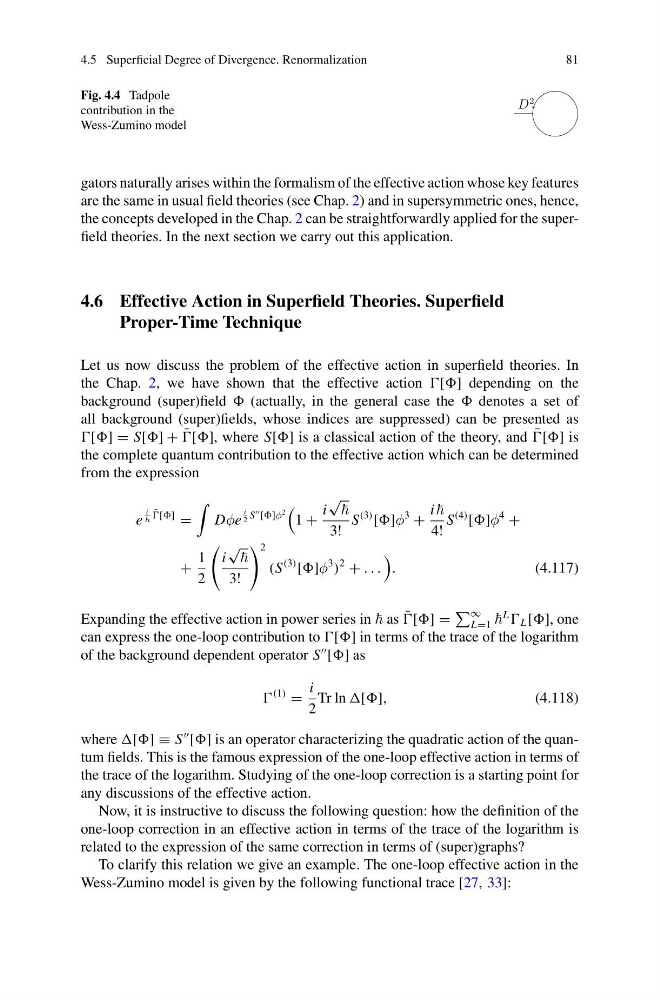
Fig. 4.4 Tadpole
contribution in the
Wess-Zumino model
-
D
2
gators naturally arises within the formalism of the effective action whose key features
are the same in usual field theories (see Chap. 2) and in supersymmetric ones, hence,
the concepts developed in the Chap. 2 can be straightforwardly applied for the superfield theories. In the next section we carry out this application.
4.6 Effective Action in Superfield Theories. Superfield
Proper-Time Technique
Let us now discuss the problem of the effective action in superfield theories. In
the Chap. 2, we have shown that the effective action depending on the
background (super)field (actually, in the general case the denotes a set of
all background (super)fields, whose indices are suppressed) can be presented as
= S[] + ¯
where S[ is a classical action of the theory, and ¯
is
the complete quantum contribution to the effective action which can be determined
from the expression
e
i
¯
=
Dφe
i
2 S
[
2
1 +
i
√
3!
S
(3)
[
3
+
i
4!
S
(4)
[
4
+
+
1
2
i
√
3!
2
(S
(3)
[
3
)
2
+ . . .
.
(4.117)
Expanding the effective action in power series in as ¯
=
∞
L=1
L
L [ one
can express the one-loop contribution to in terms of the trace of the logarithm
of the background dependent operator S
[ as
(1)
=
i
2
Tr ln
(4.118)
where ≡ S
[ is an operator characterizing the quadratic action of the quantum fields. This is the famous expression of the one-loop effective action in terms of
the trace of the logarithm. Studying of the one-loop correction is a starting point for
any discussions of the effective action.
Now, it is instructive to discuss the following question: how the definition of the
one-loop correction in an effective action in terms of the trace of the logarithm is
related to the expression of the same correction in terms of (super)graphs?
To clarify this relation we give an example. The one-loop effective action in the
Wess-Zumino model is given by the following functional trace [27, 33]:
81
Fig. 4.4 Tadpole
contribution in the
Wess-Zumino model
-
D
2
gators naturally arises within the formalism of the effective action whose key features
are the same in usual field theories (see Chap. 2) and in supersymmetric ones, hence,
the concepts developed in the Chap. 2 can be straightforwardly applied for the superfield theories. In the next section we carry out this application.
4.6 Effective Action in Superfield Theories. Superfield
Proper-Time Technique
Let us now discuss the problem of the effective action in superfield theories. In
the Chap. 2, we have shown that the effective action depending on the
background (super)field (actually, in the general case the denotes a set of
all background (super)fields, whose indices are suppressed) can be presented as
= S[] + ¯
where S[ is a classical action of the theory, and ¯
is
the complete quantum contribution to the effective action which can be determined
from the expression
e
i
¯
=
Dφe
i
2 S
[
2
1 +
i
√
3!
S
(3)
[
3
+
i
4!
S
(4)
[
4
+
+
1
2
i
√
3!
2
(S
(3)
[
3
)
2
+ . . .
.
(4.117)
Expanding the effective action in power series in as ¯
=
∞
L=1
L
L [ one
can express the one-loop contribution to in terms of the trace of the logarithm
of the background dependent operator S
[ as
(1)
=
i
2
Tr ln
(4.118)
where ≡ S
[ is an operator characterizing the quadratic action of the quantum fields. This is the famous expression of the one-loop effective action in terms of
the trace of the logarithm. Studying of the one-loop correction is a starting point for
any discussions of the effective action.
Now, it is instructive to discuss the following question: how the definition of the
one-loop correction in an effective action in terms of the trace of the logarithm is
related to the expression of the same correction in terms of (super)graphs?
To clarify this relation we give an example. The one-loop effective action in the
Wess-Zumino model is given by the following functional trace [27, 33]: