

4.1 General Properties of the Four-Dimensional Superspace
51
are bosonic and fermionic fields forming a component content of the superfield F
given by the expression above. We note that, just as in the three-dimensional case,
the numbers of bosonic and fermionic degrees of freedom in any supersymmetric
theory are equal. If a theory describing dynamics of these fields is supersymmetric, its
action should be invariant under supersymmetry transformations which are defined
as symmetry transformations with fermionic parameters.
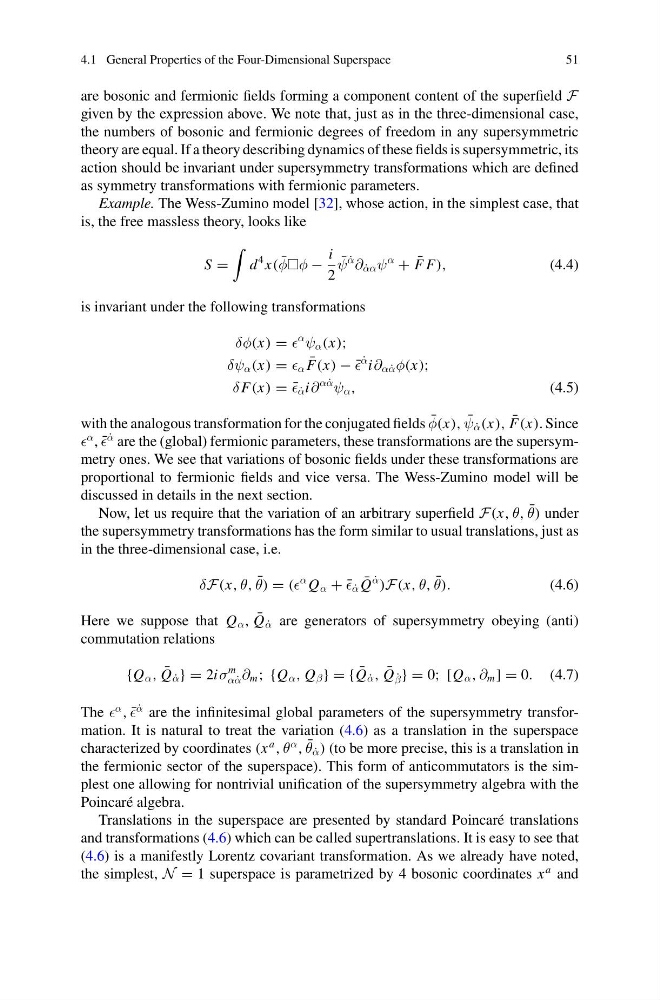
Example. The Wess-Zumino model [32], whose action, in the simplest case, that
is, the free massless theory, looks like
S =
d
4 x( ¯
φφ −
i
2
¯
ψ
˙
α
∂ ˙
αα ψ
α
+ ¯
F F),
(4.4)
is invariant under the following transformations
δφ(x) =
α
ψ α (x);
δψ α (x) = α ¯
F(x) − ¯
˙
α i∂ α ˙
α φ(x);
δ F(x) = ¯
˙
α i∂
α ˙
α
ψ α ,
(4.5)
with the analogous transformation for the conjugated fields ¯
φ(x), ¯
ψ ˙
α (x), ¯
F(x). Since
α , ¯
˙
α are the (global) fermionic parameters, these transformations are the supersymmetry ones. We see that variations of bosonic fields under these transformations are
proportional to fermionic fields and vice versa. The Wess-Zumino model will be
discussed in details in the next section.
Now, let us require that the variation of an arbitrary superfield F(x, θ, ¯
θ) under
the supersymmetry transformations has the form similar to usual translations, just as
in the three-dimensional case, i.e.
δF(x, θ, ¯
θ) = (
α Q α + ¯
˙
α
¯
Q
˙
α
)F(x, θ, ¯
θ).
(4.6)
Here we suppose that Q α , ¯
Q ˙
α are generators of supersymmetry obeying (anti)
commutation relations
{Q α , ¯
Q ˙
α } = 2iσ
m
α ˙
α ∂ m ; {Q α , Q β } = { ¯
Q ˙
α , ¯
Q ˙
β } = 0; [Q α , ∂ m ] = 0. (4.7)
The
α
, ¯
˙
α are the infinitesimal global parameters of the supersymmetry transformation. It is natural to treat the variation (4.6) as a translation in the superspace
characterized by coordinates (x
a
, θ
α
, ¯
θ ˙
α ) (to be more precise, this is a translation in
the fermionic sector of the superspace). This form of anticommutators is the simplest one allowing for nontrivial unification of the supersymmetry algebra with the
Poincaré algebra.
Translations in the superspace are presented by standard Poincaré translations
and transformations (4.6) which can be called supertranslations. It is easy to see that
(4.6) is a manifestly Lorentz covariant transformation. As we already have noted,
the simplest, N = 1 superspace is parametrized by 4 bosonic coordinates x
a and
51
are bosonic and fermionic fields forming a component content of the superfield F
given by the expression above. We note that, just as in the three-dimensional case,
the numbers of bosonic and fermionic degrees of freedom in any supersymmetric
theory are equal. If a theory describing dynamics of these fields is supersymmetric, its
action should be invariant under supersymmetry transformations which are defined
as symmetry transformations with fermionic parameters.
Example. The Wess-Zumino model [32], whose action, in the simplest case, that
is, the free massless theory, looks like
S =
d
4 x( ¯
φφ −
i
2
¯
ψ
˙
α
∂ ˙
αα ψ
α
+ ¯
F F),
(4.4)
is invariant under the following transformations
δφ(x) =
α
ψ α (x);
δψ α (x) = α ¯
F(x) − ¯
˙
α i∂ α ˙
α φ(x);
δ F(x) = ¯
˙
α i∂
α ˙
α
ψ α ,
(4.5)
with the analogous transformation for the conjugated fields ¯
φ(x), ¯
ψ ˙
α (x), ¯
F(x). Since
α , ¯
˙
α are the (global) fermionic parameters, these transformations are the supersymmetry ones. We see that variations of bosonic fields under these transformations are
proportional to fermionic fields and vice versa. The Wess-Zumino model will be
discussed in details in the next section.
Now, let us require that the variation of an arbitrary superfield F(x, θ, ¯
θ) under
the supersymmetry transformations has the form similar to usual translations, just as
in the three-dimensional case, i.e.
δF(x, θ, ¯
θ) = (
α Q α + ¯
˙
α
¯
Q
˙
α
)F(x, θ, ¯
θ).
(4.6)
Here we suppose that Q α , ¯
Q ˙
α are generators of supersymmetry obeying (anti)
commutation relations
{Q α , ¯
Q ˙
α } = 2iσ
m
α ˙
α ∂ m ; {Q α , Q β } = { ¯
Q ˙
α , ¯
Q ˙
β } = 0; [Q α , ∂ m ] = 0. (4.7)
The
α
, ¯
˙
α are the infinitesimal global parameters of the supersymmetry transformation. It is natural to treat the variation (4.6) as a translation in the superspace
characterized by coordinates (x
a
, θ
α
, ¯
θ ˙
α ) (to be more precise, this is a translation in
the fermionic sector of the superspace). This form of anticommutators is the simplest one allowing for nontrivial unification of the supersymmetry algebra with the
Poincaré algebra.
Translations in the superspace are presented by standard Poincaré translations
and transformations (4.6) which can be called supertranslations. It is easy to see that
(4.6) is a manifestly Lorentz covariant transformation. As we already have noted,
the simplest, N = 1 superspace is parametrized by 4 bosonic coordinates x
a and