

3.5 Effective Action of the Three-Dimensional Superfield Theories …
37
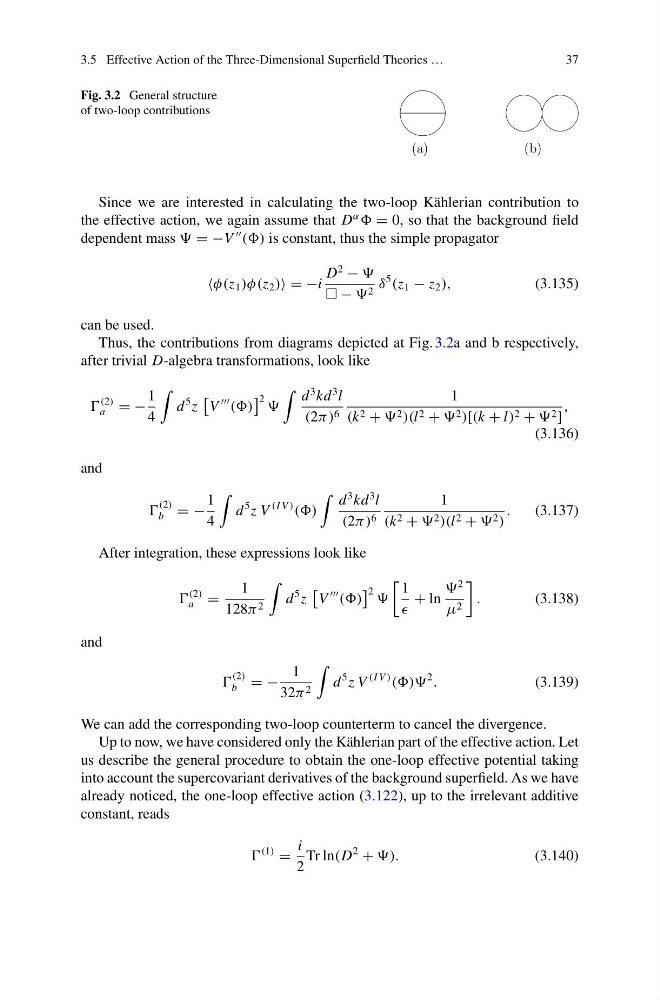
Fig. 3.2 General structure
of two-loop contributions
(a)
(b)
Since we are interested in calculating the two-loop Kählerian contribution to
the effective action, we again assume that D
α
= 0, so that the background field
dependent mass = −V
(() is constant, thus the simple propagator
φ(z 1 )φ(z 2 ) = −i
D
2
−
− 2 δ
5
(z 1 − z 2 ),
(3.135)
can be used.
Thus, the contributions from diagrams depicted at Fig. 3.2a and b respectively,
after trivial D-algebra transformations, look like
(2)
a = −
1
4
d
5 z
V
(()
2
d
3 kd
3 l
(2π) 6
1
(k 2 + 2 )(l 2 + 2 )[(k + l) 2 + 2 ]
,
(3.136)
and
(2)
b = −
1
4
d
5 z V
(I V )
(()
d
3 kd
3 l
(2π) 6
1
(k 2 + 2 )(l 2 + 2 )
.
(3.137)
After integration, these expressions look like
(2)
a =
1
128π 2
d
5 z
V
(()
2
1
+ ln
2
μ 2
.
(3.138)
and
(2)
b = −
1
32π 2
d
5 z V
(I V )
(())
2
.
(3.139)
We can add the corresponding two-loop counterterm to cancel the divergence.
Up to now, we have considered only the Kählerian part of the effective action. Let
us describe the general procedure to obtain the one-loop effective potential taking
into account the supercovariant derivatives of the background superfield. As we have
already noticed, the one-loop effective action (3.122), up to the irrelevant additive
constant, reads
(1)
=
i
2
Tr ln(D
2
+ ).
(3.140)
37
Fig. 3.2 General structure
of two-loop contributions
(a)
(b)
Since we are interested in calculating the two-loop Kählerian contribution to
the effective action, we again assume that D
α
= 0, so that the background field
dependent mass = −V
(() is constant, thus the simple propagator
φ(z 1 )φ(z 2 ) = −i
D
2
−
− 2 δ
5
(z 1 − z 2 ),
(3.135)
can be used.
Thus, the contributions from diagrams depicted at Fig. 3.2a and b respectively,
after trivial D-algebra transformations, look like
(2)
a = −
1
4
d
5 z
V
(()
2
d
3 kd
3 l
(2π) 6
1
(k 2 + 2 )(l 2 + 2 )[(k + l) 2 + 2 ]
,
(3.136)
and
(2)
b = −
1
4
d
5 z V
(I V )
(()
d
3 kd
3 l
(2π) 6
1
(k 2 + 2 )(l 2 + 2 )
.
(3.137)
After integration, these expressions look like
(2)
a =
1
128π 2
d
5 z
V
(()
2
1
+ ln
2
μ 2
.
(3.138)
and
(2)
b = −
1
32π 2
d
5 z V
(I V )
(())
2
.
(3.139)
We can add the corresponding two-loop counterterm to cancel the divergence.
Up to now, we have considered only the Kählerian part of the effective action. Let
us describe the general procedure to obtain the one-loop effective potential taking
into account the supercovariant derivatives of the background superfield. As we have
already noticed, the one-loop effective action (3.122), up to the irrelevant additive
constant, reads
(1)
=
i
2
Tr ln(D
2
+ ).
(3.140)