

3.5 Effective Action of the Three-Dimensional Superfield Theories …
35
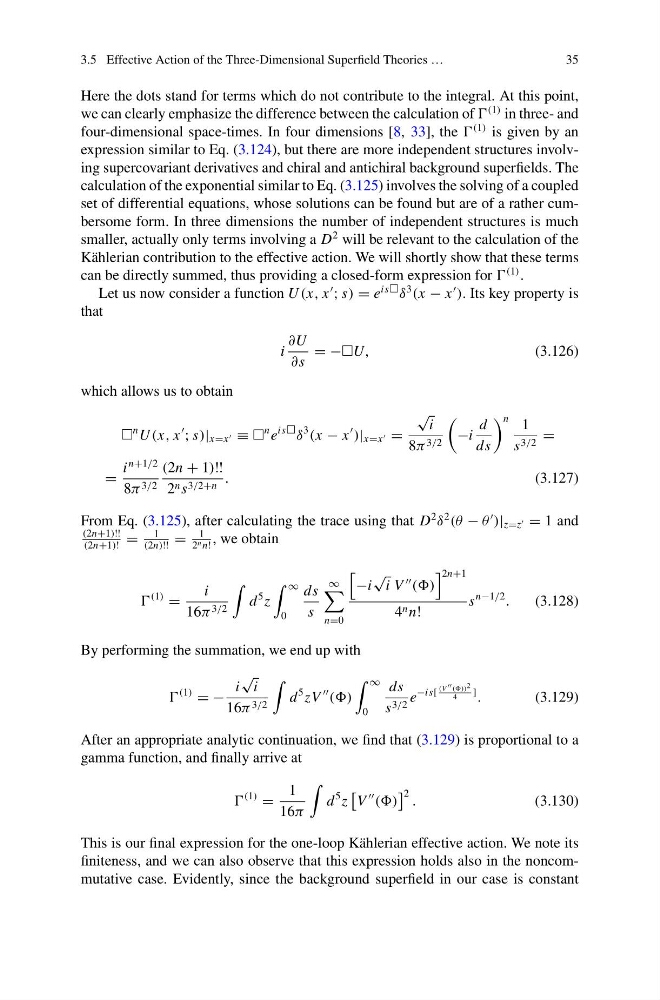
Here the dots stand for terms which do not contribute to the integral. At this point,
we can clearly emphasize the difference between the calculation of
(1) in three- and
four-dimensional space-times. In four dimensions [8, 33], the
(1) is given by an
expression similar to Eq. (3.124), but there are more independent structures involving supercovariant derivatives and chiral and antichiral background superfields. The
calculation of the exponential similar to Eq. (3.125) involves the solving of a coupled
set of differential equations, whose solutions can be found but are of a rather cumbersome form. In three dimensions the number of independent structures is much
smaller, actually only terms involving a D
2 will be relevant to the calculation of the
Kählerian contribution to the effective action. We will shortly show that these terms
can be directly summed, thus providing a closed-form expression for
(1) .
Let us now consider a function U (x, x
; s) = e
is
δ
3
(x − x
). Its key property is
that
i
∂U
∂s
= −U,
(3.126)
which allows us to obtain
n U (x, x
; s)| x=x ≡
n e
is
δ
3
(x − x
)| x=x =
√
i
8π 3/2
−i
d
ds
n 1
s 3/2 =
=
i
n+1/2
8π 3/2
(2n + 1)!!
2 n s 3/2+n .
(3.127)
From Eq. (3.125), after calculating the trace using that D
2
δ
2
(θ − θ
)| z=z = 1 and
(2n+1)!!
(2n+1)!
=
1
(2n)!!
=
1
2 n n!
, we obtain
(1)
=
i
16π 3/2
d
5 z
∞
0
ds
s
∞
n=0
−i
√
i V
(()
2n+1
4 n n!
s
n−1/2
.
(3.128)
By performing the summation, we end up with
(1)
= −
i
√
i
16π 3/2
d
5 zV
(()
∞
0
ds
s 3/2 e
−is[
(V (()) 2
4
]
.
(3.129)
After an appropriate analytic continuation, we find that (3.129) is proportional to a
gamma function, and finally arrive at
(1)
=
1
16π
d
5 z
V
(()
2 .
(3.130)
This is our final expression for the one-loop Kählerian effective action. We note its
finiteness, and we can also observe that this expression holds also in the noncommutative case. Evidently, since the background superfield in our case is constant
35
Here the dots stand for terms which do not contribute to the integral. At this point,
we can clearly emphasize the difference between the calculation of
(1) in three- and
four-dimensional space-times. In four dimensions [8, 33], the
(1) is given by an
expression similar to Eq. (3.124), but there are more independent structures involving supercovariant derivatives and chiral and antichiral background superfields. The
calculation of the exponential similar to Eq. (3.125) involves the solving of a coupled
set of differential equations, whose solutions can be found but are of a rather cumbersome form. In three dimensions the number of independent structures is much
smaller, actually only terms involving a D
2 will be relevant to the calculation of the
Kählerian contribution to the effective action. We will shortly show that these terms
can be directly summed, thus providing a closed-form expression for
(1) .
Let us now consider a function U (x, x
; s) = e
is
δ
3
(x − x
). Its key property is
that
i
∂U
∂s
= −U,
(3.126)
which allows us to obtain
n U (x, x
; s)| x=x ≡
n e
is
δ
3
(x − x
)| x=x =
√
i
8π 3/2
−i
d
ds
n 1
s 3/2 =
=
i
n+1/2
8π 3/2
(2n + 1)!!
2 n s 3/2+n .
(3.127)
From Eq. (3.125), after calculating the trace using that D
2
δ
2
(θ − θ
)| z=z = 1 and
(2n+1)!!
(2n+1)!
=
1
(2n)!!
=
1
2 n n!
, we obtain
(1)
=
i
16π 3/2
d
5 z
∞
0
ds
s
∞
n=0
−i
√
i V
(()
2n+1
4 n n!
s
n−1/2
.
(3.128)
By performing the summation, we end up with
(1)
= −
i
√
i
16π 3/2
d
5 zV
(()
∞
0
ds
s 3/2 e
−is[
(V (()) 2
4
]
.
(3.129)
After an appropriate analytic continuation, we find that (3.129) is proportional to a
gamma function, and finally arrive at
(1)
=
1
16π
d
5 z
V
(()
2 .
(3.130)
This is our final expression for the one-loop Kählerian effective action. We note its
finiteness, and we can also observe that this expression holds also in the noncommutative case. Evidently, since the background superfield in our case is constant