

140
4 Four-Dimensional Superfield Supersymmetry
(1)
=
1
16π 2
d
8 z
W
2 ¯
W
2
(( ¯
) 2 .
(4.365)
Unlike [74], we obtained the results depending both on W α and ¯
W ˙
α .
This study can be easily generalized for the SU (n) gauge group broken to its
maximal Abelian subgroup (so-called Abelian torus) U (1)
n−1 . Indeed, following
[111], we can write the one-loop effective action in this case as
(1)
=
i
2
k
a
D a − (W
α
k − W
α
l )D α − ( ¯
W ˙
αk − ¯
W ˙
αl ) ¯
D
˙
α
− | k − l |
2
).
(4.366)
Here W
α
k − W
α
l etc. are the superfield roots of the su(n) algebra (see the detailed
discussion of the algebra roots for su(n) and a derivation of this expression in [111]).
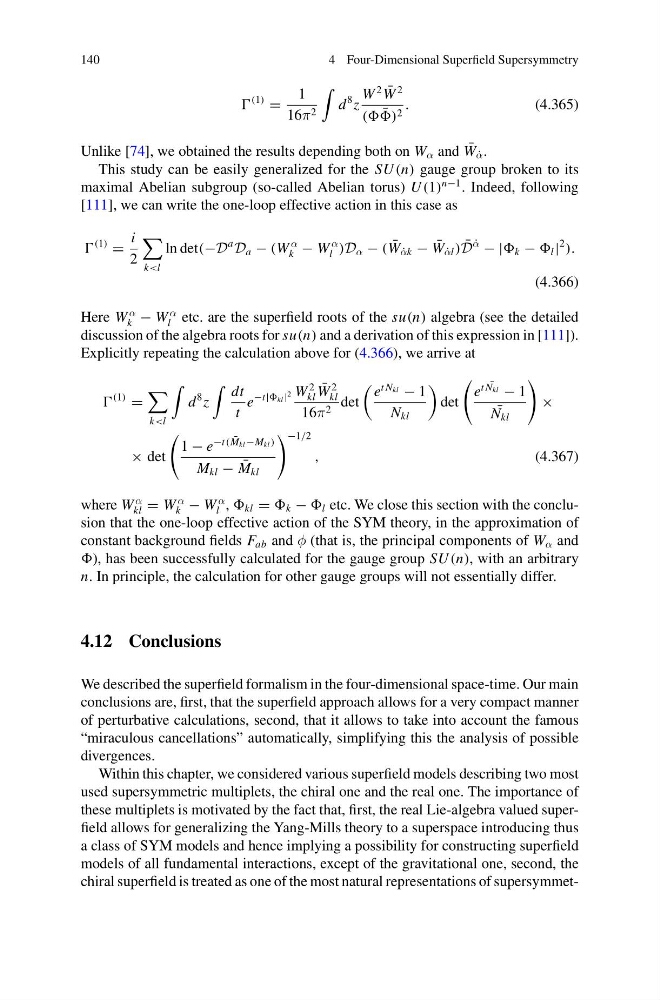
Explicitly repeating the calculation above for (4.366), we arrive at
(1)
=
k
8 z
dt
t
e
−t| kl |
2 W
2
kl
¯
W
2
kl
16π 2 det
e
t N kl − 1
N kl
det
e
t ¯
N kl − 1
¯
N kl
×
× det
1 − e
−t ( ¯
M kl −M kl )
M kl − ¯
M kl
−1/2
,
(4.367)
where W
α
kl = W
α
k − W
α
l , kl = k − l etc. We close this section with the conclusion that the one-loop effective action of the SYM theory, in the approximation of
constant background fields F ab and φ (that is, the principal components of W α and
), has been successfully calculated for the gauge group SU (n), with an arbitrary
n. In principle, the calculation for other gauge groups will not essentially differ.
4.12 Conclusions
We described the superfield formalism in the four-dimensional space-time. Our main
conclusions are, first, that the superfield approach allows for a very compact manner
of perturbative calculations, second, that it allows to take into account the famous
“miraculous cancellations” automatically, simplifying this the analysis of possible
divergences.
Within this chapter, we considered various superfield models describing two most
used supersymmetric multiplets, the chiral one and the real one. The importance of
these multiplets is motivated by the fact that, first, the real Lie-algebra valued superfield allows for generalizing the Yang-Mills theory to a superspace introducing thus
a class of SYM models and hence implying a possibility for constructing superfield
models of all fundamental interactions, except of the gravitational one, second, the
chiral superfield is treated as one of the most natural representations of supersymmet-
4 Four-Dimensional Superfield Supersymmetry
(1)
=
1
16π 2
d
8 z
W
2 ¯
W
2
(( ¯
) 2 .
(4.365)
Unlike [74], we obtained the results depending both on W α and ¯
W ˙
α .
This study can be easily generalized for the SU (n) gauge group broken to its
maximal Abelian subgroup (so-called Abelian torus) U (1)
n−1 . Indeed, following
[111], we can write the one-loop effective action in this case as
(1)
=
i
2
k
a
D a − (W
α
k − W
α
l )D α − ( ¯
W ˙
αk − ¯
W ˙
αl ) ¯
D
˙
α
− | k − l |
2
).
(4.366)
Here W
α
k − W
α
l etc. are the superfield roots of the su(n) algebra (see the detailed
discussion of the algebra roots for su(n) and a derivation of this expression in [111]).
Explicitly repeating the calculation above for (4.366), we arrive at
(1)
=
k
8 z
dt
t
e
−t| kl |
2 W
2
kl
¯
W
2
kl
16π 2 det
e
t N kl − 1
N kl
det
e
t ¯
N kl − 1
¯
N kl
×
× det
1 − e
−t ( ¯
M kl −M kl )
M kl − ¯
M kl
−1/2
,
(4.367)
where W
α
kl = W
α
k − W
α
l , kl = k − l etc. We close this section with the conclusion that the one-loop effective action of the SYM theory, in the approximation of
constant background fields F ab and φ (that is, the principal components of W α and
), has been successfully calculated for the gauge group SU (n), with an arbitrary
n. In principle, the calculation for other gauge groups will not essentially differ.
4.12 Conclusions
We described the superfield formalism in the four-dimensional space-time. Our main
conclusions are, first, that the superfield approach allows for a very compact manner
of perturbative calculations, second, that it allows to take into account the famous
“miraculous cancellations” automatically, simplifying this the analysis of possible
divergences.
Within this chapter, we considered various superfield models describing two most
used supersymmetric multiplets, the chiral one and the real one. The importance of
these multiplets is motivated by the fact that, first, the real Lie-algebra valued superfield allows for generalizing the Yang-Mills theory to a superspace introducing thus
a class of SYM models and hence implying a possibility for constructing superfield
models of all fundamental interactions, except of the gravitational one, second, the
chiral superfield is treated as one of the most natural representations of supersymmet-