

4.11 Supergauge Theories
139
0, { ¯
D ˙
α , ¯
W
˙
α
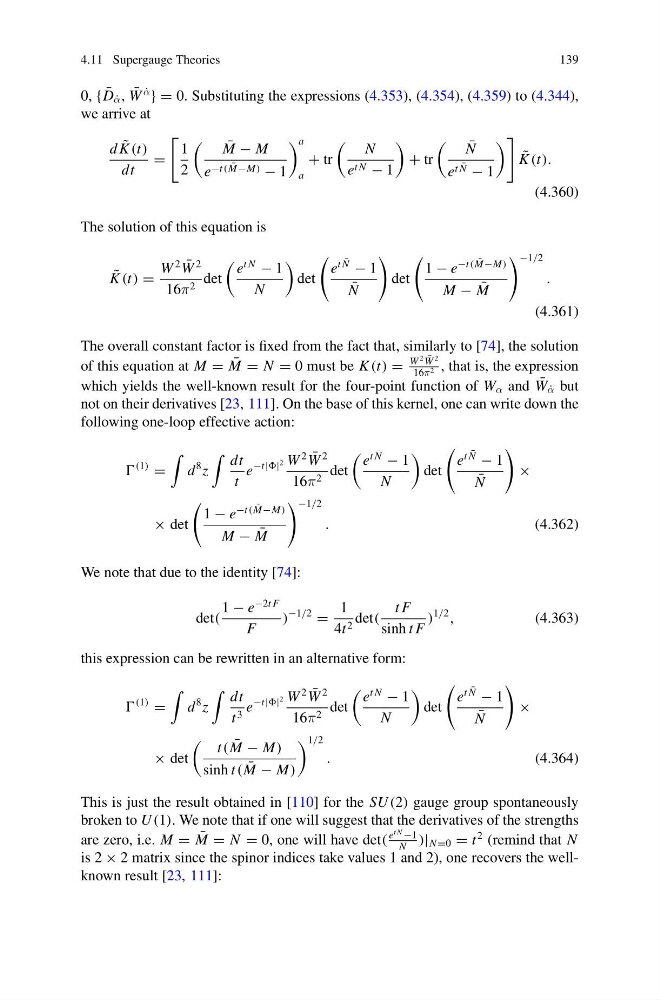
} = 0. Substituting the expressions (4.353), (4.354), (4.359) to (4.344),
we arrive at
d ˜
K (t)
dt
=
1
2
¯
M − M
e −t ( ¯
M−M) − 1
a
a
+ tr
N
e t N − 1
+ tr
¯
N
e t ¯
N − 1
˜
K (t).
(4.360)
The solution of this equation is
˜
K (t) =
W
2 ¯
W
2
16π 2 det
e
t N
− 1
N
det
e
t ¯
N
− 1
¯
N
det
1 − e
−t ( ¯
M−M)
M − ¯
M
−1/2
.
(4.361)
The overall constant factor is fixed from the fact that, similarly to [74], the solution
of this equation at M = ¯
M = N = 0 must be K (t) =
W
2 ¯
W
2
16π 2 , that is, the expression
which yields the well-known result for the four-point function of W α and ¯
W ˙
α but
not on their derivatives [23, 111]. On the base of this kernel, one can write down the
following one-loop effective action:
(1)
=
d
8 z
dt
t
e
−t||
2 W
2 ¯
W
2
16π 2 det
e
t N
− 1
N
det
e
t ¯
N
− 1
¯
N
×
× det
1 − e
−t ( ¯
M−M)
M − ¯
M
−1/2
.
(4.362)
We note that due to the identity [74]:
det(
1 − e
−2t F
F
)
−1/2
=
1
4t 2 det(
t F
sinh t F
)
1/2
,
(4.363)
this expression can be rewritten in an alternative form:
(1)
=
d
8 z
dt
t 3 e
−t||
2 W
2 ¯
W
2
16π 2 det
e
t N
− 1
N
det
e
t ¯
N
− 1
¯
N
×
× det
t ( ¯
M − M)
sinh t ( ¯
M − M)
1/2
.
(4.364)
This is just the result obtained in [110] for the SU (2) gauge group spontaneously
broken to U (1). We note that if one will suggest that the derivatives of the strengths
are zero, i.e. M = ¯
M = N = 0, one will have det(
e
t N −1
N
)| N =0 = t
2 (remind that N
is 2 × 2 matrix since the spinor indices take values 1 and 2), one recovers the wellknown result [23, 111]:
139
0, { ¯
D ˙
α , ¯
W
˙
α
} = 0. Substituting the expressions (4.353), (4.354), (4.359) to (4.344),
we arrive at
d ˜
K (t)
dt
=
1
2
¯
M − M
e −t ( ¯
M−M) − 1
a
a
+ tr
N
e t N − 1
+ tr
¯
N
e t ¯
N − 1
˜
K (t).
(4.360)
The solution of this equation is
˜
K (t) =
W
2 ¯
W
2
16π 2 det
e
t N
− 1
N
det
e
t ¯
N
− 1
¯
N
det
1 − e
−t ( ¯
M−M)
M − ¯
M
−1/2
.
(4.361)
The overall constant factor is fixed from the fact that, similarly to [74], the solution
of this equation at M = ¯
M = N = 0 must be K (t) =
W
2 ¯
W
2
16π 2 , that is, the expression
which yields the well-known result for the four-point function of W α and ¯
W ˙
α but
not on their derivatives [23, 111]. On the base of this kernel, one can write down the
following one-loop effective action:
(1)
=
d
8 z
dt
t
e
−t||
2 W
2 ¯
W
2
16π 2 det
e
t N
− 1
N
det
e
t ¯
N
− 1
¯
N
×
× det
1 − e
−t ( ¯
M−M)
M − ¯
M
−1/2
.
(4.362)
We note that due to the identity [74]:
det(
1 − e
−2t F
F
)
−1/2
=
1
4t 2 det(
t F
sinh t F
)
1/2
,
(4.363)
this expression can be rewritten in an alternative form:
(1)
=
d
8 z
dt
t 3 e
−t||
2 W
2 ¯
W
2
16π 2 det
e
t N
− 1
N
det
e
t ¯
N
− 1
¯
N
×
× det
t ( ¯
M − M)
sinh t ( ¯
M − M)
1/2
.
(4.364)
This is just the result obtained in [110] for the SU (2) gauge group spontaneously
broken to U (1). We note that if one will suggest that the derivatives of the strengths
are zero, i.e. M = ¯
M = N = 0, one will have det(
e
t N −1
N
)| N =0 = t
2 (remind that N
is 2 × 2 matrix since the spinor indices take values 1 and 2), one recovers the wellknown result [23, 111]: