

4.11 Supergauge Theories
137
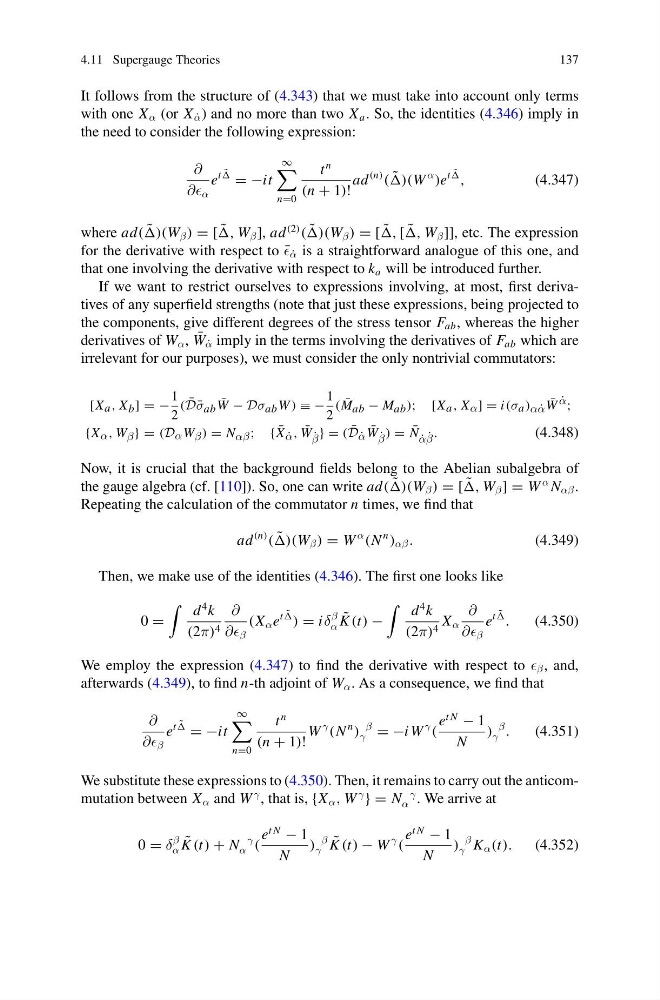
It follows from the structure of (4.343) that we must take into account only terms
with one X α (or X ˙
α ) and no more than two X a . So, the identities (4.346) imply in
the need to consider the following expression:
∂
∂∂ α
e
t ˜
= −it
∞
n=0
t
n
(n + 1)!
ad
(n)
( ˜
)(W
α
)e
t ˜
,
(4.347)
where ad( ˜
)(W β ) = [ ˜
, W β ], ad
(2)
( ˜
)(W β ) = [ ˜
, [ ˜
, W β ]], etc. The expression
for the derivative with respect to ¯
˙
α is a straightforward analogue of this one, and
that one involving the derivative with respect to k a will be introduced further.
If we want to restrict ourselves to expressions involving, at most, first derivatives of any superfield strengths (note that just these expressions, being projected to
the components, give different degrees of the stress tensor F ab , whereas the higher
derivatives of W α , ¯
W ˙
α imply in the terms involving the derivatives of F ab which are
irrelevant for our purposes), we must consider the only nontrivial commutators:
[X a , X b ] = −
1
2
( ¯
D ¯
σ ab ¯
W − Dσ ab W ) ≡ −
1
2
( ¯
M ab − M ab ); [X a , X α ] = i(σ a ) α ˙
α ¯
W ˙
α ;
{X α , W β } = (D α W β ) = N αβ ; { ¯
X ˙
α , ¯
W ˙
β } = ( ¯
D ˙
α ¯
W ˙
β ) = ¯
N ˙
α ˙
β .
(4.348)
Now, it is crucial that the background fields belong to the Abelian subalgebra of
the gauge algebra (cf. [110]). So, one can write ad( ˜
)(W β ) = [ ˜
, W β ] = W
α N αβ .
Repeating the calculation of the commutator n times, we find that
ad
(n)
( ˜
)(W β ) = W
α
(N
n
) αβ .
(4.349)
Then, we make use of the identities (4.346). The first one looks like
0 =
d
4 k
(2π) 4
∂
∂∂ β
(X α e
t ˜
) = iδ
β
α
˜
K (t) −
d
4 k
(2π) 4 X α
∂
∂∂ β
e
t ˜
.
(4.350)
We employ the expression (4.347) to find the derivative with respect to β , and,
afterwards (4.349), to find n-th adjoint of W α . As a consequence, we find that
∂
∂∂ β
e
t ˜
= −it
∞
n=0
t
n
(n + 1)!
W
γ
(N
n
)
β
γ = −i W
γ
(
e
t N
− 1
N
)
β
γ .
(4.351)
We substitute these expressions to (4.350). Then, it remains to carry out the anticommutation between X α and W
γ , that is, {X α , W
γ
} = N
γ
α . We arrive at
0 = δ
β
α
˜
K (t) + N
γ
α (
e
t N
− 1
N
)
β
γ
˜
K (t) − W
γ
(
e
t N
− 1
N
)
β
γ K α (t).
(4.352)
137
It follows from the structure of (4.343) that we must take into account only terms
with one X α (or X ˙
α ) and no more than two X a . So, the identities (4.346) imply in
the need to consider the following expression:
∂
∂∂ α
e
t ˜
= −it
∞
n=0
t
n
(n + 1)!
ad
(n)
( ˜
)(W
α
)e
t ˜
,
(4.347)
where ad( ˜
)(W β ) = [ ˜
, W β ], ad
(2)
( ˜
)(W β ) = [ ˜
, [ ˜
, W β ]], etc. The expression
for the derivative with respect to ¯
˙
α is a straightforward analogue of this one, and
that one involving the derivative with respect to k a will be introduced further.
If we want to restrict ourselves to expressions involving, at most, first derivatives of any superfield strengths (note that just these expressions, being projected to
the components, give different degrees of the stress tensor F ab , whereas the higher
derivatives of W α , ¯
W ˙
α imply in the terms involving the derivatives of F ab which are
irrelevant for our purposes), we must consider the only nontrivial commutators:
[X a , X b ] = −
1
2
( ¯
D ¯
σ ab ¯
W − Dσ ab W ) ≡ −
1
2
( ¯
M ab − M ab ); [X a , X α ] = i(σ a ) α ˙
α ¯
W ˙
α ;
{X α , W β } = (D α W β ) = N αβ ; { ¯
X ˙
α , ¯
W ˙
β } = ( ¯
D ˙
α ¯
W ˙
β ) = ¯
N ˙
α ˙
β .
(4.348)
Now, it is crucial that the background fields belong to the Abelian subalgebra of
the gauge algebra (cf. [110]). So, one can write ad( ˜
)(W β ) = [ ˜
, W β ] = W
α N αβ .
Repeating the calculation of the commutator n times, we find that
ad
(n)
( ˜
)(W β ) = W
α
(N
n
) αβ .
(4.349)
Then, we make use of the identities (4.346). The first one looks like
0 =
d
4 k
(2π) 4
∂
∂∂ β
(X α e
t ˜
) = iδ
β
α
˜
K (t) −
d
4 k
(2π) 4 X α
∂
∂∂ β
e
t ˜
.
(4.350)
We employ the expression (4.347) to find the derivative with respect to β , and,
afterwards (4.349), to find n-th adjoint of W α . As a consequence, we find that
∂
∂∂ β
e
t ˜
= −it
∞
n=0
t
n
(n + 1)!
W
γ
(N
n
)
β
γ = −i W
γ
(
e
t N
− 1
N
)
β
γ .
(4.351)
We substitute these expressions to (4.350). Then, it remains to carry out the anticommutation between X α and W
γ , that is, {X α , W
γ
} = N
γ
α . We arrive at
0 = δ
β
α
˜
K (t) + N
γ
α (
e
t N
− 1
N
)
β
γ
˜
K (t) − W
γ
(
e
t N
− 1
N
)
β
γ K α (t).
(4.352)