

136
4 Four-Dimensional Superfield Supersymmetry
X m = D m + ik m , X α = D α + i α , ¯
X ˙
α = ¯
D ˙
α + i ˙
α .
(4.341)
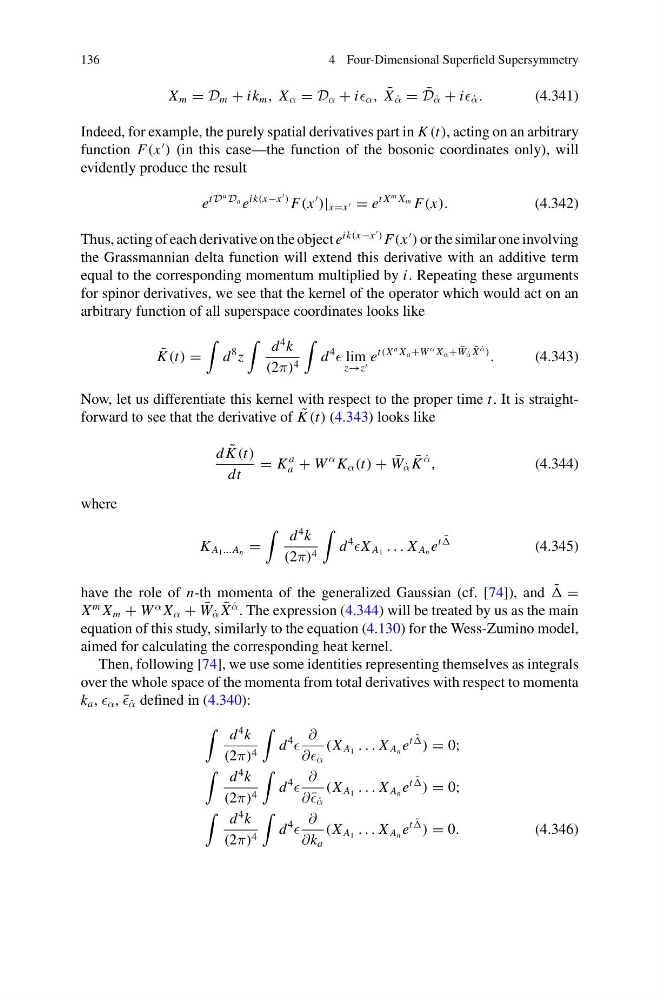
Indeed, for example, the purely spatial derivatives part in K (t), acting on an arbitrary
function F(x
) (in this case—the function of the bosonic coordinates only), will
evidently produce the result
e
tD
a D a e
ik(x−x
) F(x
)| x=x = e
t X
m X m F(x).
(4.342)
Thus, acting of each derivative on the object e
ik(x−x
) F(x
) or the similar one involving
the Grassmannian delta function will extend this derivative with an additive term
equal to the corresponding momentum multiplied by i. Repeating these arguments
for spinor derivatives, we see that the kernel of the operator which would act on an
arbitrary function of all superspace coordinates looks like
˜
K (t) =
d
8 z
d
4 k
(2π) 4
d
4
lim
z→z
e
t (X
a X a +W
α X α + ¯
W ˙
α
¯
X
˙
α )
.
(4.343)
Now, let us differentiate this kernel with respect to the proper time t. It is straightforward to see that the derivative of ˜
K (t) (4.343) looks like
d ˜
K (t)
dt
= K
a
a + W
α K α (t) + ¯
W ˙
α
¯
K
˙
α
,
(4.344)
where
K A 1 ... A n =
d
4 k
(2π) 4
d
4
X A 1 . . . X A n e
t ˜
(4.345)
have the role of n-th momenta of the generalized Gaussian (cf. [74]), and ˜
=
X
m X m + W
α X α + ¯
W ˙
α
¯
X
˙
α . The expression (4.344) will be treated by us as the main
equation of this study, similarly to the equation (4.130) for the Wess-Zumino model,
aimed for calculating the corresponding heat kernel.
Then, following [74], we use some identities representing themselves as integrals
over the whole space of the momenta from total derivatives with respect to momenta
k a , α , ¯
˙
α defined in (4.340):
d
4 k
(2π) 4
d
4
∂
∂∂ α
(X A 1 . . . X A n e
t ˜
) = 0;
d
4 k
(2π) 4
d
4
∂
∂ ¯
˙
α
(X A 1 . . . X A n e
t ˜
) = 0;
d
4 k
(2π) 4
d
4
∂
∂k a
(X A 1 . . . X A n e
t ˜
) = 0.
(4.346)
4 Four-Dimensional Superfield Supersymmetry
X m = D m + ik m , X α = D α + i α , ¯
X ˙
α = ¯
D ˙
α + i ˙
α .
(4.341)
Indeed, for example, the purely spatial derivatives part in K (t), acting on an arbitrary
function F(x
) (in this case—the function of the bosonic coordinates only), will
evidently produce the result
e
tD
a D a e
ik(x−x
) F(x
)| x=x = e
t X
m X m F(x).
(4.342)
Thus, acting of each derivative on the object e
ik(x−x
) F(x
) or the similar one involving
the Grassmannian delta function will extend this derivative with an additive term
equal to the corresponding momentum multiplied by i. Repeating these arguments
for spinor derivatives, we see that the kernel of the operator which would act on an
arbitrary function of all superspace coordinates looks like
˜
K (t) =
d
8 z
d
4 k
(2π) 4
d
4
lim
z→z
e
t (X
a X a +W
α X α + ¯
W ˙
α
¯
X
˙
α )
.
(4.343)
Now, let us differentiate this kernel with respect to the proper time t. It is straightforward to see that the derivative of ˜
K (t) (4.343) looks like
d ˜
K (t)
dt
= K
a
a + W
α K α (t) + ¯
W ˙
α
¯
K
˙
α
,
(4.344)
where
K A 1 ... A n =
d
4 k
(2π) 4
d
4
X A 1 . . . X A n e
t ˜
(4.345)
have the role of n-th momenta of the generalized Gaussian (cf. [74]), and ˜
=
X
m X m + W
α X α + ¯
W ˙
α
¯
X
˙
α . The expression (4.344) will be treated by us as the main
equation of this study, similarly to the equation (4.130) for the Wess-Zumino model,
aimed for calculating the corresponding heat kernel.
Then, following [74], we use some identities representing themselves as integrals
over the whole space of the momenta from total derivatives with respect to momenta
k a , α , ¯
˙
α defined in (4.340):
d
4 k
(2π) 4
d
4
∂
∂∂ α
(X A 1 . . . X A n e
t ˜
) = 0;
d
4 k
(2π) 4
d
4
∂
∂ ¯
˙
α
(X A 1 . . . X A n e
t ˜
) = 0;
d
4 k
(2π) 4
d
4
∂
∂k a
(X A 1 . . . X A n e
t ˜
) = 0.
(4.346)