

128
4 Four-Dimensional Superfield Supersymmetry
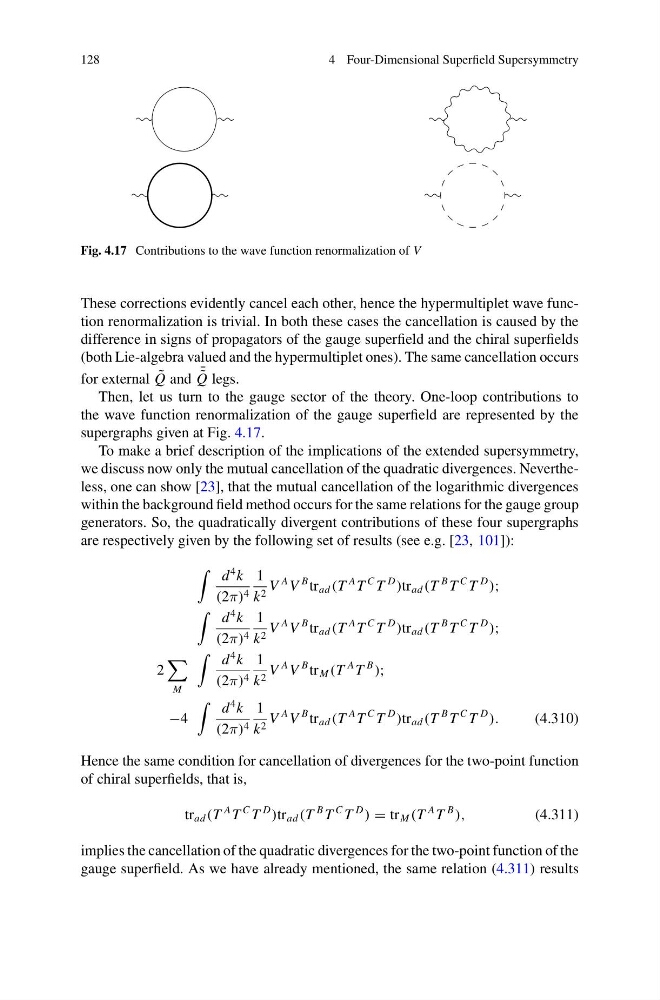
Fig. 4.17 Contributions to the wave function renormalization of V
These corrections evidently cancel each other, hence the hypermultiplet wave function renormalization is trivial. In both these cases the cancellation is caused by the
difference in signs of propagators of the gauge superfield and the chiral superfields
(both Lie-algebra valued and the hypermultiplet ones). The same cancellation occurs
for external ˜
Q and ¯ ˜
Q legs.
Then, let us turn to the gauge sector of the theory. One-loop contributions to
the wave function renormalization of the gauge superfield are represented by the
supergraphs given at Fig. 4.17.
To make a brief description of the implications of the extended supersymmetry,
we discuss now only the mutual cancellation of the quadratic divergences. Nevertheless, one can show [23], that the mutual cancellation of the logarithmic divergences
within the background field method occurs for the same relations for the gauge group
generators. So, the quadratically divergent contributions of these four supergraphs
are respectively given by the following set of results (see e.g. [23, 101]):
d
4 k
(2π) 4
1
k 2 V
A V
B tr ad (T
A T
C T
D
)tr ad (T
B T
C T
D
);
d
4 k
(2π) 4
1
k 2 V
A V
B tr ad (T
A T
C T
D
)tr ad (T
B T
C T
D
);
2
M
d
4 k
(2π) 4
1
k 2 V
A V
B tr M (T
A T
B
);
−4
d
4 k
(2π) 4
1
k 2 V
A V
B tr ad (T
A T
C T
D
)tr ad (T
B T
C T
D
).
(4.310)
Hence the same condition for cancellation of divergences for the two-point function
of chiral superfields, that is,
tr ad (T
A T
C T
D
)tr ad (T
B T
C T
D
) = tr M (T
A T
B
),
(4.311)
implies the cancellation of the quadratic divergences for the two-point function of the
gauge superfield. As we have already mentioned, the same relation (4.311) results
4 Four-Dimensional Superfield Supersymmetry
Fig. 4.17 Contributions to the wave function renormalization of V
These corrections evidently cancel each other, hence the hypermultiplet wave function renormalization is trivial. In both these cases the cancellation is caused by the
difference in signs of propagators of the gauge superfield and the chiral superfields
(both Lie-algebra valued and the hypermultiplet ones). The same cancellation occurs
for external ˜
Q and ¯ ˜
Q legs.
Then, let us turn to the gauge sector of the theory. One-loop contributions to
the wave function renormalization of the gauge superfield are represented by the
supergraphs given at Fig. 4.17.
To make a brief description of the implications of the extended supersymmetry,
we discuss now only the mutual cancellation of the quadratic divergences. Nevertheless, one can show [23], that the mutual cancellation of the logarithmic divergences
within the background field method occurs for the same relations for the gauge group
generators. So, the quadratically divergent contributions of these four supergraphs
are respectively given by the following set of results (see e.g. [23, 101]):
d
4 k
(2π) 4
1
k 2 V
A V
B tr ad (T
A T
C T
D
)tr ad (T
B T
C T
D
);
d
4 k
(2π) 4
1
k 2 V
A V
B tr ad (T
A T
C T
D
)tr ad (T
B T
C T
D
);
2
M
d
4 k
(2π) 4
1
k 2 V
A V
B tr M (T
A T
B
);
−4
d
4 k
(2π) 4
1
k 2 V
A V
B tr ad (T
A T
C T
D
)tr ad (T
B T
C T
D
).
(4.310)
Hence the same condition for cancellation of divergences for the two-point function
of chiral superfields, that is,
tr ad (T
A T
C T
D
)tr ad (T
B T
C T
D
) = tr M (T
A T
B
),
(4.311)
implies the cancellation of the quadratic divergences for the two-point function of the
gauge superfield. As we have already mentioned, the same relation (4.311) results