

4.11 Supergauge Theories
127
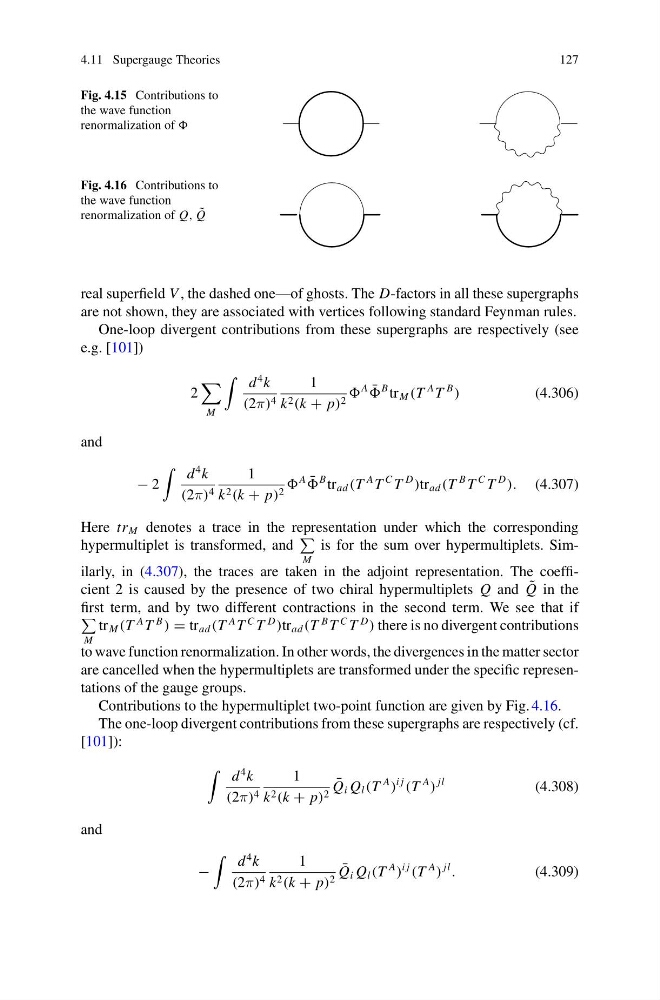
Fig. 4.15 Contributions to
the wave function
renormalization of
Fig. 4.16 Contributions to
the wave function
renormalization of Q, ˜
Q
real superfield V , the dashed one—of ghosts. The D-factors in all these supergraphs
are not shown, they are associated with vertices following standard Feynman rules.
One-loop divergent contributions from these supergraphs are respectively (see
e.g. [101])
2
M
d
4 k
(2π) 4
1
k 2 (k + p) 2
A ¯
B tr M (T
A T
B
)
(4.306)
and
− 2
d
4 k
(2π) 4
1
k 2 (k + p) 2
A ¯
B tr ad (T
A T
C T
D
)tr ad (T
B T
C T
D
). (4.307)
Here tr M denotes a trace in the representation under which the corresponding
hypermultiplet is transformed, and
M
is for the sum over hypermultiplets. Similarly, in (4.307), the traces are taken in the adjoint representation. The coefficient 2 is caused by the presence of two chiral hypermultiplets Q and ˜
Q in the
first term, and by two different contractions in the second term. We see that if
M
tr M (T
A T
B
) = tr ad (T
A T
C T
D
)tr ad (T
B T
C T
D
) there is no divergent contributions
to wave function renormalization. In other words, the divergences in the matter sector
are cancelled when the hypermultiplets are transformed under the specific representations of the gauge groups.
Contributions to the hypermultiplet two-point function are given by Fig. 4.16.
The one-loop divergent contributions from these supergraphs are respectively (cf.
[101]):
d
4 k
(2π) 4
1
k 2 (k + p) 2
¯
Q i Q l (T
A
)
i j
(T
A
)
jl
(4.308)
and
−
d
4 k
(2π) 4
1
k 2 (k + p) 2
¯
Q i Q l (T
A
)
i j
(T
A
)
jl
.
(4.309)
127
Fig. 4.15 Contributions to
the wave function
renormalization of
Fig. 4.16 Contributions to
the wave function
renormalization of Q, ˜
Q
real superfield V , the dashed one—of ghosts. The D-factors in all these supergraphs
are not shown, they are associated with vertices following standard Feynman rules.
One-loop divergent contributions from these supergraphs are respectively (see
e.g. [101])
2
M
d
4 k
(2π) 4
1
k 2 (k + p) 2
A ¯
B tr M (T
A T
B
)
(4.306)
and
− 2
d
4 k
(2π) 4
1
k 2 (k + p) 2
A ¯
B tr ad (T
A T
C T
D
)tr ad (T
B T
C T
D
). (4.307)
Here tr M denotes a trace in the representation under which the corresponding
hypermultiplet is transformed, and
M
is for the sum over hypermultiplets. Similarly, in (4.307), the traces are taken in the adjoint representation. The coefficient 2 is caused by the presence of two chiral hypermultiplets Q and ˜
Q in the
first term, and by two different contractions in the second term. We see that if
M
tr M (T
A T
B
) = tr ad (T
A T
C T
D
)tr ad (T
B T
C T
D
) there is no divergent contributions
to wave function renormalization. In other words, the divergences in the matter sector
are cancelled when the hypermultiplets are transformed under the specific representations of the gauge groups.
Contributions to the hypermultiplet two-point function are given by Fig. 4.16.
The one-loop divergent contributions from these supergraphs are respectively (cf.
[101]):
d
4 k
(2π) 4
1
k 2 (k + p) 2
¯
Q i Q l (T
A
)
i j
(T
A
)
jl
(4.308)
and
−
d
4 k
(2π) 4
1
k 2 (k + p) 2
¯
Q i Q l (T
A
)
i j
(T
A
)
jl
.
(4.309)