

4.11 Supergauge Theories
123
δ
χ(V )
¯
χ(V )
=
0 −
1
4
¯
D
2
−
1
4
D
2
0
δV
δV
.
(4.281)
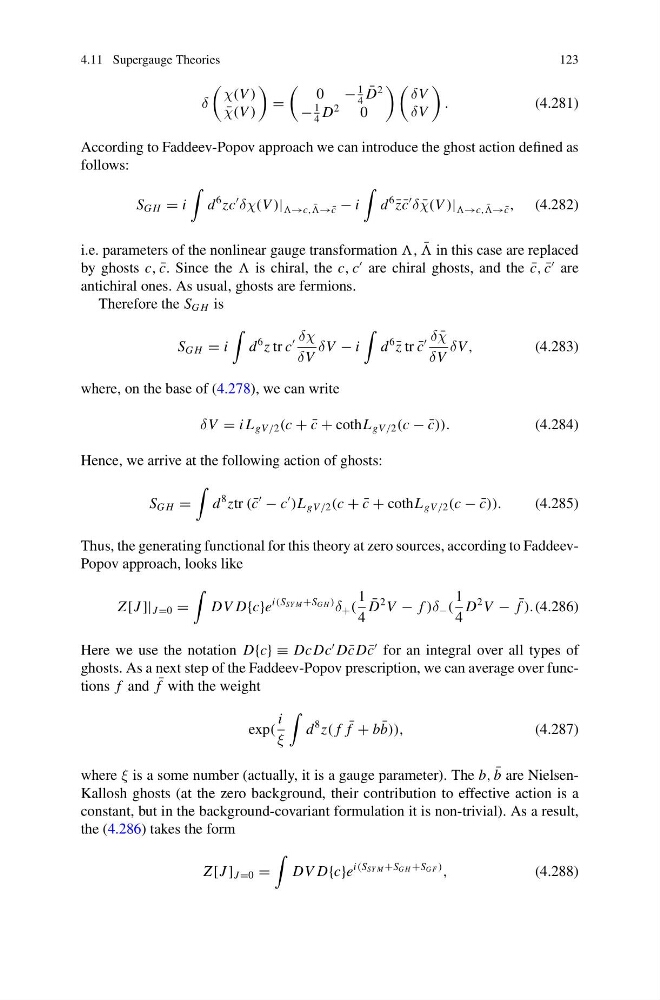
According to Faddeev-Popov approach we can introduce the ghost action defined as
follows:
S G H = i
d
6 zc
δχ(V )| →c, ¯
→¯ c − i
d
6
¯
z ¯
c
δ ¯
χ(V )| →c, ¯
→¯ c , (4.282)
i.e. parameters of the nonlinear gauge transformation , ¯
in this case are replaced
by ghosts c, ¯
c. Since the is chiral, the c, c
are chiral ghosts, and the ¯
c, ¯
c
are
antichiral ones. As usual, ghosts are fermions.
Therefore the S G H is
S G H = i
d
6 z tr c
δχ
δV
δV − i
d
6
¯
z tr ¯
c
δ ¯
χ
δV
δV,
(4.283)
where, on the base of (4.278), we can write
δV = i L gV /2 (c + ¯
c + cothL gV /2 (c − ¯
c)).
(4.284)
Hence, we arrive at the following action of ghosts:
S G H =
d
8 ztr ( ¯
c
− c
)L gV /2 (c + ¯
c + cothL gV /2 (c − ¯
c)).
(4.285)
Thus, the generating functional for this theory at zero sources, according to FaddeevPopov approach, looks like
Z [J ]| J =0 =
DV D{c}e
i(S SY M +S G H )
δ + (
1
4
¯
D
2 V − f )δ − (
1
4
D
2 V − ¯
f ).(4.286)
Here we use the notation D{c} ≡ DcDc
D ¯
cD ¯
c
for an integral over all types of
ghosts. As a next step of the Faddeev-Popov prescription, we can average over functions f and ¯
f with the weight
exp(
i
ξ
d
8 z( f ¯
f + b ¯
b)),
(4.287)
where ξ is a some number (actually, it is a gauge parameter). The b, ¯
b are NielsenKallosh ghosts (at the zero background, their contribution to effective action is a
constant, but in the background-covariant formulation it is non-trivial). As a result,
the (4.286) takes the form
Z [J ] J =0 =
DV D{c}e
i(S SY M +S G H +S G F )
,
(4.288)
123
δ
χ(V )
¯
χ(V )
=
0 −
1
4
¯
D
2
−
1
4
D
2
0
δV
δV
.
(4.281)
According to Faddeev-Popov approach we can introduce the ghost action defined as
follows:
S G H = i
d
6 zc
δχ(V )| →c, ¯
→¯ c − i
d
6
¯
z ¯
c
δ ¯
χ(V )| →c, ¯
→¯ c , (4.282)
i.e. parameters of the nonlinear gauge transformation , ¯
in this case are replaced
by ghosts c, ¯
c. Since the is chiral, the c, c
are chiral ghosts, and the ¯
c, ¯
c
are
antichiral ones. As usual, ghosts are fermions.
Therefore the S G H is
S G H = i
d
6 z tr c
δχ
δV
δV − i
d
6
¯
z tr ¯
c
δ ¯
χ
δV
δV,
(4.283)
where, on the base of (4.278), we can write
δV = i L gV /2 (c + ¯
c + cothL gV /2 (c − ¯
c)).
(4.284)
Hence, we arrive at the following action of ghosts:
S G H =
d
8 ztr ( ¯
c
− c
)L gV /2 (c + ¯
c + cothL gV /2 (c − ¯
c)).
(4.285)
Thus, the generating functional for this theory at zero sources, according to FaddeevPopov approach, looks like
Z [J ]| J =0 =
DV D{c}e
i(S SY M +S G H )
δ + (
1
4
¯
D
2 V − f )δ − (
1
4
D
2 V − ¯
f ).(4.286)
Here we use the notation D{c} ≡ DcDc
D ¯
cD ¯
c
for an integral over all types of
ghosts. As a next step of the Faddeev-Popov prescription, we can average over functions f and ¯
f with the weight
exp(
i
ξ
d
8 z( f ¯
f + b ¯
b)),
(4.287)
where ξ is a some number (actually, it is a gauge parameter). The b, ¯
b are NielsenKallosh ghosts (at the zero background, their contribution to effective action is a
constant, but in the background-covariant formulation it is non-trivial). As a result,
the (4.286) takes the form
Z [J ] J =0 =
DV D{c}e
i(S SY M +S G H +S G F )
,
(4.288)