

122
4 Four-Dimensional Superfield Supersymmetry
4.11.1 General Description of Supergauge Theories
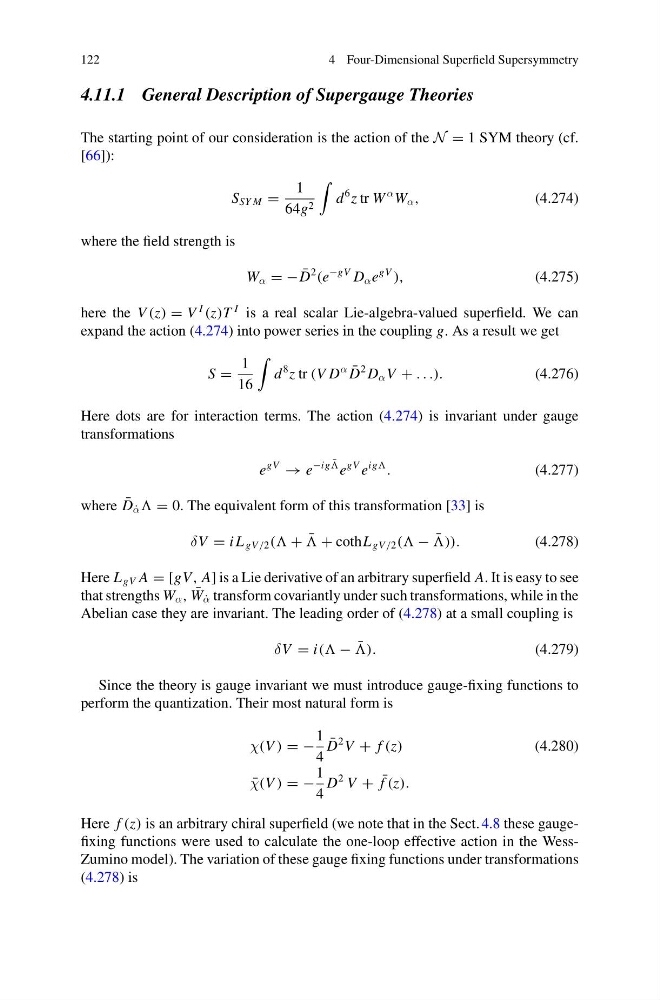
The starting point of our consideration is the action of the N = 1 SYM theory (cf.
[66]):
S SY M =
1
64g 2
d
6 z tr W
α W α ,
(4.274)
where the field strength is
W α = − ¯
D
2
(e
−gV D α e
gV
),
(4.275)
here the V (z) = V
I
(z)T
I is a real scalar Lie-algebra-valued superfield. We can
expand the action (4.274) into power series in the coupling g. As a result we get
S =
1
16
d
8 z tr (V D
α ¯
D
2 D α V + . . .).
(4.276)
Here dots are for interaction terms. The action (4.274) is invariant under gauge
transformations
e
gV
→ e
−ig ¯
e
gV e
ig
.
(4.277)
where ¯
D ˙
α = 0. The equivalent form of this transformation [33] is
δV = i L gV /2 (( + ¯
+ cothL gV /2 (( − ¯
)).
(4.278)
Here L gV A = [gV, A] is a Lie derivative of an arbitrary superfield A. It is easy to see
that strengths W α , ¯
W ˙
α transform covariantly under such transformations, while in the
Abelian case they are invariant. The leading order of (4.278) at a small coupling is
δV = i(( − ¯
).
(4.279)
Since the theory is gauge invariant we must introduce gauge-fixing functions to
perform the quantization. Their most natural form is
χ(V ) = −
1
4
¯
D
2 V + f (z)
(4.280)
¯
χ(V ) = −
1
4
D
2 V + ¯
f (z).
Here f (z) is an arbitrary chiral superfield (we note that in the Sect. 4.8 these gaugefixing functions were used to calculate the one-loop effective action in the WessZumino model). The variation of these gauge fixing functions under transformations
(4.278) is
4 Four-Dimensional Superfield Supersymmetry
4.11.1 General Description of Supergauge Theories
The starting point of our consideration is the action of the N = 1 SYM theory (cf.
[66]):
S SY M =
1
64g 2
d
6 z tr W
α W α ,
(4.274)
where the field strength is
W α = − ¯
D
2
(e
−gV D α e
gV
),
(4.275)
here the V (z) = V
I
(z)T
I is a real scalar Lie-algebra-valued superfield. We can
expand the action (4.274) into power series in the coupling g. As a result we get
S =
1
16
d
8 z tr (V D
α ¯
D
2 D α V + . . .).
(4.276)
Here dots are for interaction terms. The action (4.274) is invariant under gauge
transformations
e
gV
→ e
−ig ¯
e
gV e
ig
.
(4.277)
where ¯
D ˙
α = 0. The equivalent form of this transformation [33] is
δV = i L gV /2 (( + ¯
+ cothL gV /2 (( − ¯
)).
(4.278)
Here L gV A = [gV, A] is a Lie derivative of an arbitrary superfield A. It is easy to see
that strengths W α , ¯
W ˙
α transform covariantly under such transformations, while in the
Abelian case they are invariant. The leading order of (4.278) at a small coupling is
δV = i(( − ¯
).
(4.279)
Since the theory is gauge invariant we must introduce gauge-fixing functions to
perform the quantization. Their most natural form is
χ(V ) = −
1
4
¯
D
2 V + f (z)
(4.280)
¯
χ(V ) = −
1
4
D
2 V + ¯
f (z).
Here f (z) is an arbitrary chiral superfield (we note that in the Sect. 4.8 these gaugefixing functions were used to calculate the one-loop effective action in the WessZumino model). The variation of these gauge fixing functions under transformations
(4.278) is