

4.8 The Wess-Zumino Model and a Problem of the Chiral Effective Potential
99
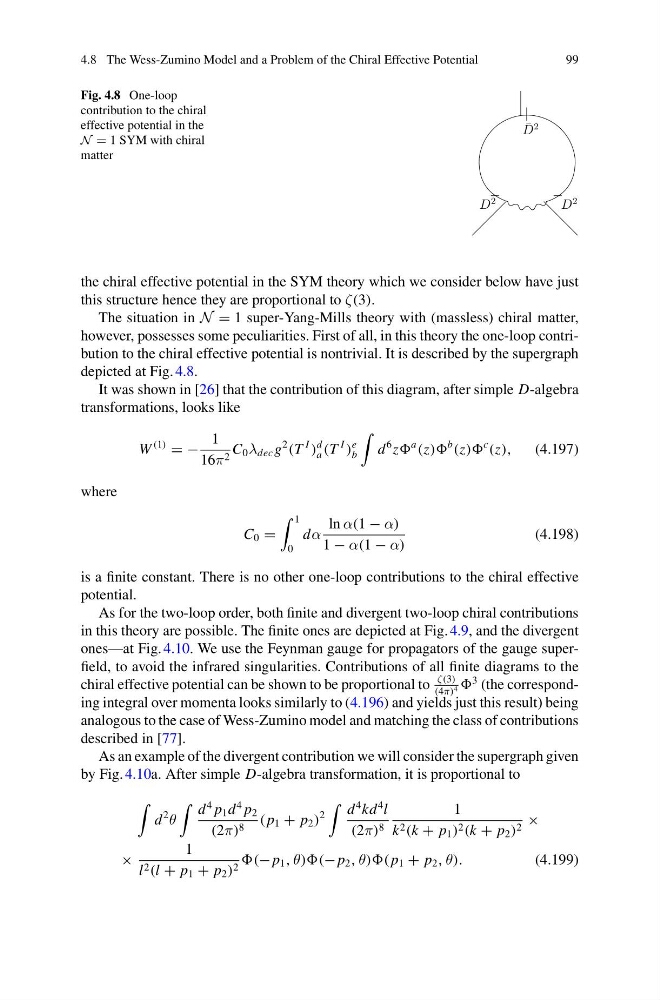
Fig. 4.8 One-loop
contribution to the chiral
effective potential in the
N = 1 SYM with chiral
matter
|
−
D
2
−
D
2
¯
D
2
the chiral effective potential in the SYM theory which we consider below have just
this structure hence they are proportional to ζ(3).
The situation in N = 1 super-Yang-Mills theory with (massless) chiral matter,
however, possesses some peculiarities. First of all, in this theory the one-loop contribution to the chiral effective potential is nontrivial. It is described by the supergraph
depicted at Fig. 4.8.
It was shown in [26] that the contribution of this diagram, after simple D-algebra
transformations, looks like
W
(1)
= −
1
16π 2 C 0 λ dec g
2
(T
I
)
d
a (T
I
)
e
b
d
6 z
a
(z))
b
(z))
c
(z),
(4.197)
where
C 0 =
1
0
dα
ln α(1 − α)
1 − α(1 − α)
(4.198)
is a finite constant. There is no other one-loop contributions to the chiral effective
potential.
As for the two-loop order, both finite and divergent two-loop chiral contributions
in this theory are possible. The finite ones are depicted at Fig. 4.9, and the divergent
ones—at Fig. 4.10. We use the Feynman gauge for propagators of the gauge superfield, to avoid the infrared singularities. Contributions of all finite diagrams to the
chiral effective potential can be shown to be proportional to
ζ(3)
(4π) 4
3 (the corresponding integral over momenta looks similarly to (4.196) and yields just this result) being
analogous to the case of Wess-Zumino model and matching the class of contributions
described in [77].
As an example of the divergent contribution we will consider the supergraph given
by Fig. 4.10a. After simple D-algebra transformation, it is proportional to
d
2
θ
d
4 p 1 d
4 p 2
(2π) 8 ( p 1 + p 2 )
2
d
4 kd
4 l
(2π) 8
1
k 2 (k + p 1 ) 2 (k + p 2 ) 2 ×
×
1
l 2 (l + p 1 + p 2 ) 2 p 1 , θ))(− p 2 , θ))( p 1 + p 2 , θ).
(4.199)
99
Fig. 4.8 One-loop
contribution to the chiral
effective potential in the
N = 1 SYM with chiral
matter
|
−
D
2
−
D
2
¯
D
2
the chiral effective potential in the SYM theory which we consider below have just
this structure hence they are proportional to ζ(3).
The situation in N = 1 super-Yang-Mills theory with (massless) chiral matter,
however, possesses some peculiarities. First of all, in this theory the one-loop contribution to the chiral effective potential is nontrivial. It is described by the supergraph
depicted at Fig. 4.8.
It was shown in [26] that the contribution of this diagram, after simple D-algebra
transformations, looks like
W
(1)
= −
1
16π 2 C 0 λ dec g
2
(T
I
)
d
a (T
I
)
e
b
d
6 z
a
(z))
b
(z))
c
(z),
(4.197)
where
C 0 =
1
0
dα
ln α(1 − α)
1 − α(1 − α)
(4.198)
is a finite constant. There is no other one-loop contributions to the chiral effective
potential.
As for the two-loop order, both finite and divergent two-loop chiral contributions
in this theory are possible. The finite ones are depicted at Fig. 4.9, and the divergent
ones—at Fig. 4.10. We use the Feynman gauge for propagators of the gauge superfield, to avoid the infrared singularities. Contributions of all finite diagrams to the
chiral effective potential can be shown to be proportional to
ζ(3)
(4π) 4
3 (the corresponding integral over momenta looks similarly to (4.196) and yields just this result) being
analogous to the case of Wess-Zumino model and matching the class of contributions
described in [77].
As an example of the divergent contribution we will consider the supergraph given
by Fig. 4.10a. After simple D-algebra transformation, it is proportional to
d
2
θ
d
4 p 1 d
4 p 2
(2π) 8 ( p 1 + p 2 )
2
d
4 kd
4 l
(2π) 8
1
k 2 (k + p 1 ) 2 (k + p 2 ) 2 ×
×
1
l 2 (l + p 1 + p 2 ) 2 p 1 , θ))(− p 2 , θ))( p 1 + p 2 , θ).
(4.199)