

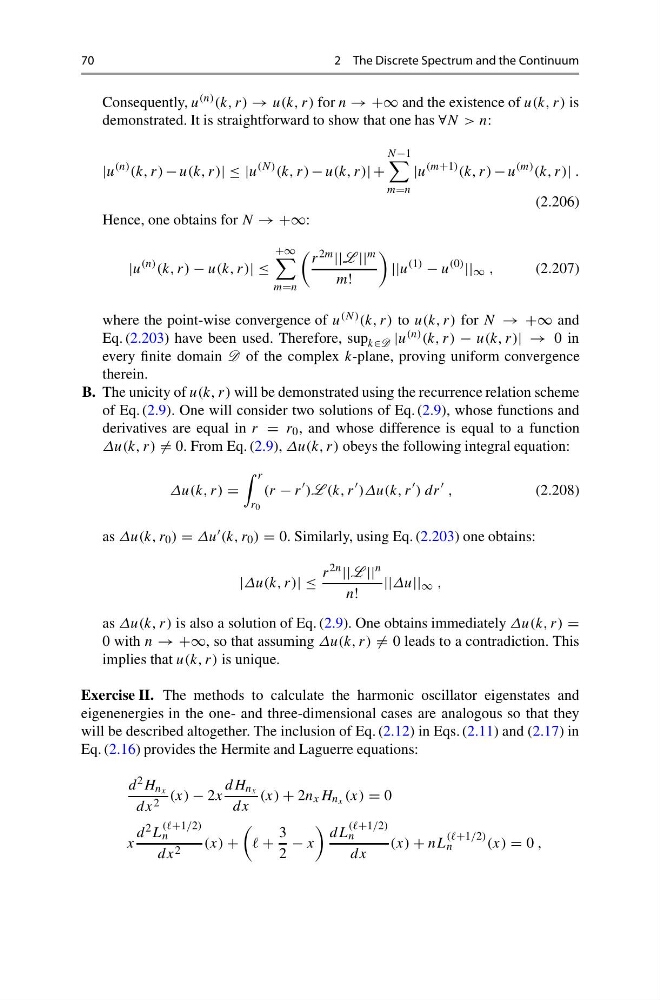
70
2 The Discrete Spectrum and the Continuum
Consequently, u (n) (k, r) → u(k, r) for n → +∞ and the existence of u(k, r) is
demonstrated. It is straightforward to show that one has ∀N > n:
|u
(n) (k, r) − u(k, r)| ≤ |u
(N) (k, r) − u(k, r)| +
N−1
m=n
|u
(m+1) (k, r) − u
(m) (k, r)| .
(2.206)
Hence, one obtains for N → +∞:
|u
(n) (k, r) − u(k, r)| ≤
+∞
m=n
r 2m ||L || m
m!
||u
(1)
− u
(0)
|| ∞ ,
(2.207)
where the point-wise convergence of u (N) (k, r) to u(k, r) for N → +∞ and
Eq. (2.203) have been used. Therefore, sup k∈D |u (n) (k, r) − u(k, r)| → 0 in
every finite domain D of the complex k-plane, proving uniform convergence
therein.
B. The unicity of u(k, r) will be demonstrated using the recurrence relation scheme
of Eq. (2.9). One will consider two solutions of Eq. (2.9), whose functions and
derivatives are equal in r = r 0 , and whose difference is equal to a function
Δu(k, r) = 0. From Eq. (2.9), Δu(k, r) obeys the following integral equation:
Δu(k, r) =
r
r 0
(r − r
)L (k, r
)Δu(k, r
) dr
,
(2.208)
as Δu(k, r 0 ) = Δu (k, r 0 ) = 0. Similarly, using Eq. (2.203) one obtains:
|Δu(k, r)| ≤
r 2n ||L || n
n!
||Δu|| ∞ ,
as Δu(k, r) is also a solution of Eq. (2.9). One obtains immediately Δu(k, r) =
0 with n → +∞, so that assuming Δu(k, r) = 0 leads to a contradiction. This
implies that u(k, r) is unique.
Exercise II. The methods to calculate the harmonic oscillator eigenstates and
eigenenergies in the one- and three-dimensional cases are analogous so that they
will be described altogether. The inclusion of Eq. (2.12) in Eqs. (2.11) and (2.17) in
Eq. (2.16) provides the Hermite and Laguerre equations:
d 2 H n x
dx 2 (x) − 2x
dH n x
dx
(x) + 2n x H n x (x) = 0
x
d 2 L
((+1/2)
n
dx 2
(x) +
+
3
2
− x
dL
((+1/2)
n
dx
(x) + nL
((+1/2)
n
(x) = 0 ,
2 The Discrete Spectrum and the Continuum
Consequently, u (n) (k, r) → u(k, r) for n → +∞ and the existence of u(k, r) is
demonstrated. It is straightforward to show that one has ∀N > n:
|u
(n) (k, r) − u(k, r)| ≤ |u
(N) (k, r) − u(k, r)| +
N−1
m=n
|u
(m+1) (k, r) − u
(m) (k, r)| .
(2.206)
Hence, one obtains for N → +∞:
|u
(n) (k, r) − u(k, r)| ≤
+∞
m=n
r 2m ||L || m
m!
||u
(1)
− u
(0)
|| ∞ ,
(2.207)
where the point-wise convergence of u (N) (k, r) to u(k, r) for N → +∞ and
Eq. (2.203) have been used. Therefore, sup k∈D |u (n) (k, r) − u(k, r)| → 0 in
every finite domain D of the complex k-plane, proving uniform convergence
therein.
B. The unicity of u(k, r) will be demonstrated using the recurrence relation scheme
of Eq. (2.9). One will consider two solutions of Eq. (2.9), whose functions and
derivatives are equal in r = r 0 , and whose difference is equal to a function
Δu(k, r) = 0. From Eq. (2.9), Δu(k, r) obeys the following integral equation:
Δu(k, r) =
r
r 0
(r − r
)L (k, r
)Δu(k, r
) dr
,
(2.208)
as Δu(k, r 0 ) = Δu (k, r 0 ) = 0. Similarly, using Eq. (2.203) one obtains:
|Δu(k, r)| ≤
r 2n ||L || n
n!
||Δu|| ∞ ,
as Δu(k, r) is also a solution of Eq. (2.9). One obtains immediately Δu(k, r) =
0 with n → +∞, so that assuming Δu(k, r) = 0 leads to a contradiction. This
implies that u(k, r) is unique.
Exercise II. The methods to calculate the harmonic oscillator eigenstates and
eigenenergies in the one- and three-dimensional cases are analogous so that they
will be described altogether. The inclusion of Eq. (2.12) in Eqs. (2.11) and (2.17) in
Eq. (2.16) provides the Hermite and Laguerre equations:
d 2 H n x
dx 2 (x) − 2x
dH n x
dx
(x) + 2n x H n x (x) = 0
x
d 2 L
((+1/2)
n
dx 2
(x) +
+
3
2
− x
dL
((+1/2)
n
dx
(x) + nL
((+1/2)
n
(x) = 0 ,