

66
2 The Discrete Spectrum and the Continuum
momentum k is then updated from the standard Newton method formula k →
k − J (k)/(dJ + (k)/dk).
Points 1–4 are then iterated until convergence.
2.6.8 Calculation of the Width of a Metastable State
When a narrow resonance has a width much smaller than typically 1 keV, it is
possible to calculate its width from the current formula. This property has an
immediate physical interest, as it relates the width of the resonance to the particle
flux, the latter being directly provided by the current formula. In particular, the
current formula is of interest when the real and imaginary parts of energy differ
by many orders of magnitude. Very narrow widths occur, for example, in proton
emitters [48, 49], whose width is of the order of 10 −22 MeV, as compared to their
excitation energy, of the order of 1 MeV. Typical examples of proton emitters are
131 Eu and 141 Ho, which are unbound by 0.947 MeV and 1.190 MeV with respect to
proton-emission threshold, and bear half-lives of 17.8 ms and 4.1 ms, respectively
[48, 50]. In fact, particle emission widths in this situation are so small that they
cannot be calculated by the direct integration of the radial wave function of Eq. (2.2)
(see Sect. 2.6.7). In the following, we will see how to obtain the particle-emission
width value from the current formula.
Let us consider a radius r ≥ R, where R is a large radius after which the
nuclear potential is negligible and only Coulomb and centrifugal parts remain. The
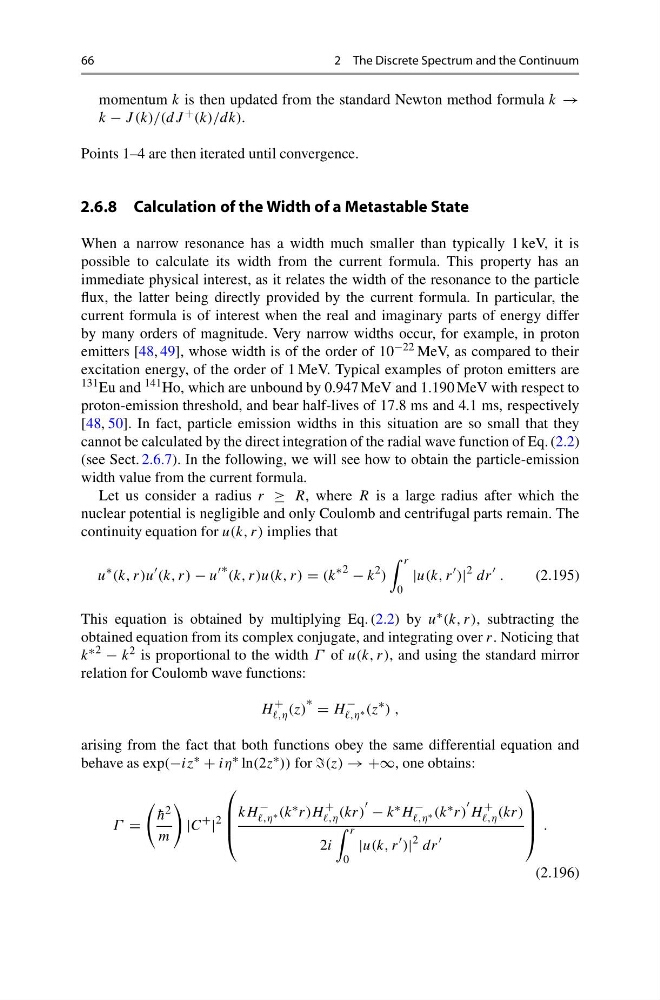
continuity equation for u(k, r) implies that
u
∗ (k, r)u
(k, r) − u
∗ (k, r)u(k, r) = (k
∗2
− k
2 )
r
0
|u(k, r
)|
2 dr
.
(2.195)
This equation is obtained by multiplying Eq. (2.2) by u ∗ (k, r), subtracting the
obtained equation from its complex conjugate, and integrating over r. Noticing that
k ∗2 − k 2 is proportional to the width Γ of u(k, r), and using the standard mirror
relation for Coulomb wave functions:
H
+
,η (z)
∗ = H
−
,η ∗ (z
∗ ) ,
arising from the fact that both functions obey the same differential equation and
behave as exp(−iz ∗ + iη ∗ ln(2z ∗ )) for (z) → +∞, one obtains:
Γ =
¯
h
2
m
|C
+
|
2
⎛
⎜
⎜
⎝
kH
−
,η ∗ (k ∗ r)H
+
,η (kr)
− k ∗ H
−
,η ∗ (k ∗ r)
H
+
,η (kr)
2i
r
0
|u(k, r
)|
2 dr
⎞
⎟
⎟
⎠ .
(2.196)
2 The Discrete Spectrum and the Continuum
momentum k is then updated from the standard Newton method formula k →
k − J (k)/(dJ + (k)/dk).
Points 1–4 are then iterated until convergence.
2.6.8 Calculation of the Width of a Metastable State
When a narrow resonance has a width much smaller than typically 1 keV, it is
possible to calculate its width from the current formula. This property has an
immediate physical interest, as it relates the width of the resonance to the particle
flux, the latter being directly provided by the current formula. In particular, the
current formula is of interest when the real and imaginary parts of energy differ
by many orders of magnitude. Very narrow widths occur, for example, in proton
emitters [48, 49], whose width is of the order of 10 −22 MeV, as compared to their
excitation energy, of the order of 1 MeV. Typical examples of proton emitters are
131 Eu and 141 Ho, which are unbound by 0.947 MeV and 1.190 MeV with respect to
proton-emission threshold, and bear half-lives of 17.8 ms and 4.1 ms, respectively
[48, 50]. In fact, particle emission widths in this situation are so small that they
cannot be calculated by the direct integration of the radial wave function of Eq. (2.2)
(see Sect. 2.6.7). In the following, we will see how to obtain the particle-emission
width value from the current formula.
Let us consider a radius r ≥ R, where R is a large radius after which the
nuclear potential is negligible and only Coulomb and centrifugal parts remain. The
continuity equation for u(k, r) implies that
u
∗ (k, r)u
(k, r) − u
∗ (k, r)u(k, r) = (k
∗2
− k
2 )
r
0
|u(k, r
)|
2 dr
.
(2.195)
This equation is obtained by multiplying Eq. (2.2) by u ∗ (k, r), subtracting the
obtained equation from its complex conjugate, and integrating over r. Noticing that
k ∗2 − k 2 is proportional to the width Γ of u(k, r), and using the standard mirror
relation for Coulomb wave functions:
H
+
,η (z)
∗ = H
−
,η ∗ (z
∗ ) ,
arising from the fact that both functions obey the same differential equation and
behave as exp(−iz ∗ + iη ∗ ln(2z ∗ )) for (z) → +∞, one obtains:
Γ =
¯
h
2
m
|C
+
|
2
⎛
⎜
⎜
⎝
kH
−
,η ∗ (k ∗ r)H
+
,η (kr)
− k ∗ H
−
,η ∗ (k ∗ r)
H
+
,η (kr)
2i
r
0
|u(k, r
)|
2 dr
⎞
⎟
⎟
⎠ .
(2.196)