

60
2 The Discrete Spectrum and the Continuum
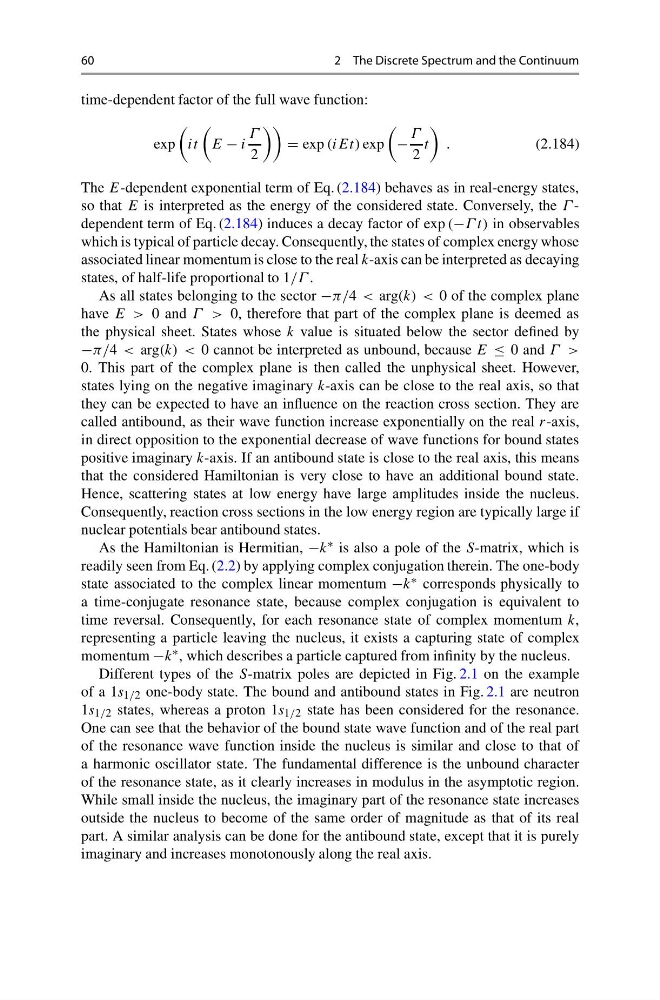
time-dependent factor of the full wave function:
exp
it
E − i
Γ
2
= exp (iEt) exp
−
Γ
2
t
.
(2.184)
The E-dependent exponential term of Eq. (2.184) behaves as in real-energy states,
so that E is interpreted as the energy of the considered state. Conversely, the Γ -
dependent term of Eq. (2.184) induces a decay factor of exp (−Γ t) in observables
which is typical of particle decay. Consequently, the states of complex energy whose
associated linear momentum is close to the real k-axis can be interpreted as decaying
states, of half-life proportional to 1/Γ .
As all states belonging to the sector −π/4 < arg(k) < 0 of the complex plane
have E > 0 and Γ > 0, therefore that part of the complex plane is deemed as
the physical sheet. States whose k value is situated below the sector defined by
−π/4 < arg(k) < 0 cannot be interpreted as unbound, because E ≤ 0 and Γ >
0. This part of the complex plane is then called the unphysical sheet. However,
states lying on the negative imaginary k-axis can be close to the real axis, so that
they can be expected to have an influence on the reaction cross section. They are
called antibound, as their wave function increase exponentially on the real r-axis,
in direct opposition to the exponential decrease of wave functions for bound states
positive imaginary k-axis. If an antibound state is close to the real axis, this means
that the considered Hamiltonian is very close to have an additional bound state.
Hence, scattering states at low energy have large amplitudes inside the nucleus.
Consequently, reaction cross sections in the low energy region are typically large if
nuclear potentials bear antibound states.
As the Hamiltonian is Hermitian, −k ∗ is also a pole of the S-matrix, which is
readily seen from Eq. (2.2) by applying complex conjugation therein. The one-body
state associated to the complex linear momentum −k ∗ corresponds physically to
a time-conjugate resonance state, because complex conjugation is equivalent to
time reversal. Consequently, for each resonance state of complex momentum k,
representing a particle leaving the nucleus, it exists a capturing state of complex
momentum −k ∗ , which describes a particle captured from infinity by the nucleus.
Different types of the S-matrix poles are depicted in Fig. 2.1 on the example
of a 1s 1/2 one-body state. The bound and antibound states in Fig. 2.1 are neutron
1s 1/2 states, whereas a proton 1s 1/2 state has been considered for the resonance.
One can see that the behavior of the bound state wave function and of the real part
of the resonance wave function inside the nucleus is similar and close to that of
a harmonic oscillator state. The fundamental difference is the unbound character
of the resonance state, as it clearly increases in modulus in the asymptotic region.
While small inside the nucleus, the imaginary part of the resonance state increases
outside the nucleus to become of the same order of magnitude as that of its real
part. A similar analysis can be done for the antibound state, except that it is purely
imaginary and increases monotonously along the real axis.
2 The Discrete Spectrum and the Continuum
time-dependent factor of the full wave function:
exp
it
E − i
Γ
2
= exp (iEt) exp
−
Γ
2
t
.
(2.184)
The E-dependent exponential term of Eq. (2.184) behaves as in real-energy states,
so that E is interpreted as the energy of the considered state. Conversely, the Γ -
dependent term of Eq. (2.184) induces a decay factor of exp (−Γ t) in observables
which is typical of particle decay. Consequently, the states of complex energy whose
associated linear momentum is close to the real k-axis can be interpreted as decaying
states, of half-life proportional to 1/Γ .
As all states belonging to the sector −π/4 < arg(k) < 0 of the complex plane
have E > 0 and Γ > 0, therefore that part of the complex plane is deemed as
the physical sheet. States whose k value is situated below the sector defined by
−π/4 < arg(k) < 0 cannot be interpreted as unbound, because E ≤ 0 and Γ >
0. This part of the complex plane is then called the unphysical sheet. However,
states lying on the negative imaginary k-axis can be close to the real axis, so that
they can be expected to have an influence on the reaction cross section. They are
called antibound, as their wave function increase exponentially on the real r-axis,
in direct opposition to the exponential decrease of wave functions for bound states
positive imaginary k-axis. If an antibound state is close to the real axis, this means
that the considered Hamiltonian is very close to have an additional bound state.
Hence, scattering states at low energy have large amplitudes inside the nucleus.
Consequently, reaction cross sections in the low energy region are typically large if
nuclear potentials bear antibound states.
As the Hamiltonian is Hermitian, −k ∗ is also a pole of the S-matrix, which is
readily seen from Eq. (2.2) by applying complex conjugation therein. The one-body
state associated to the complex linear momentum −k ∗ corresponds physically to
a time-conjugate resonance state, because complex conjugation is equivalent to
time reversal. Consequently, for each resonance state of complex momentum k,
representing a particle leaving the nucleus, it exists a capturing state of complex
momentum −k ∗ , which describes a particle captured from infinity by the nucleus.
Different types of the S-matrix poles are depicted in Fig. 2.1 on the example
of a 1s 1/2 one-body state. The bound and antibound states in Fig. 2.1 are neutron
1s 1/2 states, whereas a proton 1s 1/2 state has been considered for the resonance.
One can see that the behavior of the bound state wave function and of the real part
of the resonance wave function inside the nucleus is similar and close to that of
a harmonic oscillator state. The fundamental difference is the unbound character
of the resonance state, as it clearly increases in modulus in the asymptotic region.
While small inside the nucleus, the imaginary part of the resonance state increases
outside the nucleus to become of the same order of magnitude as that of its real
part. A similar analysis can be done for the antibound state, except that it is purely
imaginary and increases monotonously along the real axis.