

44
2 The Discrete Spectrum and the Continuum
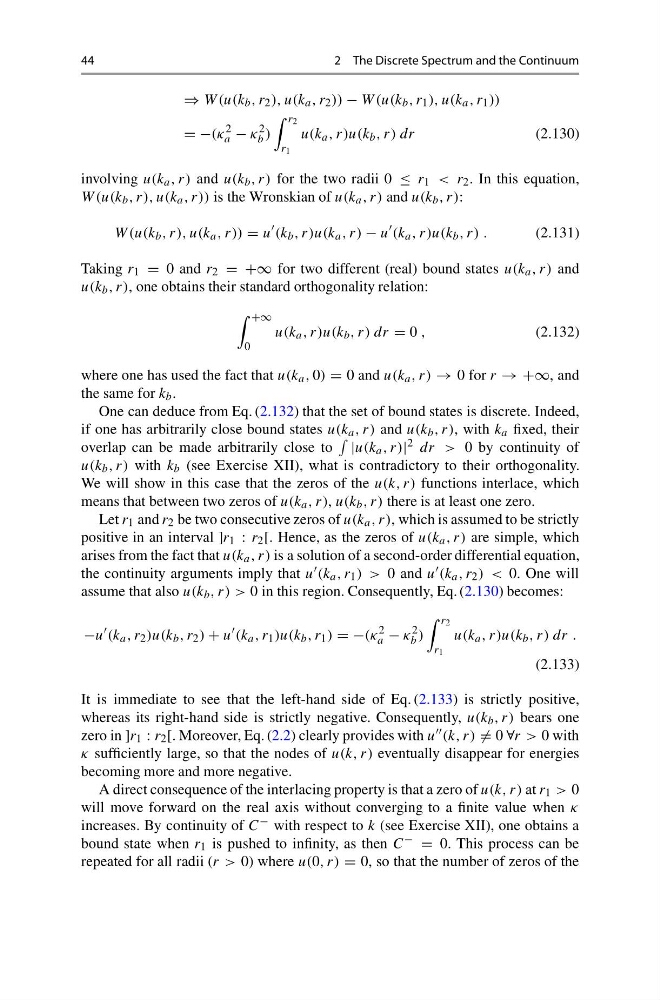
⇒ W (u(k b , r 2 ), u(k a , r 2 )) − W (u(k b , r 1 ), u(k a , r 1 ))
= −(κ
2
a − κ
2
b )
r 2
r 1
u(k a , r)u(k b , r) dr
(2.130)
involving u(k a , r) and u(k b , r) for the two radii 0 ≤ r 1 < r 2 . In this equation,
W (u(k b , r), u(k a , r)) is the Wronskian of u(k a , r) and u(k b , r):
W (u(k b , r), u(k a , r)) = u
(k b , r)u(k a , r) − u
(k a , r)u(k b , r) .
(2.131)
Taking r 1 = 0 and r 2 = +∞ for two different (real) bound states u(k a , r) and
u(k b , r), one obtains their standard orthogonality relation:
+∞
0
u(k a , r)u(k b , r) dr = 0 ,
(2.132)
where one has used the fact that u(k a , 0) = 0 and u(k a , r) → 0 for r → +∞, and
the same for k b .
One can deduce from Eq. (2.132) that the set of bound states is discrete. Indeed,
if one has arbitrarily close bound states u(k a , r) and u(k b , r), with k a fixed, their
overlap can be made arbitrarily close to
|u(k a , r)| 2 dr > 0 by continuity of
u(k b , r) with k b (see Exercise XII), what is contradictory to their orthogonality.
We will show in this case that the zeros of the u(k, r) functions interlace, which
means that between two zeros of u(k a , r), u(k b , r) there is at least one zero.
Let r 1 and r 2 be two consecutive zeros of u(k a , r), which is assumed to be strictly
positive in an interval ]r 1 : r 2 [. Hence, as the zeros of u(k a , r) are simple, which
arises from the fact that u(k a , r) is a solution of a second-order differential equation,
the continuity arguments imply that u (k a , r 1 ) > 0 and u (k a , r 2 ) < 0. One will
assume that also u(k b , r) > 0 in this region. Consequently, Eq. (2.130) becomes:
−u
(k a , r 2 )u(k b , r 2 ) + u
(k a , r 1 )u(k b , r 1 ) = −(κ
2
a − κ
2
b )
r 2
r 1
u(k a , r)u(k b , r) dr .
(2.133)
It is immediate to see that the left-hand side of Eq. (2.133) is strictly positive,
whereas its right-hand side is strictly negative. Consequently, u(k b , r) bears one
zero in ]r 1 : r 2 [. Moreover, Eq. (2.2) clearly provides with u (k, r) = 0 ∀r > 0 with
κ sufficiently large, so that the nodes of u(k, r) eventually disappear for energies
becoming more and more negative.
A direct consequence of the interlacing property is that a zero of u(k, r) at r 1 > 0
will move forward on the real axis without converging to a finite value when κ
increases. By continuity of C − with respect to k (see Exercise XII), one obtains a
bound state when r 1 is pushed to infinity, as then C − = 0. This process can be
repeated for all radii (r > 0) where u(0, r) = 0, so that the number of zeros of the
2 The Discrete Spectrum and the Continuum
⇒ W (u(k b , r 2 ), u(k a , r 2 )) − W (u(k b , r 1 ), u(k a , r 1 ))
= −(κ
2
a − κ
2
b )
r 2
r 1
u(k a , r)u(k b , r) dr
(2.130)
involving u(k a , r) and u(k b , r) for the two radii 0 ≤ r 1 < r 2 . In this equation,
W (u(k b , r), u(k a , r)) is the Wronskian of u(k a , r) and u(k b , r):
W (u(k b , r), u(k a , r)) = u
(k b , r)u(k a , r) − u
(k a , r)u(k b , r) .
(2.131)
Taking r 1 = 0 and r 2 = +∞ for two different (real) bound states u(k a , r) and
u(k b , r), one obtains their standard orthogonality relation:
+∞
0
u(k a , r)u(k b , r) dr = 0 ,
(2.132)
where one has used the fact that u(k a , 0) = 0 and u(k a , r) → 0 for r → +∞, and
the same for k b .
One can deduce from Eq. (2.132) that the set of bound states is discrete. Indeed,
if one has arbitrarily close bound states u(k a , r) and u(k b , r), with k a fixed, their
overlap can be made arbitrarily close to
|u(k a , r)| 2 dr > 0 by continuity of
u(k b , r) with k b (see Exercise XII), what is contradictory to their orthogonality.
We will show in this case that the zeros of the u(k, r) functions interlace, which
means that between two zeros of u(k a , r), u(k b , r) there is at least one zero.
Let r 1 and r 2 be two consecutive zeros of u(k a , r), which is assumed to be strictly
positive in an interval ]r 1 : r 2 [. Hence, as the zeros of u(k a , r) are simple, which
arises from the fact that u(k a , r) is a solution of a second-order differential equation,
the continuity arguments imply that u (k a , r 1 ) > 0 and u (k a , r 2 ) < 0. One will
assume that also u(k b , r) > 0 in this region. Consequently, Eq. (2.130) becomes:
−u
(k a , r 2 )u(k b , r 2 ) + u
(k a , r 1 )u(k b , r 1 ) = −(κ
2
a − κ
2
b )
r 2
r 1
u(k a , r)u(k b , r) dr .
(2.133)
It is immediate to see that the left-hand side of Eq. (2.133) is strictly positive,
whereas its right-hand side is strictly negative. Consequently, u(k b , r) bears one
zero in ]r 1 : r 2 [. Moreover, Eq. (2.2) clearly provides with u (k, r) = 0 ∀r > 0 with
κ sufficiently large, so that the nodes of u(k, r) eventually disappear for energies
becoming more and more negative.
A direct consequence of the interlacing property is that a zero of u(k, r) at r 1 > 0
will move forward on the real axis without converging to a finite value when κ
increases. By continuity of C − with respect to k (see Exercise XII), one obtains a
bound state when r 1 is pushed to infinity, as then C − = 0. This process can be
repeated for all radii (r > 0) where u(0, r) = 0, so that the number of zeros of the