

468
9 The Unification of Structure and Reaction Frameworks
7 Li(n, γ ) 8 Li reaction is described in the analogous model space as its mirror
reaction: 7 Be(p, γ ) 8 B. Similarly, the 4 He core is described by a -dependent ( ≤
2) Woods–Saxon potential supplemented by the Coulomb potential of radius r c =
2.8 fm. The Furutani–Horiuchi–Tamagaki interaction (see [74, 90] and Eq. (6.18))
describes effective two-body interaction between valence nucleons. Parameters of
the Hamiltonian have been fitted to reproduce binding energies of low-lying states
in 7 Li and 8 Li [64]. The ground state of 7 Li calculated in the Gamow shell model
is bound by 11.228 MeV with respect to 4 He, i.e. close to the experimental value
E exp = 10.948 MeV. Reaction channels in the coupled-channel Gamow shell model
calculations are obtained by the coupling of the ground state 3/2
− and the first
excited state 1/2
− of 7 Li with the neutron partial waves: s 1/2 , p 1/2 , p 3/2 , d 3/2 , and
d 5/2 .
Discrete states of a composite system 8 Li are 2
+
1 , 1
+
1 bound states, and 3
+
1
resonance. To correct for missing reaction channels in coupled-channel Gamow
shell model calculations, the channel–channel coupling potentials V c,c have been
modified, and new potentials are: ˜
V c,c = c(J π )V c,c , with c(2
+
1 ) = 1.03705,
c(1
+
1 ) = 1.04805 and c(3
+
1 ) = 1.03205.
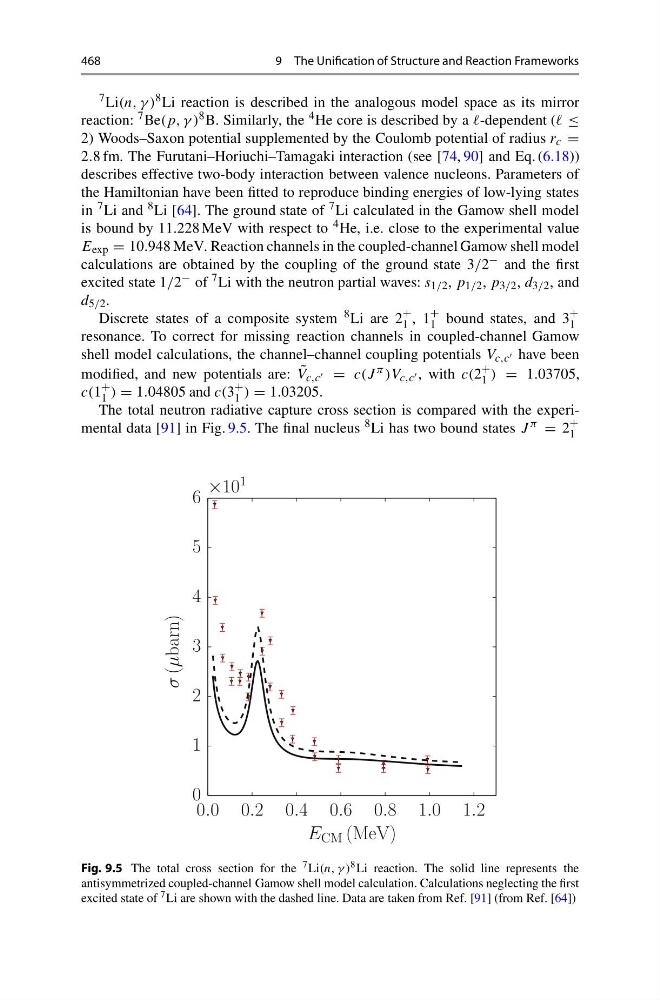
The total neutron radiative capture cross section is compared with the experimental data [91] in Fig. 9.5. The final nucleus 8 Li has two bound states J π = 2
+
1
0.0 0.2 0.4 0.6 0.8 1.0 1.2
E CM (MeV)
0
1
2
3
4
5
6
σ (μbarn)
×10
1
Fig. 9.5 The total cross section for the 7 Li(n, γ ) 8 Li reaction. The solid line represents the
antisymmetrized coupled-channel Gamow shell model calculation. Calculations neglecting the first
excited state of 7 Li are shown with the dashed line. Data are taken from Ref. [91] (from Ref. [64])
9 The Unification of Structure and Reaction Frameworks
7 Li(n, γ ) 8 Li reaction is described in the analogous model space as its mirror
reaction: 7 Be(p, γ ) 8 B. Similarly, the 4 He core is described by a -dependent ( ≤
2) Woods–Saxon potential supplemented by the Coulomb potential of radius r c =
2.8 fm. The Furutani–Horiuchi–Tamagaki interaction (see [74, 90] and Eq. (6.18))
describes effective two-body interaction between valence nucleons. Parameters of
the Hamiltonian have been fitted to reproduce binding energies of low-lying states
in 7 Li and 8 Li [64]. The ground state of 7 Li calculated in the Gamow shell model
is bound by 11.228 MeV with respect to 4 He, i.e. close to the experimental value
E exp = 10.948 MeV. Reaction channels in the coupled-channel Gamow shell model
calculations are obtained by the coupling of the ground state 3/2
− and the first
excited state 1/2
− of 7 Li with the neutron partial waves: s 1/2 , p 1/2 , p 3/2 , d 3/2 , and
d 5/2 .
Discrete states of a composite system 8 Li are 2
+
1 , 1
+
1 bound states, and 3
+
1
resonance. To correct for missing reaction channels in coupled-channel Gamow
shell model calculations, the channel–channel coupling potentials V c,c have been
modified, and new potentials are: ˜
V c,c = c(J π )V c,c , with c(2
+
1 ) = 1.03705,
c(1
+
1 ) = 1.04805 and c(3
+
1 ) = 1.03205.
The total neutron radiative capture cross section is compared with the experimental data [91] in Fig. 9.5. The final nucleus 8 Li has two bound states J π = 2
+
1
0.0 0.2 0.4 0.6 0.8 1.0 1.2
E CM (MeV)
0
1
2
3
4
5
6
σ (μbarn)
×10
1
Fig. 9.5 The total cross section for the 7 Li(n, γ ) 8 Li reaction. The solid line represents the
antisymmetrized coupled-channel Gamow shell model calculation. Calculations neglecting the first
excited state of 7 Li are shown with the dashed line. Data are taken from Ref. [91] (from Ref. [64])