

9.4 Calculation of Spectra and Reaction Cross Sections in the Coupled-. . .
467
0.0 0.5 1.0 1.5 2.0 2.5 3.0
E CM (MeV)
0.0
0.2
0.4
0.6
0.8
1.0
1.2
1.4
1.6
S (barn.eV)
×10
2
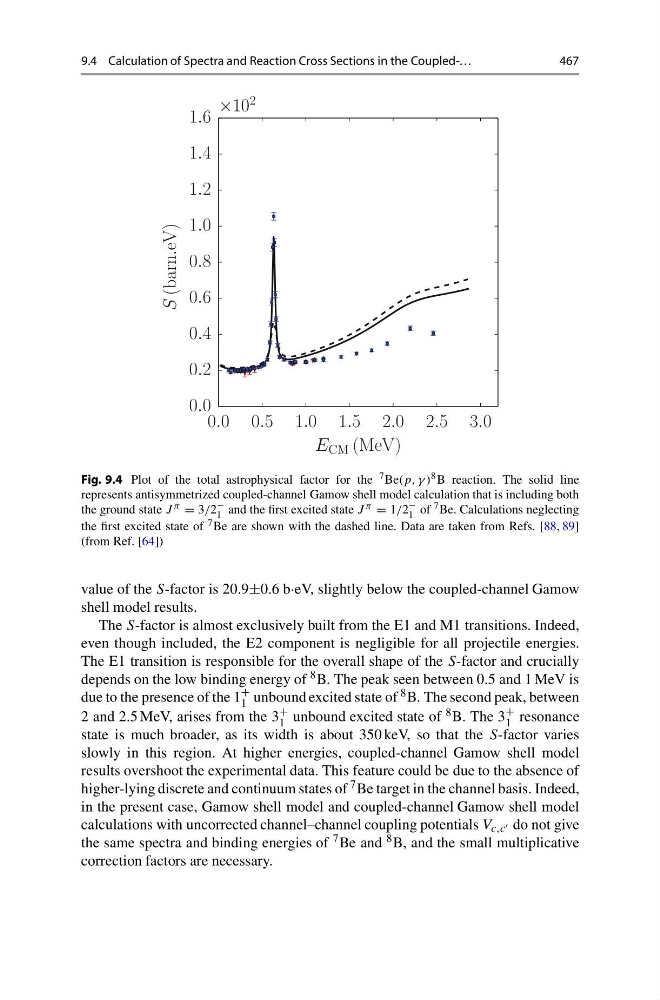
Fig. 9.4 Plot of the total astrophysical factor for the 7 Be(p, γ ) 8 B reaction. The solid line
represents antisymmetrized coupled-channel Gamow shell model calculation that is including both
the ground state J π = 3/2
−
1 and the first excited state J π = 1/2
−
1 of 7 Be. Calculations neglecting
the first excited state of 7 Be are shown with the dashed line. Data are taken from Refs. [88, 89]
(from Ref. [64])
value of the S-factor is 20.9±0.6 b·eV, slightly below the coupled-channel Gamow
shell model results.
The S-factor is almost exclusively built from the E1 and M1 transitions. Indeed,
even though included, the E2 component is negligible for all projectile energies.
The E1 transition is responsible for the overall shape of the S-factor and crucially
depends on the low binding energy of 8 B. The peak seen between 0.5 and 1 MeV is
due to the presence of the 1
+
1 unbound excited state of 8 B. The second peak, between
2 and 2.5 MeV, arises from the 3
+
1 unbound excited state of 8 B. The 3
+
1 resonance
state is much broader, as its width is about 350 keV, so that the S-factor varies
slowly in this region. At higher energies, coupled-channel Gamow shell model
results overshoot the experimental data. This feature could be due to the absence of
higher-lying discrete and continuum states of 7 Be target in the channel basis. Indeed,
in the present case, Gamow shell model and coupled-channel Gamow shell model
calculations with uncorrected channel–channel coupling potentials V c,c do not give
the same spectra and binding energies of 7 Be and 8 B, and the small multiplicative
correction factors are necessary.
467
0.0 0.5 1.0 1.5 2.0 2.5 3.0
E CM (MeV)
0.0
0.2
0.4
0.6
0.8
1.0
1.2
1.4
1.6
S (barn.eV)
×10
2
Fig. 9.4 Plot of the total astrophysical factor for the 7 Be(p, γ ) 8 B reaction. The solid line
represents antisymmetrized coupled-channel Gamow shell model calculation that is including both
the ground state J π = 3/2
−
1 and the first excited state J π = 1/2
−
1 of 7 Be. Calculations neglecting
the first excited state of 7 Be are shown with the dashed line. Data are taken from Refs. [88, 89]
(from Ref. [64])
value of the S-factor is 20.9±0.6 b·eV, slightly below the coupled-channel Gamow
shell model results.
The S-factor is almost exclusively built from the E1 and M1 transitions. Indeed,
even though included, the E2 component is negligible for all projectile energies.
The E1 transition is responsible for the overall shape of the S-factor and crucially
depends on the low binding energy of 8 B. The peak seen between 0.5 and 1 MeV is
due to the presence of the 1
+
1 unbound excited state of 8 B. The second peak, between
2 and 2.5 MeV, arises from the 3
+
1 unbound excited state of 8 B. The 3
+
1 resonance
state is much broader, as its width is about 350 keV, so that the S-factor varies
slowly in this region. At higher energies, coupled-channel Gamow shell model
results overshoot the experimental data. This feature could be due to the absence of
higher-lying discrete and continuum states of 7 Be target in the channel basis. Indeed,
in the present case, Gamow shell model and coupled-channel Gamow shell model
calculations with uncorrected channel–channel coupling potentials V c,c do not give
the same spectra and binding energies of 7 Be and 8 B, and the small multiplicative
correction factors are necessary.