

9.4 Calculation of Spectra and Reaction Cross Sections in the Coupled-. . .
461
100
200
300
400
(a)
100
200
300
400
(b)
100
200
300
400
(c)
100
200
300
400
(d)
0
100
200
300
400
0.5 1.0 1.5 2.0 2.5
(e)
0
100
200
300
400
0.5 1.0 1.5 2.0 2.5
(f)
E CM (MeV)
d /dΩ (mbarn/sr)
0
0
0
0
σ
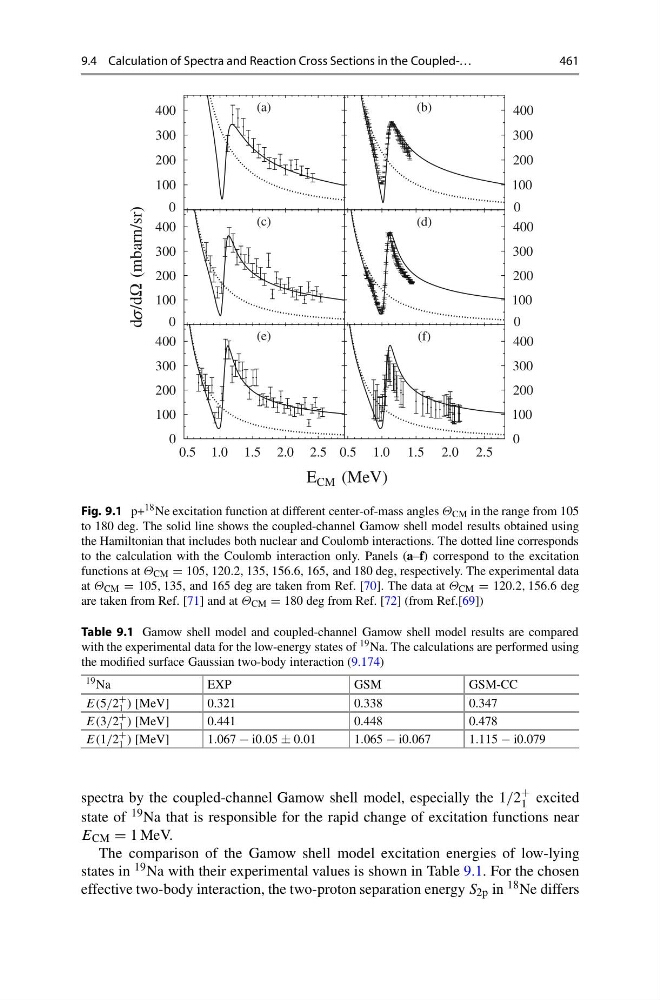
Fig. 9.1 p+ 18 Ne excitation function at different center-of-mass angles Θ CM in the range from 105
to 180 deg. The solid line shows the coupled-channel Gamow shell model results obtained using
the Hamiltonian that includes both nuclear and Coulomb interactions. The dotted line corresponds
to the calculation with the Coulomb interaction only. Panels (a–f) correspond to the excitation
functions at Θ CM = 105, 120.2, 135, 156.6, 165, and 180 deg, respectively. The experimental data
at Θ CM = 105, 135, and 165 deg are taken from Ref. [70]. The data at Θ CM = 120.2, 156.6 deg
are taken from Ref. [71] and at Θ CM = 180 deg from Ref. [72] (from Ref.[69])
Table 9.1 Gamow shell model and coupled-channel Gamow shell model results are compared
with the experimental data for the low-energy states of 19 Na. The calculations are performed using
the modified surface Gaussian two-body interaction (9.174)
19 Na
EXP
GSM
GSM-CC
E(5/2
+
1 ) [MeV]
0.321
0.338
0.347
E(3/2
+
1 ) [MeV]
0.441
0.448
0.478
E(1/2
+
1 ) [MeV]
1.067 − i0.05 ± 0.01
1.065 − i0.067
1.115 − i0.079
spectra by the coupled-channel Gamow shell model, especially the 1/2
+
1 excited
state of 19 Na that is responsible for the rapid change of excitation functions near
E CM = 1 MeV.
The comparison of the Gamow shell model excitation energies of low-lying
states in 19 Na with their experimental values is shown in Table 9.1. For the chosen
effective two-body interaction, the two-proton separation energy S 2p in 18 Ne differs
461
100
200
300
400
(a)
100
200
300
400
(b)
100
200
300
400
(c)
100
200
300
400
(d)
0
100
200
300
400
0.5 1.0 1.5 2.0 2.5
(e)
0
100
200
300
400
0.5 1.0 1.5 2.0 2.5
(f)
E CM (MeV)
d /dΩ (mbarn/sr)
0
0
0
0
σ
Fig. 9.1 p+ 18 Ne excitation function at different center-of-mass angles Θ CM in the range from 105
to 180 deg. The solid line shows the coupled-channel Gamow shell model results obtained using
the Hamiltonian that includes both nuclear and Coulomb interactions. The dotted line corresponds
to the calculation with the Coulomb interaction only. Panels (a–f) correspond to the excitation
functions at Θ CM = 105, 120.2, 135, 156.6, 165, and 180 deg, respectively. The experimental data
at Θ CM = 105, 135, and 165 deg are taken from Ref. [70]. The data at Θ CM = 120.2, 156.6 deg
are taken from Ref. [71] and at Θ CM = 180 deg from Ref. [72] (from Ref.[69])
Table 9.1 Gamow shell model and coupled-channel Gamow shell model results are compared
with the experimental data for the low-energy states of 19 Na. The calculations are performed using
the modified surface Gaussian two-body interaction (9.174)
19 Na
EXP
GSM
GSM-CC
E(5/2
+
1 ) [MeV]
0.321
0.338
0.347
E(3/2
+
1 ) [MeV]
0.441
0.448
0.478
E(1/2
+
1 ) [MeV]
1.067 − i0.05 ± 0.01
1.065 − i0.067
1.115 − i0.079
spectra by the coupled-channel Gamow shell model, especially the 1/2
+
1 excited
state of 19 Na that is responsible for the rapid change of excitation functions near
E CM = 1 MeV.
The comparison of the Gamow shell model excitation energies of low-lying
states in 19 Na with their experimental values is shown in Table 9.1. For the chosen
effective two-body interaction, the two-proton separation energy S 2p in 18 Ne differs