

460
9 The Unification of Structure and Reaction Frameworks
9.4.1 Spectra of Unbound Nuclei and Excitation Functions
of Proton–Proton Elastic Scattering
9.4.1.1 18 Ne(p,p) Elastic Scattering Cross Section and 19 Na Spectrum
The calculation of 18 Ne(p,p) elastic scattering cross sections is convenient as an
introduction to the coupled-channel Gamow shell model. Indeed, it can be modelled
by three valence protons above an 16 O core, so that Hamiltonian matrix dimensions
are small. Moreover, experimental data are available for several values of cross
section angles and projectile energies. Added to that, 19 Na is unbound, so that
continuum coupling is necessary therein to describe its spectrum.
In the calculation of 18 Ne(p,p) elastic scattering cross sections, the reaction
channels are defined by the ground state J π = 0
+
1 and the first excited state
J π = 2
+
1 of 18 Ne target coupled to the proton in different partial waves with c ≤ 2.
The single-proton configurations correspond to 0d 5/2 and 1s 1/2 resonances and
28 states of a discretized contour for each resonance. Moreover, (d 3/2 , p 3/2 , p 1/2 )
partial waves are included, which are decomposed using a real-energy contour of 21
points because in this case the resonance poles are broad. The Hamiltonian consists
of the Woods–Saxon potential describing the 16 O core and the modified surface
Gaussian effective two-body interaction among valence nucleons [69]
V
(MSG)
J T
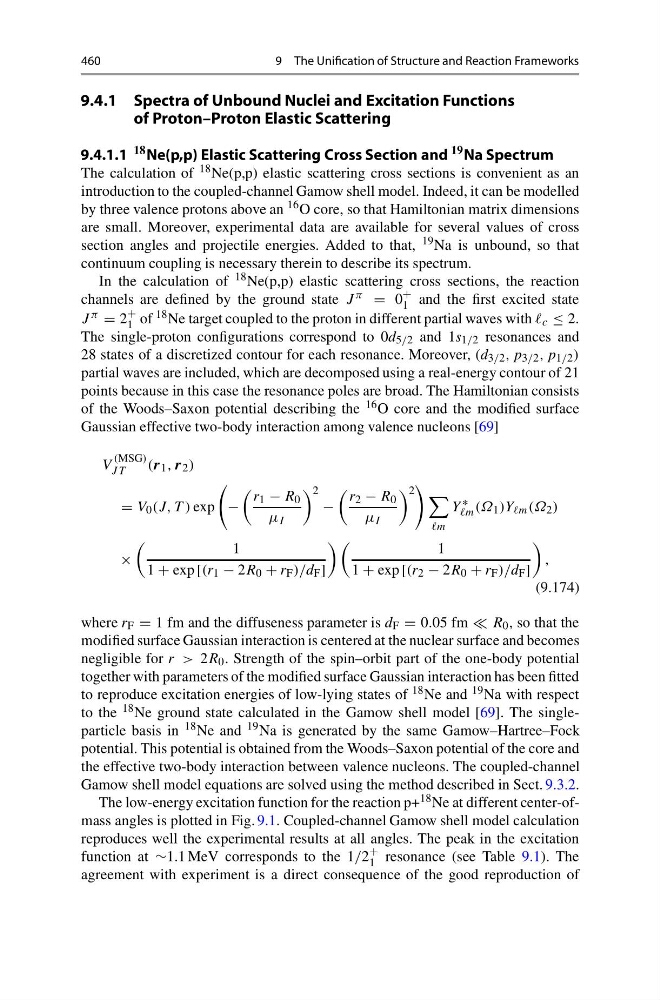
(r 1 , r 2 )
= V 0 (J, T ) exp
−
r 1 − R 0
μ I
2
−
r 2 − R 0
μ I
2
Y
∗
m (Ω 1 )Y m (Ω 2 )
×
1
1 + exp [(r 1 − 2R 0 + r F )/d F ]
1
1 + exp [(r 2 − 2R 0 + r F )/d F ]
,
(9.174)
where r F = 1 fm and the diffuseness parameter is d F = 0.05 fm R 0 , so that the
modified surface Gaussian interaction is centered at the nuclear surface and becomes
negligible for r > 2R 0 . Strength of the spin–orbit part of the one-body potential
together with parameters of the modified surface Gaussian interaction has been fitted
to reproduce excitation energies of low-lying states of 18 Ne and 19 Na with respect
to the 18 Ne ground state calculated in the Gamow shell model [69]. The singleparticle basis in 18 Ne and 19 Na is generated by the same Gamow–Hartree–Fock
potential. This potential is obtained from the Woods–Saxon potential of the core and
the effective two-body interaction between valence nucleons. The coupled-channel
Gamow shell model equations are solved using the method described in Sect. 9.3.2.
The low-energy excitation function for the reaction p+ 18 Ne at different center-ofmass angles is plotted in Fig. 9.1. Coupled-channel Gamow shell model calculation
reproduces well the experimental results at all angles. The peak in the excitation
function at ∼1.1 MeV corresponds to the 1/2
+
1 resonance (see Table 9.1). The
agreement with experiment is a direct consequence of the good reproduction of
9 The Unification of Structure and Reaction Frameworks
9.4.1 Spectra of Unbound Nuclei and Excitation Functions
of Proton–Proton Elastic Scattering
9.4.1.1 18 Ne(p,p) Elastic Scattering Cross Section and 19 Na Spectrum
The calculation of 18 Ne(p,p) elastic scattering cross sections is convenient as an
introduction to the coupled-channel Gamow shell model. Indeed, it can be modelled
by three valence protons above an 16 O core, so that Hamiltonian matrix dimensions
are small. Moreover, experimental data are available for several values of cross
section angles and projectile energies. Added to that, 19 Na is unbound, so that
continuum coupling is necessary therein to describe its spectrum.
In the calculation of 18 Ne(p,p) elastic scattering cross sections, the reaction
channels are defined by the ground state J π = 0
+
1 and the first excited state
J π = 2
+
1 of 18 Ne target coupled to the proton in different partial waves with c ≤ 2.
The single-proton configurations correspond to 0d 5/2 and 1s 1/2 resonances and
28 states of a discretized contour for each resonance. Moreover, (d 3/2 , p 3/2 , p 1/2 )
partial waves are included, which are decomposed using a real-energy contour of 21
points because in this case the resonance poles are broad. The Hamiltonian consists
of the Woods–Saxon potential describing the 16 O core and the modified surface
Gaussian effective two-body interaction among valence nucleons [69]
V
(MSG)
J T
(r 1 , r 2 )
= V 0 (J, T ) exp
−
r 1 − R 0
μ I
2
−
r 2 − R 0
μ I
2
Y
∗
m (Ω 1 )Y m (Ω 2 )
×
1
1 + exp [(r 1 − 2R 0 + r F )/d F ]
1
1 + exp [(r 2 − 2R 0 + r F )/d F ]
,
(9.174)
where r F = 1 fm and the diffuseness parameter is d F = 0.05 fm R 0 , so that the
modified surface Gaussian interaction is centered at the nuclear surface and becomes
negligible for r > 2R 0 . Strength of the spin–orbit part of the one-body potential
together with parameters of the modified surface Gaussian interaction has been fitted
to reproduce excitation energies of low-lying states of 18 Ne and 19 Na with respect
to the 18 Ne ground state calculated in the Gamow shell model [69]. The singleparticle basis in 18 Ne and 19 Na is generated by the same Gamow–Hartree–Fock
potential. This potential is obtained from the Woods–Saxon potential of the core and
the effective two-body interaction between valence nucleons. The coupled-channel
Gamow shell model equations are solved using the method described in Sect. 9.3.2.
The low-energy excitation function for the reaction p+ 18 Ne at different center-ofmass angles is plotted in Fig. 9.1. Coupled-channel Gamow shell model calculation
reproduces well the experimental results at all angles. The peak in the excitation
function at ∼1.1 MeV corresponds to the 1/2
+
1 resonance (see Table 9.1). The
agreement with experiment is a direct consequence of the good reproduction of