

432
9 The Unification of Structure and Reaction Frameworks
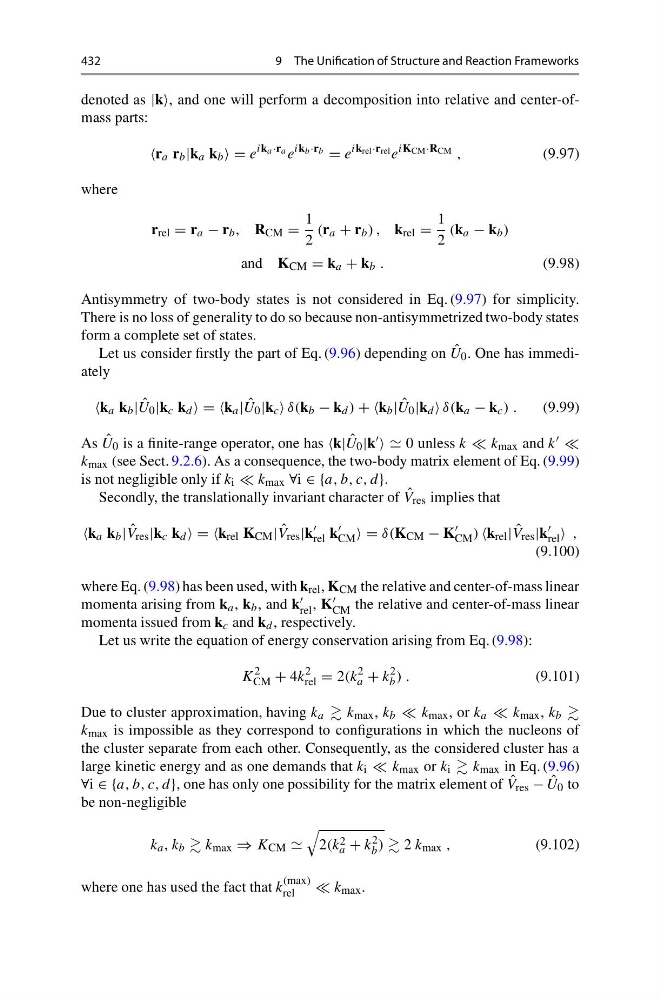
denoted as |k, and one will perform a decomposition into relative and center-ofmass parts:
a r b |k a k b = e
ik a ·r a e
ik b ·r b = e
ik rel ·r rel e
iK CM ·R CM ,
(9.97)
where
r rel = r a − r b , R CM =
1
2
(r a + r b ) , k rel =
1
2
(k a − k b )
and K CM = k a + k b .
(9.98)
Antisymmetry of two-body states is not considered in Eq. (9.97) for simplicity.
There is no loss of generality to do so because non-antisymmetrized two-body states
form a complete set of states.
Let us consider firstly the part of Eq. (9.96) depending on ˆ
U 0 . One has immediately
a k b | ˆ
U 0 |k c k d = k a | ˆ
U 0 |k c δ(k b − k d ) + +k b | ˆ
U 0 |k d δ(k a − k c ) .
(9.99)
As ˆ
U 0 is a finite-range operator, one has ˆ
U 0 |k 0 unless k k max and k
k max (see Sect. 9.2.6). As a consequence, the two-body matrix element of Eq. (9.99)
is not negligible only if k i k max ∀i ∈ {a, b, c, d}.
Secondly, the translationally invariant character of ˆ
V res implies that
a k b | ˆ
V res |k c k d = =k rel K CM | ˆ
V res |k
rel k
CM = δ(K CM − K
CM ) rel | ˆ
V res |k
rel ,
(9.100)
where Eq. (9.98) has been used, with k rel , K CM the relative and center-of-mass linear
momenta arising from k a , k b , and k
rel , K
CM the relative and center-of-mass linear
momenta issued from k c and k d , respectively.
Let us write the equation of energy conservation arising from Eq. (9.98):
K
2
CM + 4k
2
rel = 2(k
2
a + k
2
b ) .
(9.101)
Due to cluster approximation, having k a k max , k b k max , or k a k max , k b
k max is impossible as they correspond to configurations in which the nucleons of
the cluster separate from each other. Consequently, as the considered cluster has a
large kinetic energy and as one demands that k i k max or k i k max in Eq. (9.96)
∀i ∈ {a, b, c, d}, one has only one possibility for the matrix element of ˆ
V res − ˆ
U 0 to
be non-negligible
k a , k b k max ⇒ K CM
2(k 2
a + k 2
b ) 2 k max ,
(9.102)
where one has used the fact that k
(max)
rel
k max .
9 The Unification of Structure and Reaction Frameworks
denoted as |k, and one will perform a decomposition into relative and center-ofmass parts:
a r b |k a k b = e
ik a ·r a e
ik b ·r b = e
ik rel ·r rel e
iK CM ·R CM ,
(9.97)
where
r rel = r a − r b , R CM =
1
2
(r a + r b ) , k rel =
1
2
(k a − k b )
and K CM = k a + k b .
(9.98)
Antisymmetry of two-body states is not considered in Eq. (9.97) for simplicity.
There is no loss of generality to do so because non-antisymmetrized two-body states
form a complete set of states.
Let us consider firstly the part of Eq. (9.96) depending on ˆ
U 0 . One has immediately
a k b | ˆ
U 0 |k c k d = k a | ˆ
U 0 |k c δ(k b − k d ) + +k b | ˆ
U 0 |k d δ(k a − k c ) .
(9.99)
As ˆ
U 0 is a finite-range operator, one has ˆ
U 0 |k 0 unless k k max and k
k max (see Sect. 9.2.6). As a consequence, the two-body matrix element of Eq. (9.99)
is not negligible only if k i k max ∀i ∈ {a, b, c, d}.
Secondly, the translationally invariant character of ˆ
V res implies that
a k b | ˆ
V res |k c k d = =k rel K CM | ˆ
V res |k
rel k
CM = δ(K CM − K
CM ) rel | ˆ
V res |k
rel ,
(9.100)
where Eq. (9.98) has been used, with k rel , K CM the relative and center-of-mass linear
momenta arising from k a , k b , and k
rel , K
CM the relative and center-of-mass linear
momenta issued from k c and k d , respectively.
Let us write the equation of energy conservation arising from Eq. (9.98):
K
2
CM + 4k
2
rel = 2(k
2
a + k
2
b ) .
(9.101)
Due to cluster approximation, having k a k max , k b k max , or k a k max , k b
k max is impossible as they correspond to configurations in which the nucleons of
the cluster separate from each other. Consequently, as the considered cluster has a
large kinetic energy and as one demands that k i k max or k i k max in Eq. (9.96)
∀i ∈ {a, b, c, d}, one has only one possibility for the matrix element of ˆ
V res − ˆ
U 0 to
be non-negligible
k a , k b k max ⇒ K CM
2(k 2
a + k 2
b ) 2 k max ,
(9.102)
where one has used the fact that k
(max)
rel
k max .