

9.2 Generalization to Many-Nucleon Projectiles
431
the |K CM state describes the center-of-mass of the projectile. The Hamiltonian is
denoted as ˆ
H = ˆ
T + ˆ
U core + ˆ
V res , where ˆ
U core is the potential of the core and ˆ
V res
is the two-body residual interaction.
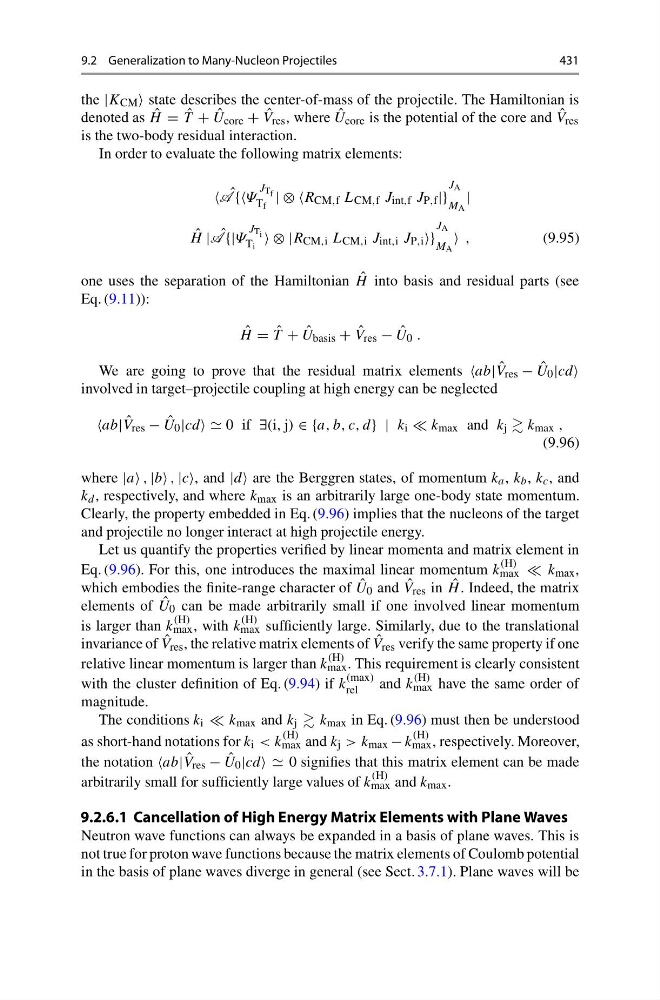
In order to evaluate the following matrix elements:
ˆ
A {{Ψ
J T f
T f
| ⊗ ⊗R CM,f L CM,f J int,f J P,f |}
J A
M A
|
ˆ
H | ˆ
A {|Ψ
J T i
T i
⊗ |R CM,i L CM,i J int,i J P,i
J A
M A
,
(9.95)
one uses the separation of the Hamiltonian ˆ
H into basis and residual parts (see
Eq. (9.11)):
ˆ
H = ˆ
T + ˆ
U basis + ˆ
V res − ˆ
U 0 .
We are going to prove that the residual matrix elements ab| ˆ
V res − ˆ
U 0 |cd
involved in target–projectile coupling at high energy can be neglected
ab| ˆ
V res − ˆ
U 0 |cd 0 if ∃(i, j) ∈ {a, b, c, d} | k i k max and k j k max ,
(9.96)
where |a , |b , |c, and |d are the Berggren states, of momentum k a , k b , k c , and
k d , respectively, and where k max is an arbitrarily large one-body state momentum.
Clearly, the property embedded in Eq. (9.96) implies that the nucleons of the target
and projectile no longer interact at high projectile energy.
Let us quantify the properties verified by linear momenta and matrix element in
Eq. (9.96). For this, one introduces the maximal linear momentum k
(H)
max k max ,
which embodies the finite-range character of ˆ
U 0 and ˆ
V res in ˆ
H . Indeed, the matrix
elements of ˆ
U 0 can be made arbitrarily small if one involved linear momentum
is larger than k
(H)
max , with k
(H)
max sufficiently large. Similarly, due to the translational
invariance of ˆ
V res , the relative matrix elements of ˆ
V res verify the same property if one
relative linear momentum is larger than k
(H)
max . This requirement is clearly consistent
with the cluster definition of Eq. (9.94) if k
(max)
rel
and k
(H)
max have the same order of
magnitude.
The conditions k i k max and k j k max in Eq. (9.96) must then be understood
as short-hand notations for k i < k
(H)
max and k j > k max − k
(H)
max , respectively. Moreover,
the notation ab| ˆ
V res − ˆ
U 0 |cd 0 signifies that this matrix element can be made
arbitrarily small for sufficiently large values of k
(H)
max and k max .
9.2.6.1 Cancellation of High Energy Matrix Elements with Plane Waves
Neutron wave functions can always be expanded in a basis of plane waves. This is
not true for proton wave functions because the matrix elements of Coulomb potential
in the basis of plane waves diverge in general (see Sect. 3.7.1). Plane waves will be
431
the |K CM state describes the center-of-mass of the projectile. The Hamiltonian is
denoted as ˆ
H = ˆ
T + ˆ
U core + ˆ
V res , where ˆ
U core is the potential of the core and ˆ
V res
is the two-body residual interaction.
In order to evaluate the following matrix elements:
ˆ
A {{Ψ
J T f
T f
| ⊗ ⊗R CM,f L CM,f J int,f J P,f |}
J A
M A
|
ˆ
H | ˆ
A {|Ψ
J T i
T i
⊗ |R CM,i L CM,i J int,i J P,i
J A
M A
,
(9.95)
one uses the separation of the Hamiltonian ˆ
H into basis and residual parts (see
Eq. (9.11)):
ˆ
H = ˆ
T + ˆ
U basis + ˆ
V res − ˆ
U 0 .
We are going to prove that the residual matrix elements ab| ˆ
V res − ˆ
U 0 |cd
involved in target–projectile coupling at high energy can be neglected
ab| ˆ
V res − ˆ
U 0 |cd 0 if ∃(i, j) ∈ {a, b, c, d} | k i k max and k j k max ,
(9.96)
where |a , |b , |c, and |d are the Berggren states, of momentum k a , k b , k c , and
k d , respectively, and where k max is an arbitrarily large one-body state momentum.
Clearly, the property embedded in Eq. (9.96) implies that the nucleons of the target
and projectile no longer interact at high projectile energy.
Let us quantify the properties verified by linear momenta and matrix element in
Eq. (9.96). For this, one introduces the maximal linear momentum k
(H)
max k max ,
which embodies the finite-range character of ˆ
U 0 and ˆ
V res in ˆ
H . Indeed, the matrix
elements of ˆ
U 0 can be made arbitrarily small if one involved linear momentum
is larger than k
(H)
max , with k
(H)
max sufficiently large. Similarly, due to the translational
invariance of ˆ
V res , the relative matrix elements of ˆ
V res verify the same property if one
relative linear momentum is larger than k
(H)
max . This requirement is clearly consistent
with the cluster definition of Eq. (9.94) if k
(max)
rel
and k
(H)
max have the same order of
magnitude.
The conditions k i k max and k j k max in Eq. (9.96) must then be understood
as short-hand notations for k i < k
(H)
max and k j > k max − k
(H)
max , respectively. Moreover,
the notation ab| ˆ
V res − ˆ
U 0 |cd 0 signifies that this matrix element can be made
arbitrarily small for sufficiently large values of k
(H)
max and k max .
9.2.6.1 Cancellation of High Energy Matrix Elements with Plane Waves
Neutron wave functions can always be expanded in a basis of plane waves. This is
not true for proton wave functions because the matrix elements of Coulomb potential
in the basis of plane waves diverge in general (see Sect. 3.7.1). Plane waves will be