

9.1 Nucleon–Nucleus Reactions
413
where “nas” means that channels are not antisymmetrized in the considered matrix
element and HO means that operators and scattering states u c (r) are expanded in
harmonic oscillator basis. One can use an expansion in terms of the harmonic oscillator states for the difference between antisymmetrized and non-antisymmetrized
matrix elements in Eq. (9.28) because antisymmetry is important only inside of the
nucleus. Thus, divergence problems are avoided, as there is no need of complex
scaling when using an expansion of harmonic oscillator states.
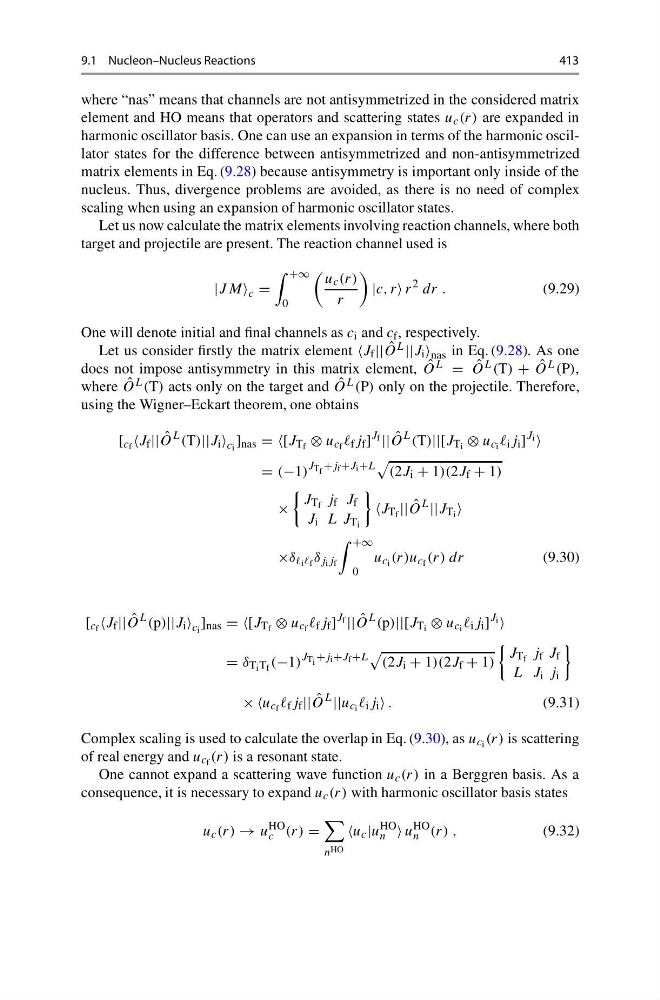
Let us now calculate the matrix elements involving reaction channels, where both
target and projectile are present. The reaction channel used is
|J M c =
+∞
0
u c (r)
r
|c, r r
2 dr .
(9.29)
One will denote initial and final channels as c i and c f , respectively.
Let us consider firstly the matrix element f || ˆ
O L ||J i nas in Eq. (9.28). As one
does not impose antisymmetry in this matrix element, ˆ
O L = ˆ
O L (T) + ˆ
O L (P),
where ˆ
O L (T) acts only on the target and ˆ
O L (P) only on the projectile. Therefore,
using the Wigner–Eckart theorem, one obtains
[ c f f || ˆ
O
L (T)||J i c i ] nas = =[J T f ⊗ u c f f j f ]
J f || ˆ
O
L (T)||[J T i ⊗ u c i i j i ]
J i
= (−1)
J T f +j f +J i +L
(2J i + 1)(2J f + 1)
×
J T f j f J f
J i L J T i
T f || ˆ
O
L
||J T i
×δ i f δ j i j f
+∞
0
u c i (r)u c f (r) dr
(9.30)
[ c f f || ˆ
O
L (p)||J i c i ] nas = =[J T f ⊗ u c f f j f ]
J f || ˆ
O
L (p)||[J T i ⊗ u c i i j i ]
J i
= δ T i T f (−1)
J T i +j i +J f +L
(2J i + 1)(2J f + 1)
J T f j f J f
L J i j i
× ×u c f f j f || ˆ
O
L
||u c i i j i .
(9.31)
Complex scaling is used to calculate the overlap in Eq. (9.30), as u c i (r) is scattering
of real energy and u c f (r) is a resonant state.
One cannot expand a scattering wave function u c (r) in a Berggren basis. As a
consequence, it is necessary to expand u c (r) with harmonic oscillator basis states
u c (r) → u
HO
c (r) =
n HO
c |u
HO
n u
HO
n (r) ,
(9.32)
413
where “nas” means that channels are not antisymmetrized in the considered matrix
element and HO means that operators and scattering states u c (r) are expanded in
harmonic oscillator basis. One can use an expansion in terms of the harmonic oscillator states for the difference between antisymmetrized and non-antisymmetrized
matrix elements in Eq. (9.28) because antisymmetry is important only inside of the
nucleus. Thus, divergence problems are avoided, as there is no need of complex
scaling when using an expansion of harmonic oscillator states.
Let us now calculate the matrix elements involving reaction channels, where both
target and projectile are present. The reaction channel used is
|J M c =
+∞
0
u c (r)
r
|c, r r
2 dr .
(9.29)
One will denote initial and final channels as c i and c f , respectively.
Let us consider firstly the matrix element f || ˆ
O L ||J i nas in Eq. (9.28). As one
does not impose antisymmetry in this matrix element, ˆ
O L = ˆ
O L (T) + ˆ
O L (P),
where ˆ
O L (T) acts only on the target and ˆ
O L (P) only on the projectile. Therefore,
using the Wigner–Eckart theorem, one obtains
[ c f f || ˆ
O
L (T)||J i c i ] nas = =[J T f ⊗ u c f f j f ]
J f || ˆ
O
L (T)||[J T i ⊗ u c i i j i ]
J i
= (−1)
J T f +j f +J i +L
(2J i + 1)(2J f + 1)
×
J T f j f J f
J i L J T i
T f || ˆ
O
L
||J T i
×δ i f δ j i j f
+∞
0
u c i (r)u c f (r) dr
(9.30)
[ c f f || ˆ
O
L (p)||J i c i ] nas = =[J T f ⊗ u c f f j f ]
J f || ˆ
O
L (p)||[J T i ⊗ u c i i j i ]
J i
= δ T i T f (−1)
J T i +j i +J f +L
(2J i + 1)(2J f + 1)
J T f j f J f
L J i j i
× ×u c f f j f || ˆ
O
L
||u c i i j i .
(9.31)
Complex scaling is used to calculate the overlap in Eq. (9.30), as u c i (r) is scattering
of real energy and u c f (r) is a resonant state.
One cannot expand a scattering wave function u c (r) in a Berggren basis. As a
consequence, it is necessary to expand u c (r) with harmonic oscillator basis states
u c (r) → u
HO
c (r) =
n HO
c |u
HO
n u
HO
n (r) ,
(9.32)