

412
9 The Unification of Structure and Reaction Frameworks
consist to a large extent of radiative proton capture. Nuclei 7 Li and 7 Be were also
generated during the big bang nucleosynthesis by the α-particle capture on 3 H and
3 He, respectively. Finally, heavy nuclei are created in stars by nucleon capture, with
the so-called p (proton), r (rapid neutron), and s (slow neutron) capture processes.
Radiative capture reactions in stars occur at very low energies and are peripheral,
so that they mainly depend on the asymptotes of many-body wave functions
involved in these reactions. Many-body wave functions give a correct asymptotic
behavior in the Gamow coupled-channel framework due to the use of the Berggren
basis to expand cluster scattering wave functions. As a consequence, the coupledchannel Gamow shell model is an appropriate theoretical tool to study radiative
capture processes.
Let us now discuss how one can calculate proton and neutron radiative capture
cross sections in the coupled-channel Gamow shell model approach. For this,
one has to calculate the matrix elements of the electromagnetic operators (see
Eqs. (9.53–9.55)). The presence of resonance and scattering states of the Berggren
basis in Eq. (9.5) generates new problems, inexistent in standard reaction models.
A direct calculation of matrix elements involving one-body scattering states of the
Berggren ensemble is indeed not possible. This arises because of the infinite-range
of electromagnetic operators, which induces infinite matrix elements even when
exterior complex scaling is applied. However, if one neglects the antisymmetrization
in |(c, r) = ˆ
A {|Ψ
J T
T ⊗ |Ψ
J P
P
J A
M A
, then the calculation of these matrix elements
involves only overlaps of one resonant state and one scattering state, so that they
converge using complex scaling. Note that the antisymmetry plays a significant
role only close to the target. Indeed, if one considers a projectile scattering state
orthogonal to all the occupied states inside the target, antisymmetry disappears
between target and projectile as the index of the projectile state can be taken to
be larger than the indices of the bound states present in the target. This technique
has been successfully implemented in the shell model embedded in the continuum
(see Refs. [19–21]).
In order to separate target from projectile for a given operator ˆ
O L
M L
, it is sufficient
to assume that all A-nucleons of the target are distinguishable from those of the
projectile:
ˆ
O
L
M L
=
i∈A
ˆ
O
L
M L
(i) + ˆ
O
L
M L
(p) .
(9.27)
In this expression, ˆ
O L
M L
(i) is the part of the many-body operator ˆ
O L
M L
associated to
the i-th nucleon of the target and ˆ
O L
M L
(p) is the operator associated with the onenucleon projectile. The operator ˆ
O L
M L
(i) acts only on the target nucleus, which has
A-nucleons. In this case, channels are not antisymmetrized, and matrix elements can
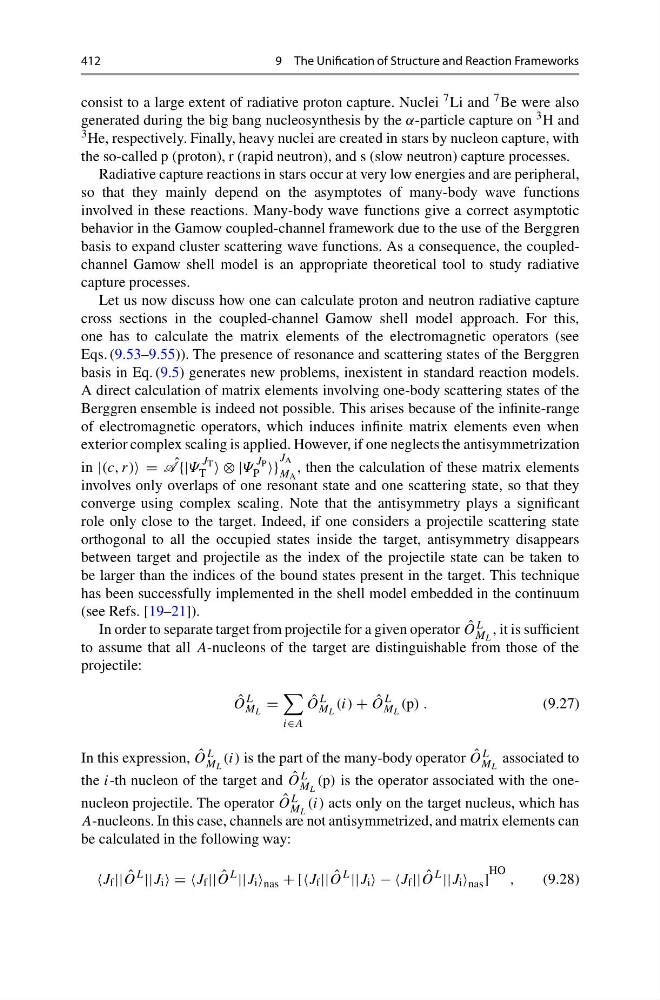
be calculated in the following way:
f || ˆ
O
L
||J i = =J f || ˆ
O
L
||J i nas + [[J f || ˆ
O
L
||J i − −J f || ˆ
O
L
||J i nas ]
HO ,
(9.28)
9 The Unification of Structure and Reaction Frameworks
consist to a large extent of radiative proton capture. Nuclei 7 Li and 7 Be were also
generated during the big bang nucleosynthesis by the α-particle capture on 3 H and
3 He, respectively. Finally, heavy nuclei are created in stars by nucleon capture, with
the so-called p (proton), r (rapid neutron), and s (slow neutron) capture processes.
Radiative capture reactions in stars occur at very low energies and are peripheral,
so that they mainly depend on the asymptotes of many-body wave functions
involved in these reactions. Many-body wave functions give a correct asymptotic
behavior in the Gamow coupled-channel framework due to the use of the Berggren
basis to expand cluster scattering wave functions. As a consequence, the coupledchannel Gamow shell model is an appropriate theoretical tool to study radiative
capture processes.
Let us now discuss how one can calculate proton and neutron radiative capture
cross sections in the coupled-channel Gamow shell model approach. For this,
one has to calculate the matrix elements of the electromagnetic operators (see
Eqs. (9.53–9.55)). The presence of resonance and scattering states of the Berggren
basis in Eq. (9.5) generates new problems, inexistent in standard reaction models.
A direct calculation of matrix elements involving one-body scattering states of the
Berggren ensemble is indeed not possible. This arises because of the infinite-range
of electromagnetic operators, which induces infinite matrix elements even when
exterior complex scaling is applied. However, if one neglects the antisymmetrization
in |(c, r) = ˆ
A {|Ψ
J T
T ⊗ |Ψ
J P
P
J A
M A
, then the calculation of these matrix elements
involves only overlaps of one resonant state and one scattering state, so that they
converge using complex scaling. Note that the antisymmetry plays a significant
role only close to the target. Indeed, if one considers a projectile scattering state
orthogonal to all the occupied states inside the target, antisymmetry disappears
between target and projectile as the index of the projectile state can be taken to
be larger than the indices of the bound states present in the target. This technique
has been successfully implemented in the shell model embedded in the continuum
(see Refs. [19–21]).
In order to separate target from projectile for a given operator ˆ
O L
M L
, it is sufficient
to assume that all A-nucleons of the target are distinguishable from those of the
projectile:
ˆ
O
L
M L
=
i∈A
ˆ
O
L
M L
(i) + ˆ
O
L
M L
(p) .
(9.27)
In this expression, ˆ
O L
M L
(i) is the part of the many-body operator ˆ
O L
M L
associated to
the i-th nucleon of the target and ˆ
O L
M L
(p) is the operator associated with the onenucleon projectile. The operator ˆ
O L
M L
(i) acts only on the target nucleus, which has
A-nucleons. In this case, channels are not antisymmetrized, and matrix elements can
be calculated in the following way:
f || ˆ
O
L
||J i = =J f || ˆ
O
L
||J i nas + [[J f || ˆ
O
L
||J i − −J f || ˆ
O
L
||J i nas ]
HO ,
(9.28)