

392
8 No-Core Gamow Shell Model
The main problem arising in Gamow shell model and absent in standard shell
model is the optimization of the single-particle basis, as discussed in Sect. 5.5.
The first calculations involving the ˆ ¯
Q-box method in Gamow shell model were
done using a Woods–Saxon potential to generate the single-particle basis. This was
not an optimal solution, however, because the many-body perturbation expansion
poorly converges when the basis potential is of Woods–Saxon type [70]. Much better
convergence was obtained if the Berggren basis was generated by the Hartree–Fock
potential of the Hamiltonian. Indeed, the use of the Hartree–Fock potential allows
to cancel many diagrams of the many-body perturbation theory.
In order to apply the ˆ ¯
Q-box method, one separates the many-body Hamiltonian (8.1) into a zeroth-order part ˆ
H 0 and a perturbation ˆ
V :
ˆ
H = ˆ
H 0 + ( ˆ
H − ˆ
H 0 ) = ˆ
H 0 + ˆ
V .
(8.13)
The Hartree–Fock Hamiltonian is used for ˆ
H 0 , and the ˆ ¯
Q-box folded-diagram
calculation are performed in the basis generated by the multi-Slater determinant
coupled Hartree–Fock method.
A powerful renormalization method of many-body perturbation theory is that
of the extended Kuo–Krenciglowa method [133] which was originally derived
with degenerate basis states. However, one-body states of Berggren ensemble have
different energies, so it is preferable to use the extended Kuo–Krenciglowa method
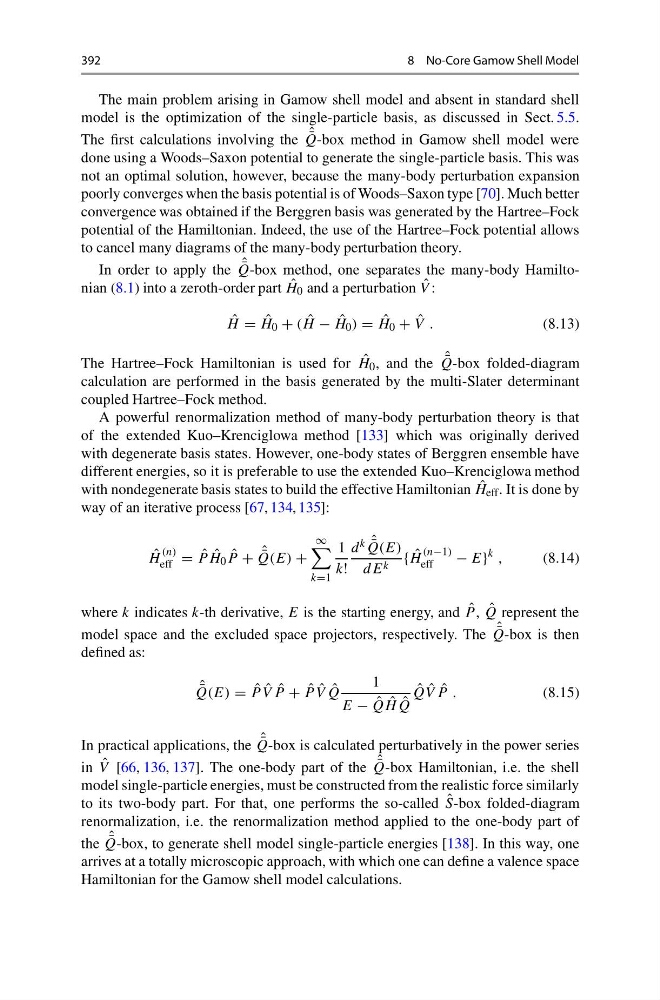
with nondegenerate basis states to build the effective Hamiltonian ˆ
H eff . It is done by
way of an iterative process [67, 134, 135]:
ˆ
H
(n)
eff = ˆ
P ˆ
H 0 ˆ
P + ˆ ¯
Q(E) +
∞
k=1
1
k!
d k ˆ ¯
Q(E)
dE k { ˆ
H
(n−1)
eff
− E}
k ,
(8.14)
where k indicates k-th derivative, E is the starting energy, and ˆ
P , ˆ
Q represent the
model space and the excluded space projectors, respectively. The ˆ ¯
Q-box is then
defined as:
ˆ ¯
Q(E) = ˆ
P ˆ
V ˆ
P + ˆ
P ˆ
V ˆ
Q
1
E − ˆ
Q ˆ
H ˆ
Q
ˆ
Q ˆ
V ˆ
P .
(8.15)
In practical applications, the ˆ ¯
Q-box is calculated perturbatively in the power series
in ˆ
V [66, 136, 137]. The one-body part of the ˆ ¯
Q-box Hamiltonian, i.e. the shell
model single-particle energies, must be constructed from the realistic force similarly
to its two-body part. For that, one performs the so-called ˆ
S-box folded-diagram
renormalization, i.e. the renormalization method applied to the one-body part of
the ˆ ¯
Q-box, to generate shell model single-particle energies [138]. In this way, one
arrives at a totally microscopic approach, with which one can define a valence space
Hamiltonian for the Gamow shell model calculations.
8 No-Core Gamow Shell Model
The main problem arising in Gamow shell model and absent in standard shell
model is the optimization of the single-particle basis, as discussed in Sect. 5.5.
The first calculations involving the ˆ ¯
Q-box method in Gamow shell model were
done using a Woods–Saxon potential to generate the single-particle basis. This was
not an optimal solution, however, because the many-body perturbation expansion
poorly converges when the basis potential is of Woods–Saxon type [70]. Much better
convergence was obtained if the Berggren basis was generated by the Hartree–Fock
potential of the Hamiltonian. Indeed, the use of the Hartree–Fock potential allows
to cancel many diagrams of the many-body perturbation theory.
In order to apply the ˆ ¯
Q-box method, one separates the many-body Hamiltonian (8.1) into a zeroth-order part ˆ
H 0 and a perturbation ˆ
V :
ˆ
H = ˆ
H 0 + ( ˆ
H − ˆ
H 0 ) = ˆ
H 0 + ˆ
V .
(8.13)
The Hartree–Fock Hamiltonian is used for ˆ
H 0 , and the ˆ ¯
Q-box folded-diagram
calculation are performed in the basis generated by the multi-Slater determinant
coupled Hartree–Fock method.
A powerful renormalization method of many-body perturbation theory is that
of the extended Kuo–Krenciglowa method [133] which was originally derived
with degenerate basis states. However, one-body states of Berggren ensemble have
different energies, so it is preferable to use the extended Kuo–Krenciglowa method
with nondegenerate basis states to build the effective Hamiltonian ˆ
H eff . It is done by
way of an iterative process [67, 134, 135]:
ˆ
H
(n)
eff = ˆ
P ˆ
H 0 ˆ
P + ˆ ¯
Q(E) +
∞
k=1
1
k!
d k ˆ ¯
Q(E)
dE k { ˆ
H
(n−1)
eff
− E}
k ,
(8.14)
where k indicates k-th derivative, E is the starting energy, and ˆ
P , ˆ
Q represent the
model space and the excluded space projectors, respectively. The ˆ ¯
Q-box is then
defined as:
ˆ ¯
Q(E) = ˆ
P ˆ
V ˆ
P + ˆ
P ˆ
V ˆ
Q
1
E − ˆ
Q ˆ
H ˆ
Q
ˆ
Q ˆ
V ˆ
P .
(8.15)
In practical applications, the ˆ ¯
Q-box is calculated perturbatively in the power series
in ˆ
V [66, 136, 137]. The one-body part of the ˆ ¯
Q-box Hamiltonian, i.e. the shell
model single-particle energies, must be constructed from the realistic force similarly
to its two-body part. For that, one performs the so-called ˆ
S-box folded-diagram
renormalization, i.e. the renormalization method applied to the one-body part of
the ˆ ¯
Q-box, to generate shell model single-particle energies [138]. In this way, one
arrives at a totally microscopic approach, with which one can define a valence space
Hamiltonian for the Gamow shell model calculations.