

8.4 Renormalization of Realistic Interactions in a Finite Model Space Using. . .
391
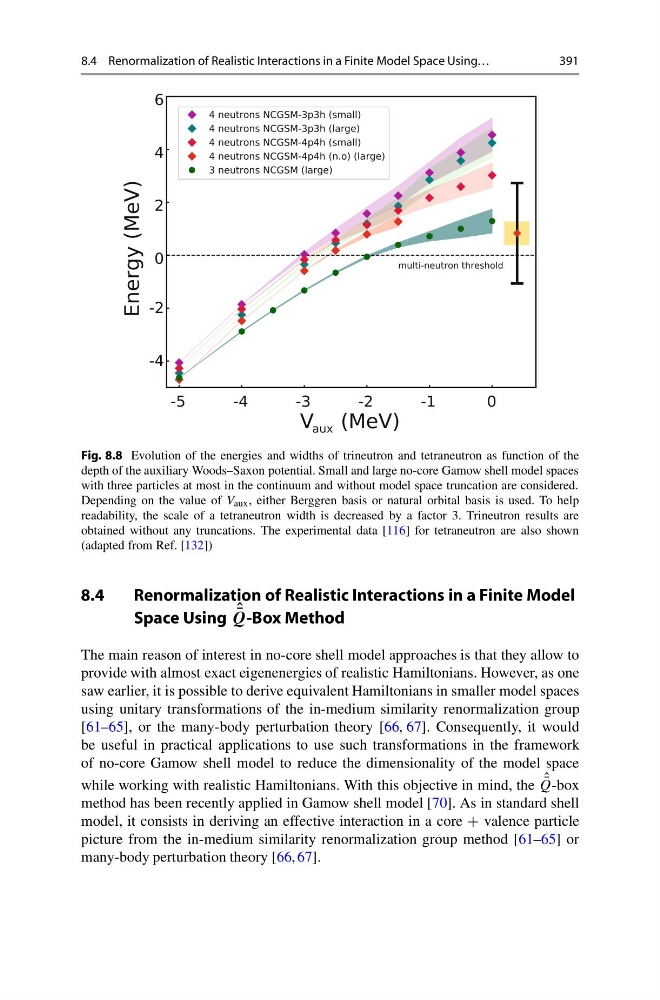
Fig. 8.8 Evolution of the energies and widths of trineutron and tetraneutron as function of the
depth of the auxiliary Woods–Saxon potential. Small and large no-core Gamow shell model spaces
with three particles at most in the continuum and without model space truncation are considered.
Depending on the value of V aux , either Berggren basis or natural orbital basis is used. To help
readability, the scale of a tetraneutron width is decreased by a factor 3. Trineutron results are
obtained without any truncations. The experimental data [116] for tetraneutron are also shown
(adapted from Ref. [132])
8.4
Renormalization of Realistic Interactions in a Finite Model
Space Using ˆ ¯
Q-Box Method
The main reason of interest in no-core shell model approaches is that they allow to
provide with almost exact eigenenergies of realistic Hamiltonians. However, as one
saw earlier, it is possible to derive equivalent Hamiltonians in smaller model spaces
using unitary transformations of the in-medium similarity renormalization group
[61–65], or the many-body perturbation theory [66, 67]. Consequently, it would
be useful in practical applications to use such transformations in the framework
of no-core Gamow shell model to reduce the dimensionality of the model space
while working with realistic Hamiltonians. With this objective in mind, the ˆ ¯
Q-box
method has been recently applied in Gamow shell model [70]. As in standard shell
model, it consists in deriving an effective interaction in a core + valence particle
picture from the in-medium similarity renormalization group method [61–65] or
many-body perturbation theory [66, 67].
391
Fig. 8.8 Evolution of the energies and widths of trineutron and tetraneutron as function of the
depth of the auxiliary Woods–Saxon potential. Small and large no-core Gamow shell model spaces
with three particles at most in the continuum and without model space truncation are considered.
Depending on the value of V aux , either Berggren basis or natural orbital basis is used. To help
readability, the scale of a tetraneutron width is decreased by a factor 3. Trineutron results are
obtained without any truncations. The experimental data [116] for tetraneutron are also shown
(adapted from Ref. [132])
8.4
Renormalization of Realistic Interactions in a Finite Model
Space Using ˆ ¯
Q-Box Method
The main reason of interest in no-core shell model approaches is that they allow to
provide with almost exact eigenenergies of realistic Hamiltonians. However, as one
saw earlier, it is possible to derive equivalent Hamiltonians in smaller model spaces
using unitary transformations of the in-medium similarity renormalization group
[61–65], or the many-body perturbation theory [66, 67]. Consequently, it would
be useful in practical applications to use such transformations in the framework
of no-core Gamow shell model to reduce the dimensionality of the model space
while working with realistic Hamiltonians. With this objective in mind, the ˆ ¯
Q-box
method has been recently applied in Gamow shell model [70]. As in standard shell
model, it consists in deriving an effective interaction in a core + valence particle
picture from the in-medium similarity renormalization group method [61–65] or
many-body perturbation theory [66, 67].