

8.1 Formulation of the No-Core Gamow Shell Model
371
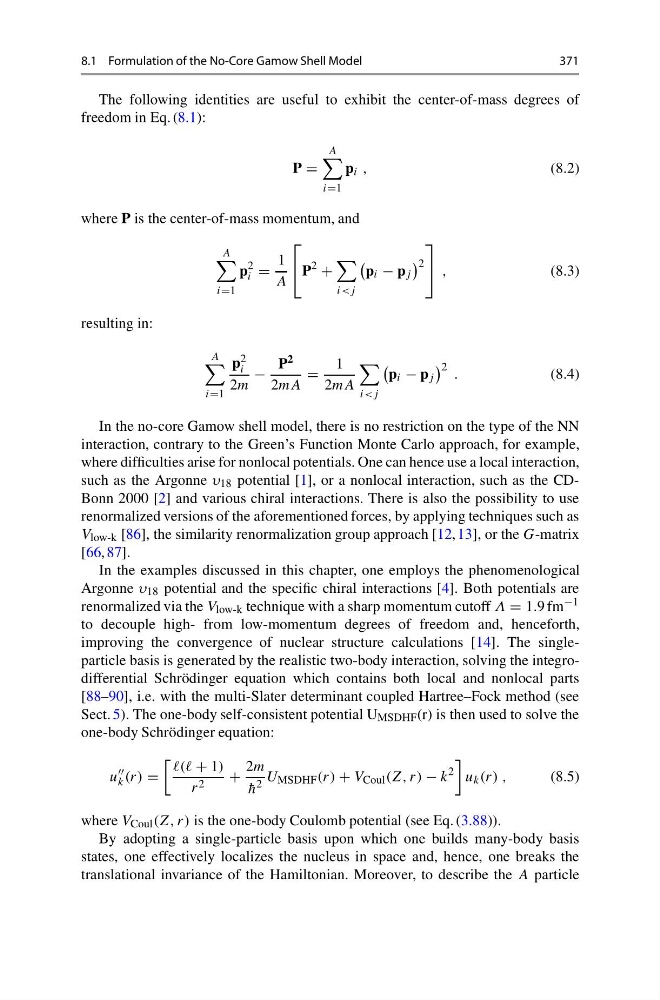
The following identities are useful to exhibit the center-of-mass degrees of
freedom in Eq. (8.1):
P =
A
i=1
p i ,
(8.2)
where P is the center-of-mass momentum, and
A
i=1
p
2
i =
1
A
⎡
⎣ P
2
+
i
2
⎤
⎦ ,
(8.3)
resulting in:
A
i=1
p 2
i
2m
−
P 2
2mA
=
1
2mA
i
2 .
(8.4)
In the no-core Gamow shell model, there is no restriction on the type of the NN
interaction, contrary to the Green’s Function Monte Carlo approach, for example,
where difficulties arise for nonlocal potentials. One can hence use a local interaction,
such as the Argonne υ 18 potential [1], or a nonlocal interaction, such as the CDBonn 2000 [2] and various chiral interactions. There is also the possibility to use
renormalized versions of the aforementioned forces, by applying techniques such as
V low-k [86], the similarity renormalization group approach [12, 13], or the G-matrix
[66, 87].
In the examples discussed in this chapter, one employs the phenomenological
Argonne υ 18 potential and the specific chiral interactions [4]. Both potentials are
renormalized via the V low-k technique with a sharp momentum cutoff Λ = 1.9 fm −1
to decouple high- from low-momentum degrees of freedom and, henceforth,
improving the convergence of nuclear structure calculations [14]. The singleparticle basis is generated by the realistic two-body interaction, solving the integrodifferential Schrödinger equation which contains both local and nonlocal parts
[88–90], i.e. with the multi-Slater determinant coupled Hartree–Fock method (see
Sect. 5). The one-body self-consistent potential U MSDHF (r) is then used to solve the
one-body Schrödinger equation:
u
k (r) =
+ 1)
r 2
+
2m
¯
h
2
U MSDHF (r) + V Coul (Z, r) − k
2
u k (r) ,
(8.5)
where V Coul (Z, r) is the one-body Coulomb potential (see Eq. (3.88)).
By adopting a single-particle basis upon which one builds many-body basis
states, one effectively localizes the nucleus in space and, hence, one breaks the
translational invariance of the Hamiltonian. Moreover, to describe the A particle
371
The following identities are useful to exhibit the center-of-mass degrees of
freedom in Eq. (8.1):
P =
A
i=1
p i ,
(8.2)
where P is the center-of-mass momentum, and
A
i=1
p
2
i =
1
A
⎡
⎣ P
2
+
i
2
⎤
⎦ ,
(8.3)
resulting in:
A
i=1
p 2
i
2m
−
P 2
2mA
=
1
2mA
i
2 .
(8.4)
In the no-core Gamow shell model, there is no restriction on the type of the NN
interaction, contrary to the Green’s Function Monte Carlo approach, for example,
where difficulties arise for nonlocal potentials. One can hence use a local interaction,
such as the Argonne υ 18 potential [1], or a nonlocal interaction, such as the CDBonn 2000 [2] and various chiral interactions. There is also the possibility to use
renormalized versions of the aforementioned forces, by applying techniques such as
V low-k [86], the similarity renormalization group approach [12, 13], or the G-matrix
[66, 87].
In the examples discussed in this chapter, one employs the phenomenological
Argonne υ 18 potential and the specific chiral interactions [4]. Both potentials are
renormalized via the V low-k technique with a sharp momentum cutoff Λ = 1.9 fm −1
to decouple high- from low-momentum degrees of freedom and, henceforth,
improving the convergence of nuclear structure calculations [14]. The singleparticle basis is generated by the realistic two-body interaction, solving the integrodifferential Schrödinger equation which contains both local and nonlocal parts
[88–90], i.e. with the multi-Slater determinant coupled Hartree–Fock method (see
Sect. 5). The one-body self-consistent potential U MSDHF (r) is then used to solve the
one-body Schrödinger equation:
u
k (r) =
+ 1)
r 2
+
2m
¯
h
2
U MSDHF (r) + V Coul (Z, r) − k
2
u k (r) ,
(8.5)
where V Coul (Z, r) is the one-body Coulomb potential (see Eq. (3.88)).
By adopting a single-particle basis upon which one builds many-body basis
states, one effectively localizes the nucleus in space and, hence, one breaks the
translational invariance of the Hamiltonian. Moreover, to describe the A particle