

370
8 No-Core Gamow Shell Model
describe deformed nuclei, where basis states are issued from solvable Hamiltonians
bearing SU(3) symmetry, so that deformation is included in basis states [76–
78]. SU(3) symmetry arises from the fact that basis states are described in
terms of irreducible representations of the Sp(3,R) symplectic group [76]. As a
consequence, the shell model framework based on the use of basis states bearing
SU(3) symmetry is also called symplectic shell model. The symplectic symmetry
borne by SU(3) basis states allows to classify the shell model space in different
irreducible representations labeled by two collective quantum numbers [79,80]. The
fundamental interest of symplectic irreducible representations is that the dominant
representations of nuclear states bear small quantum numbers, so that symplectic
shell model space dimensions are greatly reduced as compared to standard shell
model [76]. Usefulness of the symplectic symmetry has been confirmed in many
ab initio calculations [80–83]. A successful description of light nuclei, including in
particular the Hoyle state of 12 C, can then be obtained with very small model space
dimensions [78].
Another class of models which also allow to include the continuum couplings
is based on the solution of Faddeev and Faddeev–Yakubovsky equations [84, 85].
These models are, however, typically restricted to A ≤ 5 nuclei due to computer
limitations. The only general ab initio approach including continuum couplings
is that of the no-core shell model with continuum [31–40], where the degrees of
freedom of unbound states are accounted for by coupled channel equations. While
theoretically justified, it nevertheless becomes quickly inapplicable in practice due
to the growing dimensions of model spaces. Moreover, particle-emission channels
are non-orthogonal in general, which can generate problems due to overcomplete
model spaces. Up to now, the heaviest nuclear system considered in the no-core
shell model with continuum is that of 11 Be [45].
An alternative ab initio theoretical approach, which also includes the continuum
coupling, is based on the generalization of Gamow shell model. This no-core
Gamow shell model, which can describe weakly bound and unbound states of light
nuclei using realistic interactions and allowing all nucleons to be active, will be
discussed in next sections. This fully microscopic model is using the Berggren
ensemble of single-particle states to build Slater determinants.
8.1
Formulation of the No-Core Gamow Shell Model
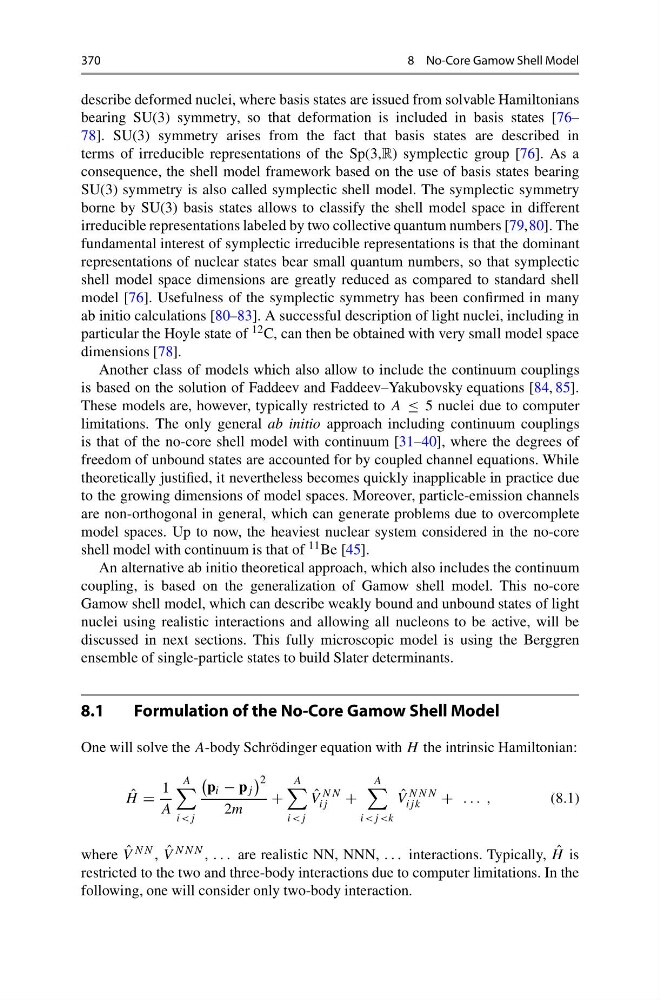
One will solve the A-body Schrödinger equation with H the intrinsic Hamiltonian:
ˆ
H =
1
A
A
i
2
2m
+
A
i
V
NN
ij
+
A
i
V
NNN
ij k
+ . . . ,
(8.1)
where ˆ
V NN , ˆ
V NNN , . . . are realistic NN, NNN, . . . interactions. Typically, ˆ
H is
restricted to the two and three-body interactions due to computer limitations. In the
following, one will consider only two-body interaction.
8 No-Core Gamow Shell Model
describe deformed nuclei, where basis states are issued from solvable Hamiltonians
bearing SU(3) symmetry, so that deformation is included in basis states [76–
78]. SU(3) symmetry arises from the fact that basis states are described in
terms of irreducible representations of the Sp(3,R) symplectic group [76]. As a
consequence, the shell model framework based on the use of basis states bearing
SU(3) symmetry is also called symplectic shell model. The symplectic symmetry
borne by SU(3) basis states allows to classify the shell model space in different
irreducible representations labeled by two collective quantum numbers [79,80]. The
fundamental interest of symplectic irreducible representations is that the dominant
representations of nuclear states bear small quantum numbers, so that symplectic
shell model space dimensions are greatly reduced as compared to standard shell
model [76]. Usefulness of the symplectic symmetry has been confirmed in many
ab initio calculations [80–83]. A successful description of light nuclei, including in
particular the Hoyle state of 12 C, can then be obtained with very small model space
dimensions [78].
Another class of models which also allow to include the continuum couplings
is based on the solution of Faddeev and Faddeev–Yakubovsky equations [84, 85].
These models are, however, typically restricted to A ≤ 5 nuclei due to computer
limitations. The only general ab initio approach including continuum couplings
is that of the no-core shell model with continuum [31–40], where the degrees of
freedom of unbound states are accounted for by coupled channel equations. While
theoretically justified, it nevertheless becomes quickly inapplicable in practice due
to the growing dimensions of model spaces. Moreover, particle-emission channels
are non-orthogonal in general, which can generate problems due to overcomplete
model spaces. Up to now, the heaviest nuclear system considered in the no-core
shell model with continuum is that of 11 Be [45].
An alternative ab initio theoretical approach, which also includes the continuum
coupling, is based on the generalization of Gamow shell model. This no-core
Gamow shell model, which can describe weakly bound and unbound states of light
nuclei using realistic interactions and allowing all nucleons to be active, will be
discussed in next sections. This fully microscopic model is using the Berggren
ensemble of single-particle states to build Slater determinants.
8.1
Formulation of the No-Core Gamow Shell Model
One will solve the A-body Schrödinger equation with H the intrinsic Hamiltonian:
ˆ
H =
1
A
A
i
2
2m
+
A
i
V
NN
ij
+
A
i
V
NNN
ij k
+ . . . ,
(8.1)
where ˆ
V NN , ˆ
V NNN , . . . are realistic NN, NNN, . . . interactions. Typically, ˆ
H is
restricted to the two and three-body interactions due to computer limitations. In the
following, one will consider only two-body interaction.