

7.5 Mirror Nuclei and Isospin Symmetry Breaking
357
between 5 He and 6 He wave functions is not very large. Indeed, the bound asymptote
of 6 He is entirely due to continuum coupling, whereas its pole approximation,
consisting of two 0p 3/2 resonant neutron states, is unbound. This decreases the
probability to find a resonance 5 He ground state in the wave function of the 6 He
ground state. On the contrary, the ground states of 5 Li and 6 Be are both unbound,
so that their associated spectroscopic factor is closer to one.
Exercise IV
One will illustrate Wigner cusps in spectroscopic factors in different partial waves
by considering a numerical example involving s, d shells in the pairs 13 C/ 14 C and
13 N/ 14 O. Even though these nuclei are p-shell nuclei, one will concentrate on their
excited states, where p-shells are unimportant. In this study, one will use a core
of 12 C.
A. Point out the advantages and disadvantages of the use of a 12 C core in a shell
model. For this, one will take into account the closed-shell character of the 12 C
ground state at the Hartree–Fock level, as well as the oblate deformation of the
12 C ground state.
B. In the following, we will concentrate on the spectroscopic factors involving
s and d shells. Explain why the 0p 1/2 valence shells are unimportant for this
study. Present the current situation when isospin symmetry is exact and explain
why the isospin symmetry breaking is important in this example.
C. Run the two-body Gamow shell model code in cluster orbital shell model
coordinates to calculate spectroscopic factors 13 C/ 14 C and 13 N/ 14 O.
Plot the spectroscopic factors and their derivatives as a function of energy, and
explain the presence or absence of Wigner cusps at S 1n/1p =0 MeV.
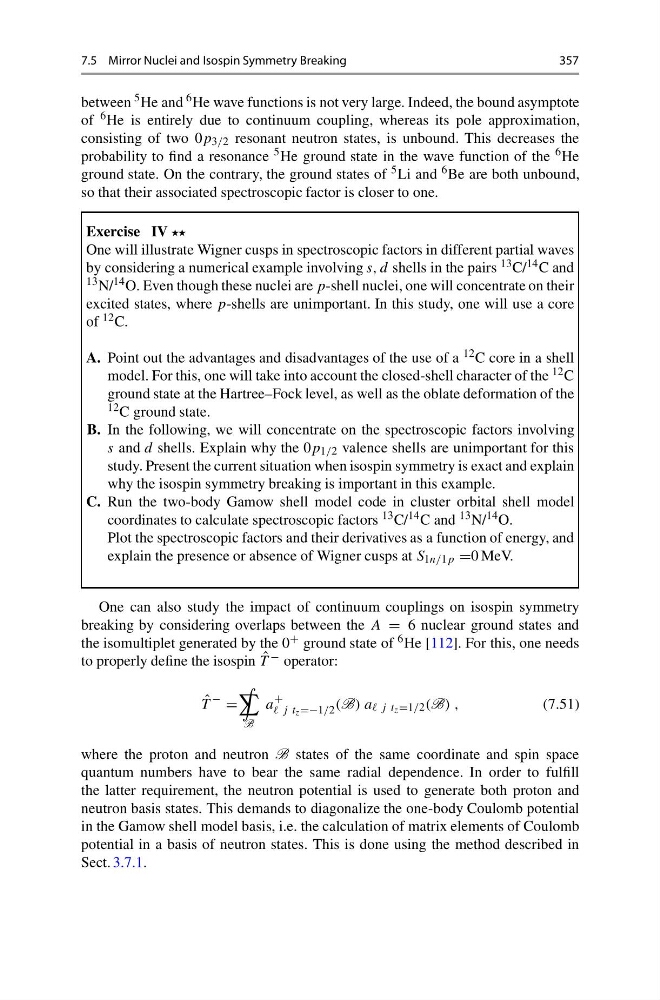
One can also study the impact of continuum couplings on isospin symmetry
breaking by considering overlaps between the A = 6 nuclear ground states and
the isomultiplet generated by the 0 + ground state of 6 He [112]. For this, one needs
to properly define the isospin ˆ
T − operator:
ˆ
T
−
=
B
a
+
j t z =−1/2 (B) a j t z =1/2 (B) ,
(7.51)
where the proton and neutron B states of the same coordinate and spin space
quantum numbers have to bear the same radial dependence. In order to fulfill
the latter requirement, the neutron potential is used to generate both proton and
neutron basis states. This demands to diagonalize the one-body Coulomb potential
in the Gamow shell model basis, i.e. the calculation of matrix elements of Coulomb
potential in a basis of neutron states. This is done using the method described in
Sect. 3.7.1.
357
between 5 He and 6 He wave functions is not very large. Indeed, the bound asymptote
of 6 He is entirely due to continuum coupling, whereas its pole approximation,
consisting of two 0p 3/2 resonant neutron states, is unbound. This decreases the
probability to find a resonance 5 He ground state in the wave function of the 6 He
ground state. On the contrary, the ground states of 5 Li and 6 Be are both unbound,
so that their associated spectroscopic factor is closer to one.
Exercise IV
One will illustrate Wigner cusps in spectroscopic factors in different partial waves
by considering a numerical example involving s, d shells in the pairs 13 C/ 14 C and
13 N/ 14 O. Even though these nuclei are p-shell nuclei, one will concentrate on their
excited states, where p-shells are unimportant. In this study, one will use a core
of 12 C.
A. Point out the advantages and disadvantages of the use of a 12 C core in a shell
model. For this, one will take into account the closed-shell character of the 12 C
ground state at the Hartree–Fock level, as well as the oblate deformation of the
12 C ground state.
B. In the following, we will concentrate on the spectroscopic factors involving
s and d shells. Explain why the 0p 1/2 valence shells are unimportant for this
study. Present the current situation when isospin symmetry is exact and explain
why the isospin symmetry breaking is important in this example.
C. Run the two-body Gamow shell model code in cluster orbital shell model
coordinates to calculate spectroscopic factors 13 C/ 14 C and 13 N/ 14 O.
Plot the spectroscopic factors and their derivatives as a function of energy, and
explain the presence or absence of Wigner cusps at S 1n/1p =0 MeV.
One can also study the impact of continuum couplings on isospin symmetry
breaking by considering overlaps between the A = 6 nuclear ground states and
the isomultiplet generated by the 0 + ground state of 6 He [112]. For this, one needs
to properly define the isospin ˆ
T − operator:
ˆ
T
−
=
B
a
+
j t z =−1/2 (B) a j t z =1/2 (B) ,
(7.51)
where the proton and neutron B states of the same coordinate and spin space
quantum numbers have to bear the same radial dependence. In order to fulfill
the latter requirement, the neutron potential is used to generate both proton and
neutron basis states. This demands to diagonalize the one-body Coulomb potential
in the Gamow shell model basis, i.e. the calculation of matrix elements of Coulomb
potential in a basis of neutron states. This is done using the method described in
Sect. 3.7.1.