

356
7 Wave Functions in the Vicinity of Particle-Emission Threshold
unbound 6 Be. However, when the A = 5 nucleon ground state is unbound (E T > 0),
or when E T ≤ 0 and S 1n < 0 for 6 He, i.e. when 6 He is unbound with respect
to a bound 5 He, the nonresonant continuum plays an important role for both real
and imaginary parts of spectroscopic factors. In particular, when E T > 0 and
S 1p /S 1n ≥ 0, c ] is negative, which implies that 1. Moreover, c ]
and c ] are comparable therein, although this does not occur every time that
1. As a result, spectroscopic factors obtained solely via A-body resonances
cannot fully reproduce the experimental spectroscopic factor, which can contain an
important nonresonant contribution. The requirement of unitarity oblige us to keep
both resonant and nonresonant contributions, as otherwise their artificial separation
leads to errors.
Let us now consider a physical situation of 0 + and 2 + states of 6 He, 6 Li, and
6 Be, which belong to the T = 1 triplet in the absence of Coulomb interaction [112].
The 0 + and 2 + states of 6 He are fitted to their experimental value. This fixes the
nuclear part of the Hamiltonian. Consequently, the Hamiltonian differs only by the
way of its Coulomb part for 6 Li and 6 Be.
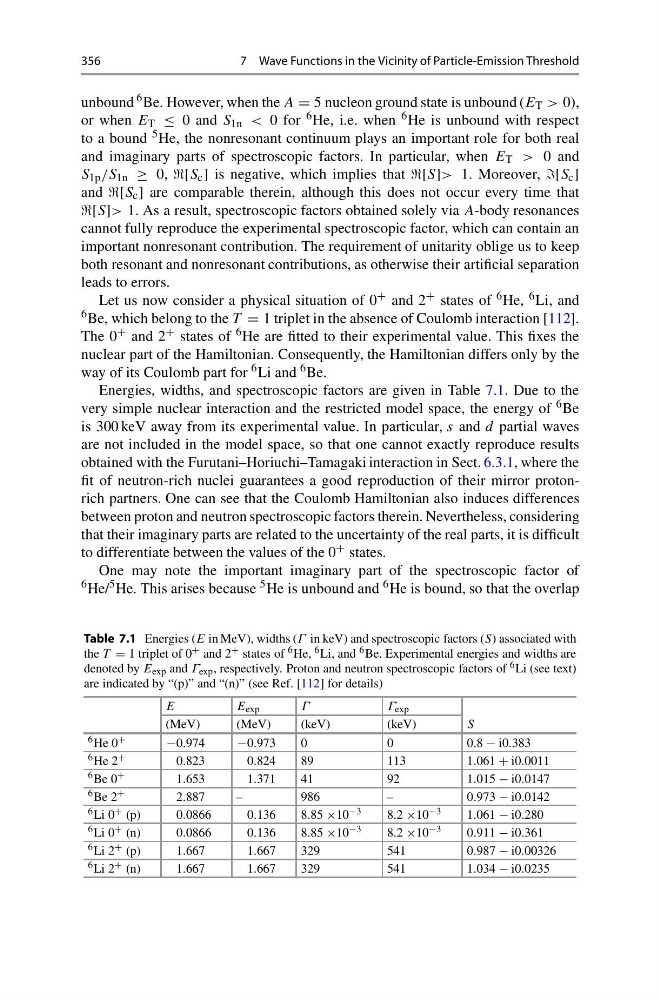
Energies, widths, and spectroscopic factors are given in Table 7.1. Due to the
very simple nuclear interaction and the restricted model space, the energy of 6 Be
is 300 keV away from its experimental value. In particular, s and d partial waves
are not included in the model space, so that one cannot exactly reproduce results
obtained with the Furutani–Horiuchi–Tamagaki interaction in Sect. 6.3.1, where the
fit of neutron-rich nuclei guarantees a good reproduction of their mirror protonrich partners. One can see that the Coulomb Hamiltonian also induces differences
between proton and neutron spectroscopic factors therein. Nevertheless, considering
that their imaginary parts are related to the uncertainty of the real parts, it is difficult
to differentiate between the values of the 0 + states.
One may note the important imaginary part of the spectroscopic factor of
6 He/ 5 He. This arises because 5 He is unbound and 6 He is bound, so that the overlap
Table 7.1 Energies (E in MeV), widths (Γ in keV) and spectroscopic factors (S) associated with
the T = 1 triplet of 0 + and 2 + states of 6 He, 6 Li, and 6 Be. Experimental energies and widths are
denoted by E exp and Γ exp , respectively. Proton and neutron spectroscopic factors of 6 Li (see text)
are indicated by “(p)” and “(n)” (see Ref. [112] for details)
E
E exp
Γ
Γ exp
(MeV)
(MeV)
(keV)
(keV)
S
6 He 0 +
−0.974
−0.973
0
0
0.8 − i0.383
6 He 2 +
0.823
0.824
89
113
1.061 + i0.0011
6 Be 0 +
1.653
1.371
41
92
1.015 − i0.0147
6 Be 2 +
2.887
–
986
–
0.973 − i0.0142
6 Li 0 + (p)
0.0866
0.136
8.85 ×10 −3
8.2 ×10 −3
1.061 − i0.280
6 Li 0 + (n)
0.0866
0.136
8.85 ×10 −3
8.2 ×10 −3
0.911 − i0.361
6 Li 2 + (p)
1.667
1.667
329
541
0.987 − i0.00326
6 Li 2 + (n)
1.667
1.667
329
541
1.034 − i0.0235
7 Wave Functions in the Vicinity of Particle-Emission Threshold
unbound 6 Be. However, when the A = 5 nucleon ground state is unbound (E T > 0),
or when E T ≤ 0 and S 1n < 0 for 6 He, i.e. when 6 He is unbound with respect
to a bound 5 He, the nonresonant continuum plays an important role for both real
and imaginary parts of spectroscopic factors. In particular, when E T > 0 and
S 1p /S 1n ≥ 0, c ] is negative, which implies that 1. Moreover, c ]
and c ] are comparable therein, although this does not occur every time that
1. As a result, spectroscopic factors obtained solely via A-body resonances
cannot fully reproduce the experimental spectroscopic factor, which can contain an
important nonresonant contribution. The requirement of unitarity oblige us to keep
both resonant and nonresonant contributions, as otherwise their artificial separation
leads to errors.
Let us now consider a physical situation of 0 + and 2 + states of 6 He, 6 Li, and
6 Be, which belong to the T = 1 triplet in the absence of Coulomb interaction [112].
The 0 + and 2 + states of 6 He are fitted to their experimental value. This fixes the
nuclear part of the Hamiltonian. Consequently, the Hamiltonian differs only by the
way of its Coulomb part for 6 Li and 6 Be.
Energies, widths, and spectroscopic factors are given in Table 7.1. Due to the
very simple nuclear interaction and the restricted model space, the energy of 6 Be
is 300 keV away from its experimental value. In particular, s and d partial waves
are not included in the model space, so that one cannot exactly reproduce results
obtained with the Furutani–Horiuchi–Tamagaki interaction in Sect. 6.3.1, where the
fit of neutron-rich nuclei guarantees a good reproduction of their mirror protonrich partners. One can see that the Coulomb Hamiltonian also induces differences
between proton and neutron spectroscopic factors therein. Nevertheless, considering
that their imaginary parts are related to the uncertainty of the real parts, it is difficult
to differentiate between the values of the 0 + states.
One may note the important imaginary part of the spectroscopic factor of
6 He/ 5 He. This arises because 5 He is unbound and 6 He is bound, so that the overlap
Table 7.1 Energies (E in MeV), widths (Γ in keV) and spectroscopic factors (S) associated with
the T = 1 triplet of 0 + and 2 + states of 6 He, 6 Li, and 6 Be. Experimental energies and widths are
denoted by E exp and Γ exp , respectively. Proton and neutron spectroscopic factors of 6 Li (see text)
are indicated by “(p)” and “(n)” (see Ref. [112] for details)
E
E exp
Γ
Γ exp
(MeV)
(MeV)
(keV)
(keV)
S
6 He 0 +
−0.974
−0.973
0
0
0.8 − i0.383
6 He 2 +
0.823
0.824
89
113
1.061 + i0.0011
6 Be 0 +
1.653
1.371
41
92
1.015 − i0.0147
6 Be 2 +
2.887
–
986
–
0.973 − i0.0142
6 Li 0 + (p)
0.0866
0.136
8.85 ×10 −3
8.2 ×10 −3
1.061 − i0.280
6 Li 0 + (n)
0.0866
0.136
8.85 ×10 −3
8.2 ×10 −3
0.911 − i0.361
6 Li 2 + (p)
1.667
1.667
329
541
0.987 − i0.00326
6 Li 2 + (n)
1.667
1.667
329
541
1.034 − i0.0235