

7.5 Mirror Nuclei and Isospin Symmetry Breaking
353
ν π
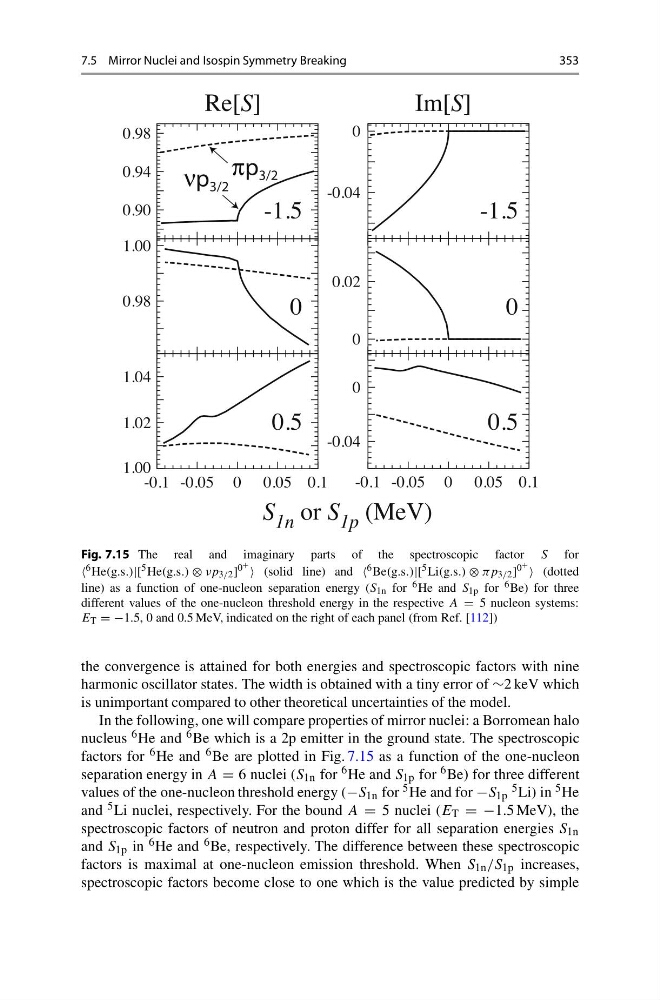
Fig. 7.15 The real and imaginary parts of the spectroscopic factor S for
6 He(g.s.)|[ 5 He(g.s.) ⊗ νp 3/2 ] 0 + (solid line) and 6 Be(g.s.)|[ 5 Li(g.s.) ⊗ πp 3/2 ] 0 + (dotted
line) as a function of one-nucleon separation energy (S 1n for 6 He and S 1p for 6 Be) for three
different values of the one-nucleon threshold energy in the respective A = 5 nucleon systems:
E T = −1.5, 0 and 0.5 MeV, indicated on the right of each panel (from Ref. [112])
the convergence is attained for both energies and spectroscopic factors with nine
harmonic oscillator states. The width is obtained with a tiny error of ∼2 keV which
is unimportant compared to other theoretical uncertainties of the model.
In the following, one will compare properties of mirror nuclei: a Borromean halo
nucleus 6 He and 6 Be which is a 2p emitter in the ground state. The spectroscopic
factors for 6 He and 6 Be are plotted in Fig. 7.15 as a function of the one-nucleon
separation energy in A = 6 nuclei (S 1n for 6 He and S 1p for 6 Be) for three different
values of the one-nucleon threshold energy (−S 1n for 5 He and for −S 1p
5 Li) in 5 He
and 5 Li nuclei, respectively. For the bound A = 5 nuclei (E T = −1.5 MeV), the
spectroscopic factors of neutron and proton differ for all separation energies S 1n
and S 1p in 6 He and 6 Be, respectively. The difference between these spectroscopic
factors is maximal at one-nucleon emission threshold. When S 1n /S 1p increases,
spectroscopic factors become close to one which is the value predicted by simple
353
ν π
Fig. 7.15 The real and imaginary parts of the spectroscopic factor S for
6 He(g.s.)|[ 5 He(g.s.) ⊗ νp 3/2 ] 0 + (solid line) and 6 Be(g.s.)|[ 5 Li(g.s.) ⊗ πp 3/2 ] 0 + (dotted
line) as a function of one-nucleon separation energy (S 1n for 6 He and S 1p for 6 Be) for three
different values of the one-nucleon threshold energy in the respective A = 5 nucleon systems:
E T = −1.5, 0 and 0.5 MeV, indicated on the right of each panel (from Ref. [112])
the convergence is attained for both energies and spectroscopic factors with nine
harmonic oscillator states. The width is obtained with a tiny error of ∼2 keV which
is unimportant compared to other theoretical uncertainties of the model.
In the following, one will compare properties of mirror nuclei: a Borromean halo
nucleus 6 He and 6 Be which is a 2p emitter in the ground state. The spectroscopic
factors for 6 He and 6 Be are plotted in Fig. 7.15 as a function of the one-nucleon
separation energy in A = 6 nuclei (S 1n for 6 He and S 1p for 6 Be) for three different
values of the one-nucleon threshold energy (−S 1n for 5 He and for −S 1p
5 Li) in 5 He
and 5 Li nuclei, respectively. For the bound A = 5 nuclei (E T = −1.5 MeV), the
spectroscopic factors of neutron and proton differ for all separation energies S 1n
and S 1p in 6 He and 6 Be, respectively. The difference between these spectroscopic
factors is maximal at one-nucleon emission threshold. When S 1n /S 1p increases,
spectroscopic factors become close to one which is the value predicted by simple