

352
7 Wave Functions in the Vicinity of Particle-Emission Threshold
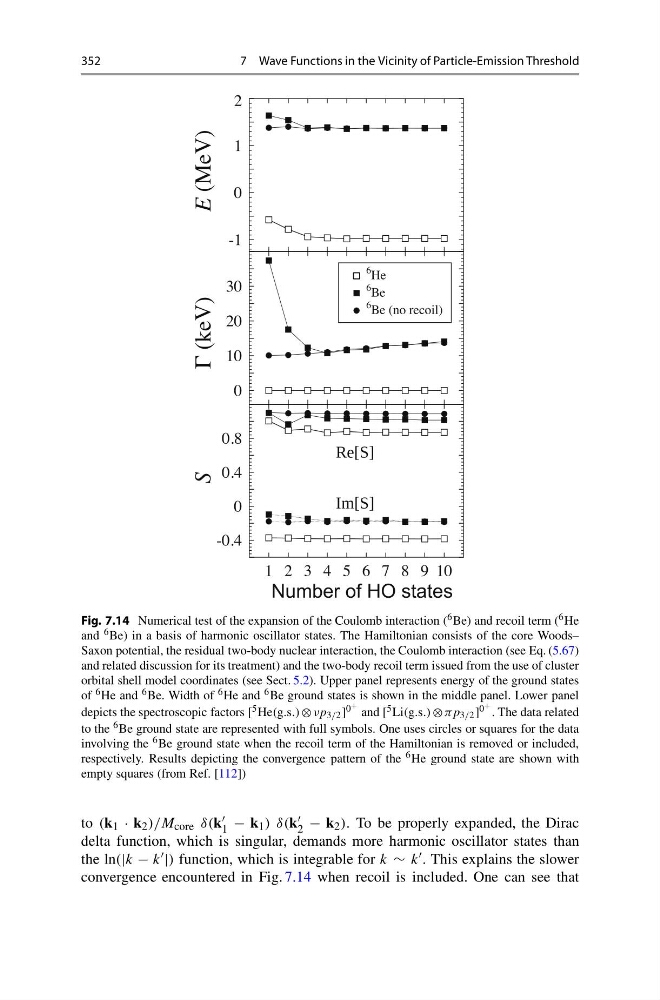
Fig. 7.14 Numerical test of the expansion of the Coulomb interaction ( 6 Be) and recoil term ( 6 He
and 6 Be) in a basis of harmonic oscillator states. The Hamiltonian consists of the core Woods–
Saxon potential, the residual two-body nuclear interaction, the Coulomb interaction (see Eq. (5.67)
and related discussion for its treatment) and the two-body recoil term issued from the use of cluster
orbital shell model coordinates (see Sect. 5.2). Upper panel represents energy of the ground states
of 6 He and 6 Be. Width of 6 He and 6 Be ground states is shown in the middle panel. Lower panel
depicts the spectroscopic factors [ 5 He(g.s.) ⊗ νp 3/2 ] 0 + and [ 5 Li(g.s.) ⊗ πp 3/2 ] 0 + . The data related
to the 6 Be ground state are represented with full symbols. One uses circles or squares for the data
involving the 6 Be ground state when the recoil term of the Hamiltonian is removed or included,
respectively. Results depicting the convergence pattern of the 6 He ground state are shown with
empty squares (from Ref. [112])
to (k 1 · k 2 )/M core δ(k
1 − k 1 ) δ(k
2 − k 2 ). To be properly expanded, the Dirac
delta function, which is singular, demands more harmonic oscillator states than
the ln(|k − k |) function, which is integrable for k ∼ k . This explains the slower
convergence encountered in Fig. 7.14 when recoil is included. One can see that
7 Wave Functions in the Vicinity of Particle-Emission Threshold
Fig. 7.14 Numerical test of the expansion of the Coulomb interaction ( 6 Be) and recoil term ( 6 He
and 6 Be) in a basis of harmonic oscillator states. The Hamiltonian consists of the core Woods–
Saxon potential, the residual two-body nuclear interaction, the Coulomb interaction (see Eq. (5.67)
and related discussion for its treatment) and the two-body recoil term issued from the use of cluster
orbital shell model coordinates (see Sect. 5.2). Upper panel represents energy of the ground states
of 6 He and 6 Be. Width of 6 He and 6 Be ground states is shown in the middle panel. Lower panel
depicts the spectroscopic factors [ 5 He(g.s.) ⊗ νp 3/2 ] 0 + and [ 5 Li(g.s.) ⊗ πp 3/2 ] 0 + . The data related
to the 6 Be ground state are represented with full symbols. One uses circles or squares for the data
involving the 6 Be ground state when the recoil term of the Hamiltonian is removed or included,
respectively. Results depicting the convergence pattern of the 6 He ground state are shown with
empty squares (from Ref. [112])
to (k 1 · k 2 )/M core δ(k
1 − k 1 ) δ(k
2 − k 2 ). To be properly expanded, the Dirac
delta function, which is singular, demands more harmonic oscillator states than
the ln(|k − k |) function, which is integrable for k ∼ k . This explains the slower
convergence encountered in Fig. 7.14 when recoil is included. One can see that